Key takeaways
- switches running Cisco IOS XE 17.15.2 or later to less than five seconds.
- The paired operating model shifts enterprise vulnerability management from high-risk emergency maintenance windows into a staged workflow balancing immediate exposure reduction with planned permanent image remediation.
Modern campus network security faces a fundamental operational conflict: security teams must remediate software flaws faster than automated, machine-speed exploits emerge, yet production campus access layers cannot absorb the multi-minute outages traditionally required by switch reboots. Enterprise environments host latency-sensitive clinical workstations, automated manufacturing robotics, point-of-sale registers, and continuous AI agents that depend on uninterrupted local connectivity. To resolve this tension, network infrastructure must separate immediate exposure reduction from permanent image deployment. By combining kernel-level runtime shielding via Cisco Live Protect with Extended Fast Software Upgrade (xFSU), enterprise teams can shield active vulnerabilities without reloading hardware and subsequently execute full software upgrades on Cisco Catalyst 9300 Series switches with less than five seconds of traffic disruption.
Machine-Speed Vulnerabilities and the Campus Uptime Dilemma
The operational landscape for enterprise campus infrastructure has fundamentally shifted under the pressure of automated offensive tooling. In a threat environment shaped by autonomous vulnerability discovery platforms such as Claude Mythos, attackers employ frontier models featuring massive context windows to systematically analyze legacy networking codebases. These systems identify subtle logic flaws, assemble exploit chains, and weaponize vulnerabilities at machine speed. As detailed in industry analyses of machine-speed defenses, the window between public vulnerability disclosure and active exploitation has compressed from months to days or hours.
Conversely, campus network topology does not mirror the hyperscale redundancy of cloud data centers. In enterprise facilities—such as hospitals, university laboratories, fulfillment centers, and municipal branches—access-layer switches frequently terminate single-homed physical endpoints. Clinicians pushing mobile medical carts, sensors tracking assembly lines, and badge access readers rely on direct Ethernet runs without redundant Layer 2 or Layer 3 forwarding paths. A conventional switch operating system reload requires three to five minutes of downtime per unit. In stacked switch configurations, sequential reloads can compound this outage into double-digit minutes, directly halting business operations.
Because emergency maintenance windows carry severe operational friction, network engineering teams have historically deferred non-critical patches until planned quarterly or annual maintenance cycles. This lag creates an expansive patching gap where vulnerable infrastructure remains exposed to lateral exploitation. Resolving this dilemma requires modern campus platforms to serve as active, self-defending enforcement points rather than passive forwarding appliances that wait for off-hours maintenance windows.
Live Protect: Kernel-Level Runtime Shielding via eBPF
To eliminate the exposure window without destabilizing production traffic, Cisco introduced Live Protect, an operational mechanism validated directly through Cisco Product Security Incident Response Team (PSIRT) and engineering workflows. Rather than treating patching as an all-or-nothing emergency reload, Live Protect injects temporary, targeted compensating controls called Vulnerability Shields directly into supported Cisco IOS XE environments.
Architecturally, Live Protect relies on extended Berkeley Packet Filter (eBPF) instrumentation integrated through an embedded Tetragon security agent inside the Cisco IOS XE operating system kernel. By hooking critical kernel functions, the Tetragon agent provides deep visibility into system calls, process executions, and memory operations without imposing significant forwarding overhead. When a vulnerability is identified, Cisco engineering creates and tests a specific shield that inspects system-level events associated with the exploit vector.
The operational lifecycle of a Live Protect Vulnerability Shield follows a structured, risk-mitigated sequence:
- Advisory Ingestion and Scope Verification: The security operations (SecOps) team identifies an applicable Cisco PSIRT advisory specifying the affected platforms, software versions, and verified fixed paths.
- Shield Deployment: Network operators deploy the validated Vulnerability Shield configuration file to eligible access devices. The shield matches specific vulnerability prerequisites, platform architectures, and operating modes.
- Telemetry and Event Monitoring: Before active enforcement, operators run the shield in an audit mode. The embedded eBPF sensors generate telemetry on matching system events, allowing teams to verify policy behavior and confirm the absence of false positives against legitimate operational traffic.
- Real-Time Enforcement: Once validated, enforcement is activated. The kernel hooks surgically block the specific system call sequence or payload triggering the vulnerability, neutralizing the exploit path in real time while standard control plane and data plane operations continue uninterrupted.
- Retirement Following Remediation: After the permanent software fix is applied, the temporary shield is retired and removed, ensuring no accumulated legacy rules linger inside the system kernel.
Live Protect is intentionally bounded: it does not serve as a generic third-party workload firewall, nor does it replace the requirement for permanent patching. However, by providing verified runtime mitigation without a reload, it removes the immediate pressure that drives hasty, high-risk maintenance interventions.
Extended Fast Software Upgrade: Decoupling Control and Forwarding Planes
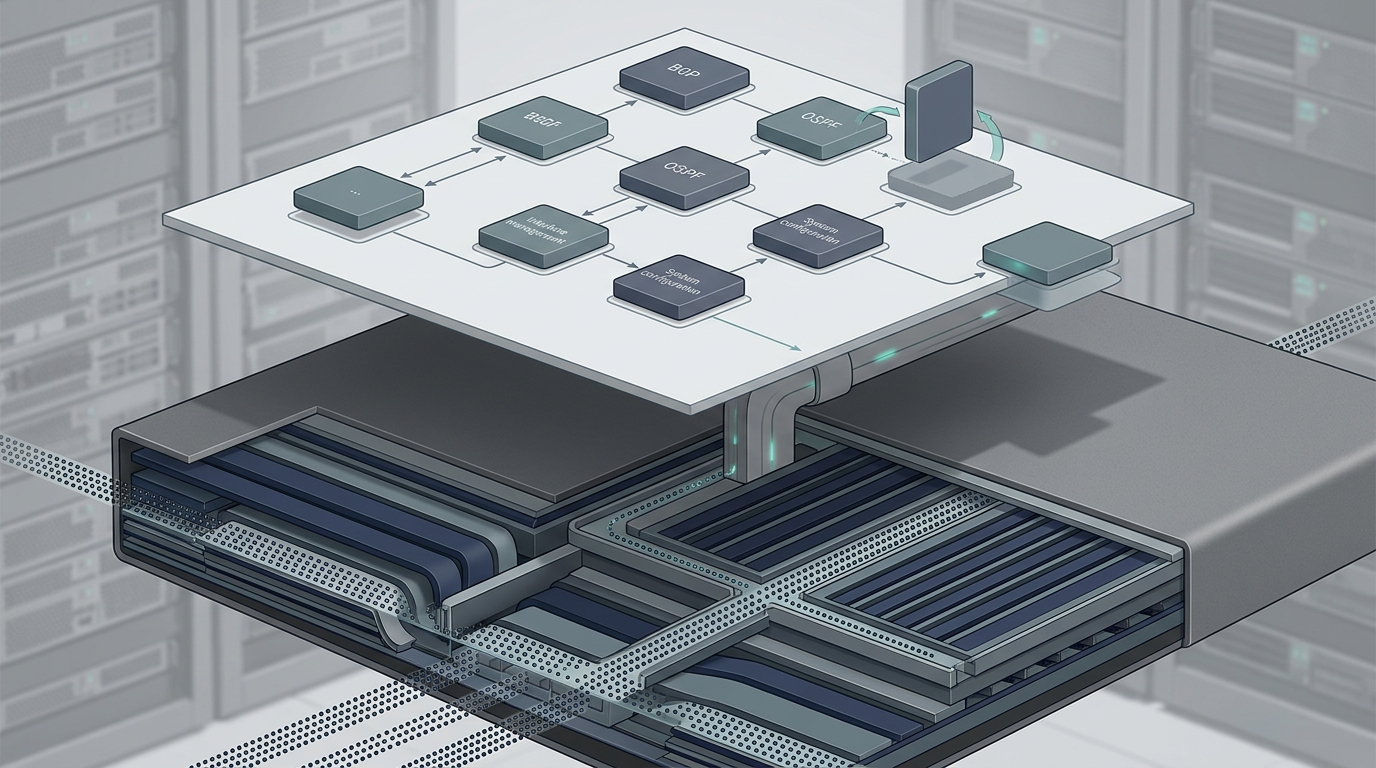
While runtime shields provide immediate defense, permanent remediation through a Software Maintenance Upgrade (SMU) or full base image replacement remains necessary. This is where Extended Fast Software Upgrade (xFSU) alters the operational economics of enterprise software maintenance. Described in technical detail in the Cisco Networking architectural disclosure, xFSU addresses the access-layer downtime penalty by decoupling control plane restarts from hardware packet forwarding.
In standard network switch reloads, the control plane (responsible for routing protocols, spanning tree, and system management) and the data plane (the application-specific integrated circuits, or ASICs, responsible for line-rate packet transmission) reset simultaneously. Traffic stops forwarding until the operating system reboots, initializes hardware drivers, establishes neighbor relationships, and rebuilds forwarding tables.
Under xFSU, this dependency is separated across a coordinated execution flow:
- Hardware Forwarding State Preservation: Prior to restarting the operating system, the system freezes and preserves the programmed forwarding states in the ASIC Ternary Content-Addressable Memory (TCAM). Layer 2 forwarding databases and Layer 3 routing tables remain active in hardware.
- Control Plane Reload: The switch control plane reboots into the updated Cisco IOS XE target release. During this phase, Non-Stop Forwarding (NSF) and Graceful Restart extensions inform neighboring peers to retain existing routing adjacencies rather than tearing down sessions or recalculating topologies.
- Micro-Disruption Cutover: Once the new control plane software has fully initialized, it performs a brief, synchronized reconciliation with the data plane. Forwarding states are re-validated, and hardware tables receive any pending updates.
On standalone Cisco Catalyst 9300 Series Switches running Cisco IOS XE 17.15.2 or later, this mechanism compresses data forwarding interruption from several minutes to less than five seconds. In switch stacks, xFSU staggers the upgrade process across stack members and utilizes stateful switchover (SSO) to maintain overall cluster integrity throughout the software migration.
| Operational Dimension | Cisco Live Protect | Extended Fast Software Upgrade (xFSU) |
|---|---|---|
| Primary Mechanism | eBPF and Tetragon kernel-level system call interception | Control plane reboot decoupled from ASIC hardware forwarding |
| Disruption Profile | Zero downtime; no interface flap or device reboot | Sub-5-second forwarding interruption on Catalyst 9300 (IOS XE 17.15.2+) |
| Operational Role | Temporary compensating control (Vulnerability Shield) | Permanent software image upgrade and patch deployment |
| Lifecycle Timing | Immediate deployment upon vulnerability disclosure | Scheduled standard maintenance or automated lifecycle window |
| Platform Requirements | Supported Cisco platforms, validated releases, and compatible policy modes | Cisco Catalyst 9300 Series hardware prerequisites and feature caveats |
Operational Trade-Offs and NetOps-SecOps Alignment
The combination of runtime shielding and low-disruption upgrades addresses a long-standing organizational fracture between security operations (SecOps) and network operations (NetOps). Traditionally, SecOps prioritizes minimizing Mean Time to Remediate (MTTR), frequently demanding emergency patching that NetOps resists due to stringent Service Level Agreements (SLAs) regarding network availability. This friction often results in adversarial change-advisory board deliberations.
Pairing Live Protect with xFSU establishes a shared, two-stage response framework. SecOps gains a rapid, verified path to eliminate exposure through Live Protect, providing observable telemetry that proves exploit attempts are blocked. Concurrently, NetOps retains infrastructure stability without sacrificing change-management rigor. Because xFSU reduces maintenance risk and reduces downtime to sub-five-second blips, network teams can migrate away from rare, high-stakes overnight overhauls toward frequent, small-batch updates.
However, enterprise infrastructure architects must account for specific operational constraints before adopting this model:
- Prerequisite Compliance: Neither capability functions as a universal panacea. Live Protect shields are developed and released selectively by Cisco for specific high-impact vulnerabilities; they do not cover every third-party application flaw or unvalidated software version. Similarly, xFSU requires strict adherence to supported switch hardware revisions, memory baselines, and feature configurations detailed in Cisco technical documentation.
- Observability Hygiene: Deploying runtime eBPF shields introduces operational state into the operating system kernel. Teams must integrate shield logging into centralized SIEM and telemetry dashboards to detect unauthorized policy modifications and track when temporary mitigations have reached end-of-life.
- Configuration Caveats: Complex campus features—such as proprietary Layer 2 extensions or specialized edge inspection pipelines—must be audited against xFSU compatibility matrices to prevent unexpected state drops during control plane cutovers.
Bottom line
As offensive AI systems compress the timeline between vulnerability disclosure and active weaponization, enterprise campus networks can no longer rely on patching strategies designed around disruptive, multi-minute maintenance windows. The access layer connects critical physical systems, unmanaged IoT devices, and autonomous software workflows that require constant connectivity.
Cisco Live Protect and Extended Fast Software Upgrade provide a viable operational blueprint for modern campus resilience. By implementing validated eBPF runtime shields to neutralize immediate exposure and leveraging control-plane/data-plane decoupling to execute full software image upgrades in under five seconds, enterprise IT teams can protect infrastructure at machine speed while upholding strict operational availability requirements.
Sources
- When security moves at machine speed, campus networks can’t afford to stop – Cisco Blogs
- Live Protect – Cisco
- Shields Up: Cisco Live Protect Closes Vulnerability Gap with Compensating Controls – Cisco Blogs
- Cisco details Live Protect’s real-time threat mitigation capabilities | Network World
- Extended Fast Software Upgrade (xFSU) on Cisco Catalyst 9300 Series Switches White Paper – Cisco
- Protecting against rising cybersecurity risks in data centers – Cisco Blogs
- Trust at machine speed: Building secure campus networks for the AI era – Cisco Blogs