Key takeaways
- Elon Musk revealed SpaceX closed $40 billion in debt financing to purchase Nvidia GPUs for AI data centers, supported by its investment-grade rating and revenues from Starlink and launches.
- Musk warned that commercial credit markets have closed to pure-play AI infrastructure providers lacking independent revenue, predicting a wave of consolidation among more than 200 neocloud startups.
- Big Tech hyperscalers are projected to borrow $250 billion this year, pushing global AI debt issuance past $570 billion and driving higher bond yields across the infrastructure sector.
A severe neocloud shakeout is approaching across the artificial intelligence computing sector as commercial debt markets aggressively tighten credit for infrastructure providers lacking diversified revenue. Elon Musk warned on October 25, 2026, that over 200 independent cloud startups specializing in rented graphics processing unit capacity face widespread failure or forced consolidation. While SpaceX completed a $40 billion debt facility to acquire Nvidia chips for AI data centers—leveraging investment-grade credit ratings and steady cash flow from Starlink and rocket launches—debt financing has abruptly closed for standalone operators. With rising capital costs and global AI-related debt issuance surpassing $570 billion, the cloud infrastructure landscape is dividing sharply between balance-sheet hyperscalers and struggling independent providers.
Credit markets freeze out pure-play GPU clouds
In a public statement on his post on X, Space Exploration Technologies Corp. Chief Executive Elon Musk detailed that debt markets have spent the past several weeks cutting off capital to infrastructure startups that rely solely on AI data center leasing. According to Musk, SpaceX successfully closed $40 billion in debt to acquire graphics processing units from Nvidia Corp. and secondary suppliers specifically because the aerospace company maintains an investment-grade rating backed by non-AI commercial operations, including satellite internet and space launch contracts.
The disclosure substantiates an October 7 report from the Financial Times indicating that SpaceX was negotiating a multi-part financing structure. That package includes approximately $10 billion in direct bank loans alongside $30 billion in investment-grade debt, anchored by lead investor Apollo Global Management Inc. with co-investment from Pacific Investment Management Company LLC (PIMCO). Musk noted that the procured silicon is scheduled for deployment during the first and second quarters of 2027, adding that he expects the obligations to be repaid early without distorting near-term operating margins.
However, that liquidity is not accessible to venture-backed hosting startups. Independent neoclouds expanded aggressively over the past 24 months by taking on high-yield debt to secure scarce accelerator allocations. Without auxiliary balance-sheet revenue to backstop debt service during cluster buildouts, these operators now face an abrupt halt in private credit availability.
The capital gap between hyperscalers and startup clouds
The tightening credit environment highlights an expanding structural gulf between Tier-1 cloud hyperscalers and alternative compute vendors. As documented by SiliconANGLE, capital expenditure projections from Morgan Stanley show that Amazon Web Services Inc., Microsoft Corp., Alphabet Inc.’s Google, and Meta Platforms Inc. will spend $700 billion collectively on infrastructure this year, with capital outlays topping $1 trillion in 2027.
To support this expansion, hyperscalers are turning heavily to debt markets. Projections from Goldman Sachs indicate that these four companies will borrow roughly $250 billion this year and up to $400 billion in 2027. Sourcing from a Morgan Stanley report estimates that total global AI-related debt issuance will exceed $570 billion in 2026 alone.
| Entity / Market Segment | Projected Metric | Timeline | Reporting Source |
|---|---|---|---|
| SpaceX Infrastructure Debt | $40B total ($10B bank loans, $30B debt) | Delivery Q1–Q2 2027 | Elon Musk, Financial Times |
| Hyperscaler Capex (AWS, MSFT, GOOG, META) | $700B (2026) / Exceeding $1T (2027) | 2026–2027 | Morgan Stanley |
| Hyperscaler Borrowing | $250B (2026) / $400B (2027) | 2026–2027 | Goldman Sachs |
| Global AI-Related Debt Issuance | Exceeding $570B | 2026 | Morgan Stanley |
The sheer volume of corporate paper hitting credit markets has begun distorting debt dynamics. As reported by Reuters, fixed-income investors are requiring wider yield spreads on AI infrastructure bonds due to concerns over delayed monetization. When bond markets demand higher yields from investment-grade tech giants, the risk premium on unrated, single-product neocloud startups becomes prohibitive.
Consolidation pressures across two hundred neoclouds
The immediate operational consequence of restricted credit is an accelerated wave of mergers and bankruptcies. Musk projected that more than 200 neocloud startups will experience widespread distress, noting that smaller participants will likely be absorbed by capitalized competitors or liquidated entirely as debt maturities come due.
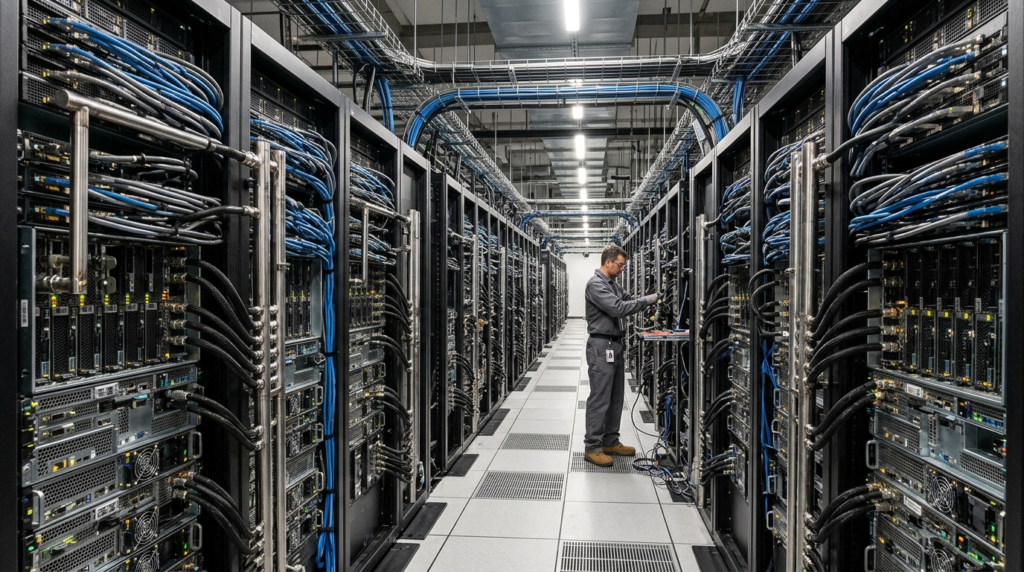
Pure-play GPU rental providers operate under punishing unit economics. Server chassis, high-bandwidth optical interconnects, liquid cooling retrofits, and multi-megawatt power reservations must be financed upfront before customer instances generate billing revenue. As smaller operators navigate these operational burdens, maintaining reliable uptime often requires specialized external engineering to keep neocloud GPU capacity healthy under tight operational margins.
When external debt financing halts, operators cannot bridge the lag between procuring hardware and achieving cash-flow breakeven. A cascade of neocloud cancellations could trigger downstream friction across the supply chain, muting baseline spot demand for enterprise server racks and potentially tempering shipment growth for accelerator vendors.
What happens next
Cloud infrastructure architects and enterprise procurement teams must monitor several concrete developments over the coming quarter:
- Hyperscaler Earnings Disclosures: Third-quarter financial updates from AWS, Microsoft, and Google will reveal whether public cloud giants are maintaining their aggressive capital deployment schedules or tempering forward commitments as borrowing costs increase.
- Refinancing Pressures for Mid-Tier Hosts: Neocloud operators with short-term hardware debt maturing in late 2026 must either secure equity injections at lower valuations, enter strategic asset sales, or surrender reserved allocations.
- Secondary Hardware Availability: Distressed liquidations and canceled cluster expansions could release allocated accelerators back into the secondary colocation market, briefly altering spot pricing for high-density compute.
- Procurement Due Diligence: Engineering leads booking long-term GPU cluster reservations should evaluate the underlying balance sheet and debt structures of independent hosts to avoid workload migration disruptions caused by sudden operator insolvency.
Sources
- Elon Musk predicts neocloud shakeout as credit for AI infrastructure dries up – SiliconANGLE
- Elon Musk on X
- SpaceX in talks for $40bn AI funding package – Financial Times
- US Big Tech Ratchets Up AI Spending Past $700 Billion This Year – Bloomberg
- Hyperscaler debt binge pushes yields up as investor demand cools – Reuters