Key takeaways
- Data center construction jobs pay 42% more than equivalent roles in other industries.
- The industry needs up to 499,000 additional workers in 2026 alone to meet demand.
- Hyperscaler capital expenditure is projected to reach $602–$630 billion in 2026.
- Meta, Google, and BlackRock are investing hundreds of millions in accelerated trades training.
- Modular prefabrication can reduce on-site labor demand by 20–40%, but adoption remains uneven.
The Architectural Reality Behind the Data Center Labor Boom
There is no precedent in American industrial history for the scale of physical construction now underway to support artificial intelligence infrastructure. The data center labor boom of 2025–2026 is not a metaphor. It is a concrete, steel, and copper reality that has fundamentally reordered the economics of the American construction industry—pulling hundreds of thousands of electricians, carpenters, welders, and plumbers into a sector that, just five years ago, most of them had never considered.
The numbers are staggering. According to an analysis by Indeed, the job listings website, hourly installation and maintenance jobs at data centers now pay 42 percent more than similar positions in other fields. In high-demand markets like Dallas and Northern Virginia, the premium is even steeper, with electricians commanding six-figure salaries and contractors offering signing bonuses and inflated per diem rates to prevent workers from jumping to rival projects. “It is creating a labor tension that is really delicate,” said Marty Schager, Aerotek’s director of data center market development. “You’ve got a passive job-seeker community out there right now that I think is looking to potentially capture opportunity with this once-in-a-generation data center gold rush.”
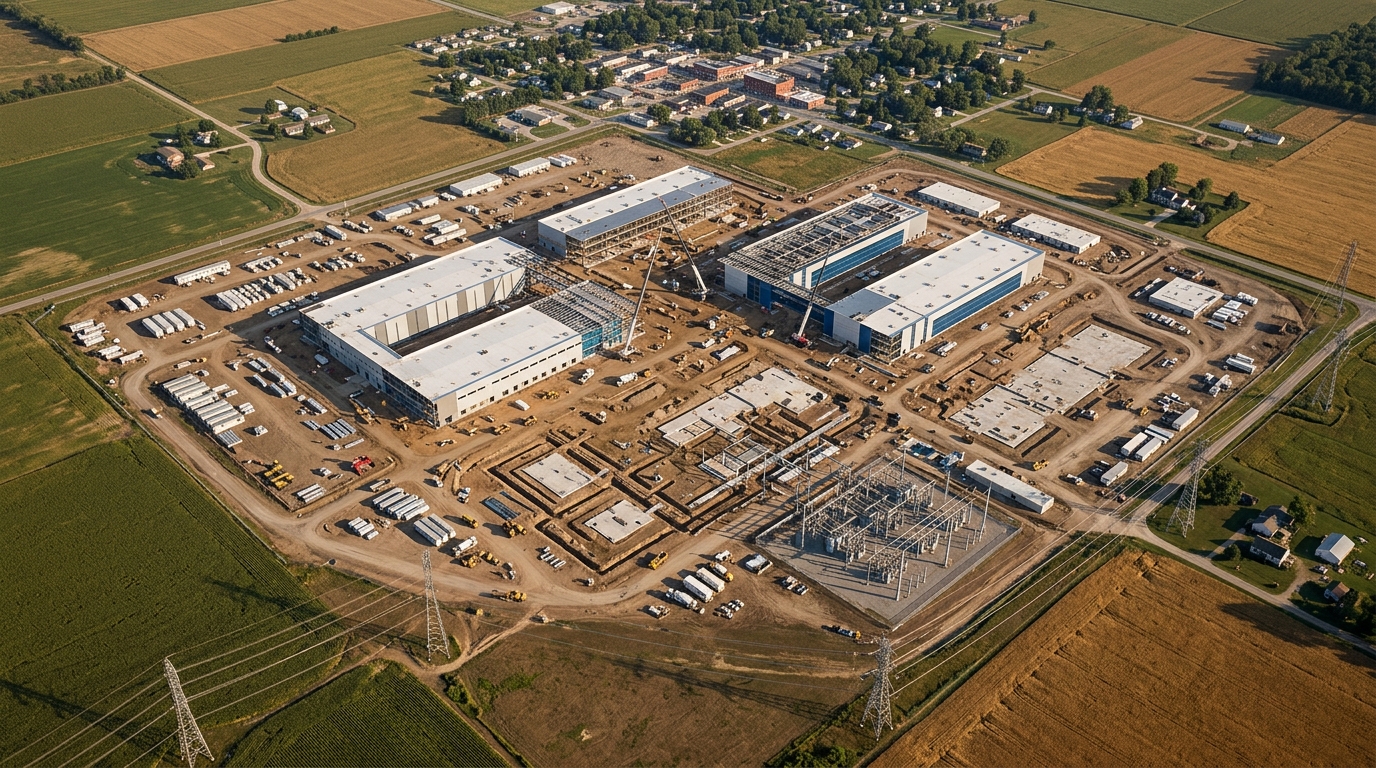
Behind this tension sits an infrastructure investment cycle unlike anything the technology or construction industries have previously absorbed. The top five hyperscalers—Amazon, Microsoft, Alphabet, Meta, and Oracle—spent approximately $443 billion in capital expenditure in 2025. Projections for 2026 range from $602 billion to $630 billion, with roughly 75 percent of that spending tied directly to AI infrastructure. In the United States alone, data center construction spending exceeded $52–$60 billion in 2025, and global construction market valuation reached approximately $261.3 billion. This is not a speculative forecast. The concrete is already being poured.
Why Data Centers Are Building-Sized Machines
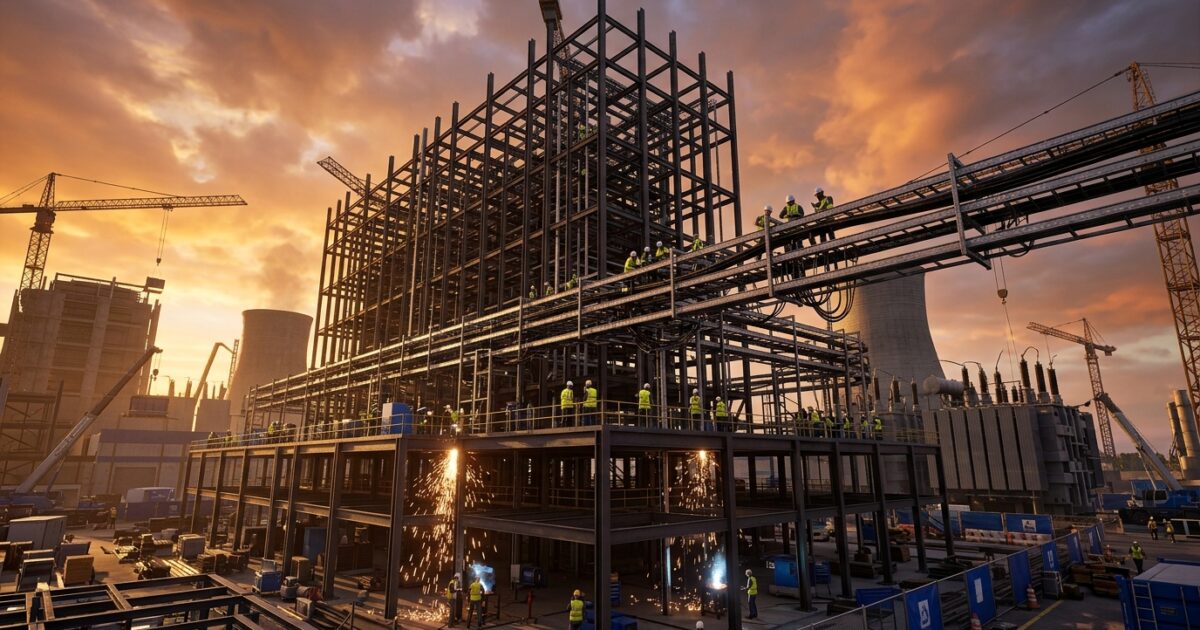
A data center is not a warehouse that happens to hold servers. It is, in industry parlance, a “building-sized machine”—a precision-engineered facility requiring high-density power distribution systems, redundant electrical backup chains, and industrial-grade cooling architectures that have more in common with pharmaceutical manufacturing or nuclear plant design than with standard commercial construction. The MEP (mechanical, electrical, and plumbing) trades are the critical bottleneck. A single hyperscale campus can require 4,000 to 5,000 workers on-site simultaneously, each performing highly sequenced, interdependent tasks where a delay in one trade cascades through the entire project timeline.
Mario Iacobacci, who runs the construction and infrastructure advisory practice at Oxford Economics, framed the constraint with characteristically academic precision: “There’s no question the resources are very limited, so decisions to build one thing kind of drag from another.” That “drag” is measurable. The data center boom has offset flagging activity in sectors like office construction—which never recovered after the pandemic—but the zero-sum math of labor allocation means that every electrician wiring a server rack is an electrician not wiring a house, an apartment building, or a wind turbine.
Market Impact & Deployment: The $600 Billion Crowding Effect

The resource competition created by the data center labor boom extends well beyond wage inflation. It is reshaping land use, distorting local power grids, and intensifying an already acute national housing shortage. In Northern Virginia—the world’s largest data center market—developers of multi-megawatt facilities are outbidding residential and office builders for power-ready land at prices that homebuilders simply cannot match. Housing construction, already depressed by high interest rates, faces a compounded constraint: not only is financing expensive, but the skilled labor needed to build homes is being siphoned into higher-paying data center work.
The consequences ripple outward. Offshore wind development, already battered by political opposition, loses access to the same electricians and welders. Municipal infrastructure projects—water treatment plants, school renovations, bridge repairs—must compete for contractors whose crews are increasingly committed to 18-month data center build-outs. Jeff Strohl, director of Georgetown University’s Center on Education and the Workforce, articulated the uncomfortable question: “If we have an influx of workers at this point with the data centers being built, what happens when they’re done? Where do those workers go? How many people does it take to run a data center after taking up all this property and all this land that could have been used for something else?”
The Training Pipeline: Fast-Track vs. Foundation
To address the labor gap, major technology companies and financial institutions have committed hundreds of millions of dollars to workforce development—but the approaches diverge sharply in philosophy and timeline. Meta’s America’s Workforce Academy is a free, five-week intensive that produces workers certified to enter data center construction sites immediately, backed by $115 million in investment and launching across Indiana, Louisiana, Ohio, and Texas. Google has committed to training 100,000 electrical workers and 30,000 new apprentices through a $10 million grant to the Electrical Training Alliance, established by the International Brotherhood of Electrical Workers (IBEW) and the National Electrical Contractors Association (NECA). BlackRock’s Future Builders Initiative, announced in March 2026, is a $100 million philanthropic program targeting 50,000 workers over five years.
The tension between these models is instructive. A five-week accelerated program and a four-year registered apprenticeship are fundamentally different products. The former fills an immediate construction seat. The latter produces a licensed journeyman with portable, nationally recognized credentials. Industry veterans worry that fast-tracked workers may lack the depth to transition safely into other high-voltage environments—nuclear plants, pharmaceutical factories, utility substations—when the data center pipeline eventually slows. The quality-versus-quantity trade-off is a design decision with long-term workforce consequences that no one is fully accounting for.
Modular Construction: The Partial Escape Valve
The industry is not entirely dependent on solving the labor equation through recruitment. Modular and prefabricated construction—where complex MEP assemblies are fabricated in controlled factory environments and shipped to sites as “plug-and-play” units—can reduce on-site labor demand by 20 to 40 percent and lower capital expenditure by a comparable margin. This approach allows site preparation and module fabrication to proceed in parallel, preventing the sequential bottleneck where a shortage of one trade idles an entire project.
However, modular adoption remains uneven. It requires significant upfront engineering investment, standardized facility designs, and a manufacturing supply chain that is itself capacity-constrained. For hyperscalers building at frontier scale—campuses designed for 500+ megawatts of power—modular approaches work well for repeatable infrastructure like power distribution units and cooling skids. For the site-specific civil, structural, and high-voltage work that constitutes the first phase of any greenfield project, skilled on-site labor remains irreplaceable.
The Consumer Translation: What This Means for Everyone Else
For the general public, the data center labor boom produces a paradox: the same cloud computing services that power everyday digital life—streaming, search, email, navigation—are being built by a workforce that is simultaneously being pulled away from the construction of homes, schools, and local infrastructure. The economic theory is straightforward. When a sector with “functionally unlimited cash” competes for the same finite pool of electricians and plumbers as the residential housing market, prices rise across the board. Homeowners already struggling to hire contractors for kitchen renovations or electrical panel upgrades are facing longer wait times and higher quotes, as local tradespeople increasingly gravitate toward data center projects offering premium pay, overtime, and travel stipends.
The environmental dimension compounds the consumer impact. Data centers now consume approximately 2 percent of global electricity, and a single large facility can use up to 5 million gallons of water per day for cooling—an amount comparable to the daily consumption of a city of 50,000 people. In regions where these facilities cluster, local power grids experience measurable strain, utility bills can rise, and backup diesel generators raise air quality concerns. The 2026 report by the United Nations University (UNU-INWEH) emphasized that data centers carry environmental costs beyond carbon emissions, including significant land-use changes and mineral extraction for hardware.
Strohl’s “best-case scenario”—that the cohort of workers trained for data center construction would seamlessly transition into a housing boom once the build-out decelerates—remains, by his own assessment, “probably not likely.” The more realistic outcome is a familiar pattern from previous infrastructure booms: a period of intense demand followed by a painful contraction in which specialized workers either relocate to the next construction hotspot, accept lower-paying local work, or leave the trades entirely. The AI industry is creating a once-in-a-generation opportunity for blue-collar workers. The question is whether anyone is building the off-ramp.
The Real Cost of AI Infrastructure
For enterprise IT budgets, the data center labor boom translates directly to Total Cost of Ownership. Every month of construction delay on a hyperscale facility represents millions of dollars in lost revenue from AI services that cannot be deployed on schedule. The 42 percent wage premium is not generosity—it is the cost of keeping the pipeline moving. For CTOs and infrastructure leaders, the strategic calculus is stark: either invest in longer-term workforce pipelines and modular construction partnerships that reduce schedule risk, or accept escalating per-project costs as labor competition intensifies through at least 2028.
The broader construction industry faces a structural challenge that predates the data center surge but has been dramatically accelerated by it. An estimated 41 percent of the current construction workforce is expected to retire by 2031. The pipeline of replacement workers—even with the unprecedented training investments from Meta, Google, and BlackRock—is not growing fast enough to offset both normal attrition and the extraordinary demand created by AI infrastructure. The industry needs an additional 349,000 to 499,000 workers in 2026 alone. The data center labor boom is not a temporary disruption. It is the new structural reality of the American construction economy.
Frequently Asked Questions
Why are AI companies hiring electricians and carpenters?
AI companies need massive physical data centers to power their models, and these facilities require specialized electrical, mechanical, and plumbing work. The industry needs an estimated 349,000 to 499,000 additional workers in 2026 alone, creating a “gold rush” for skilled trades.
How much more do data center construction jobs pay compared to other industries?
According to an Indeed analysis, hourly installation and maintenance jobs at data centers pay 42% more than similar jobs in other fields. In high-demand markets, electricians can earn six-figure salaries, with some reports citing earnings potential as high as $260,000 annually.
Is the data center construction boom hurting the housing market?
Yes. Data center developers are outbidding homebuilders for land, labor, and materials—particularly in hotspots like Northern Virginia and Texas. Combined with high interest rates already depressing housing starts, the competition for skilled trades is further constraining residential construction capacity.
What training programs exist for workers who want to enter data center construction?
Meta’s America’s Workforce Academy offers free five-week training with guaranteed job placement. Google has committed to training 100,000 electrical workers and 30,000 apprentices. BlackRock’s Future Builders Initiative is a $100 million program aiming to connect 50,000 workers to skilled trades training over five years.
What happens to these workers when data center construction slows down?
Georgetown University’s Jeff Strohl notes the “best-case scenario” would be a housing boom absorbing trained tradespeople, but calls that outcome “probably not likely.” Fully trained journeymen could shift to nuclear plants, pharmaceutical factories, or other infrastructure, but nothing matches the current scale of data center construction.
TechNode HQ Verdict: Pros, Cons & Usability
- Pro (Engineering): Hyperscaler investment ensures state-of-the-art electrical and cooling infrastructure is being deployed at unprecedented scale, advancing the frontier of mission-critical facility design.
- Pro (Consumer): Skilled trades workers are experiencing generational wage gains—42% premiums, six-figure earnings potential, and employer-funded training—creating genuine economic mobility for blue-collar Americans.
- Con: The boom is a zero-sum reallocation of finite labor: every electrician pulled into data center work is an electrician not building housing, schools, or renewable energy installations, compounding existing infrastructure deficits.
- Con: Accelerated 5-week training programs risk producing a workforce with narrow, non-transferable skills—creating boom-bust vulnerability when the construction pipeline inevitably contracts.
Enterprise Usability: CTOs should diversify infrastructure deployment strategies immediately—invest in modular/prefab partnerships to reduce schedule dependency on scarce on-site labor, lock in multi-year contractor relationships to insulate against further wage escalation, and factor a 20–30% labor cost premium into all forward-looking data center CapEx projections through 2028.
Everyday Usability: If you are a skilled tradesperson or considering entering the trades, the window for premium data center wages is open now but structurally temporary. Prioritize training programs that yield portable, nationally recognized credentials (registered apprenticeships, IBEW/NECA certifications) over fast-track courses—your long-term employability depends on skills that transfer beyond a single construction cycle.