
Key takeaways
- Agentic traffic fundamentally shatters traditional human-driven, predictable infrastructure scaling models.
- Core microservices must achieve absolute domain sovereignty and decouple from consumer semantics.
- Strict idempotency moats are mandatory to prevent agent loops from triggering destructive ghost actions.
- Scaling LLMs requires PagedAttention, speculative decoding, and intelligent Layer 7 GPU queue routing.
- Composable Server-Driven UI enables dynamic, LLM-generated native experiences with graceful semantic fallbacks.
The technology industry is currently obsessed with letting Large Language Models (LLMs) output entire microservices, infrastructure layouts, and functional code in seconds. While it is incredibly fast and powerful, it completely redefines how software must be built. The true value for engineering teams is no longer in manually writing out implementation details, but in orchestrating macro system topology. Welcome to the era of Agentic System Architecture. When your consumers are no longer just human eyes looking at a browser, but autonomous AI agents executing multi-step workflows, your system design cannot afford to be loose. AI operates strictly within the structural constraints we provide; if asked to build inside a tightly-coupled system, it will generate highly sophisticated code that inadvertently scales that complexity at warp speed. To build for an AI-driven ecosystem, we must treat system architecture as the ultimate governance tool.
The Architectural Reality of Agentic System Architecture
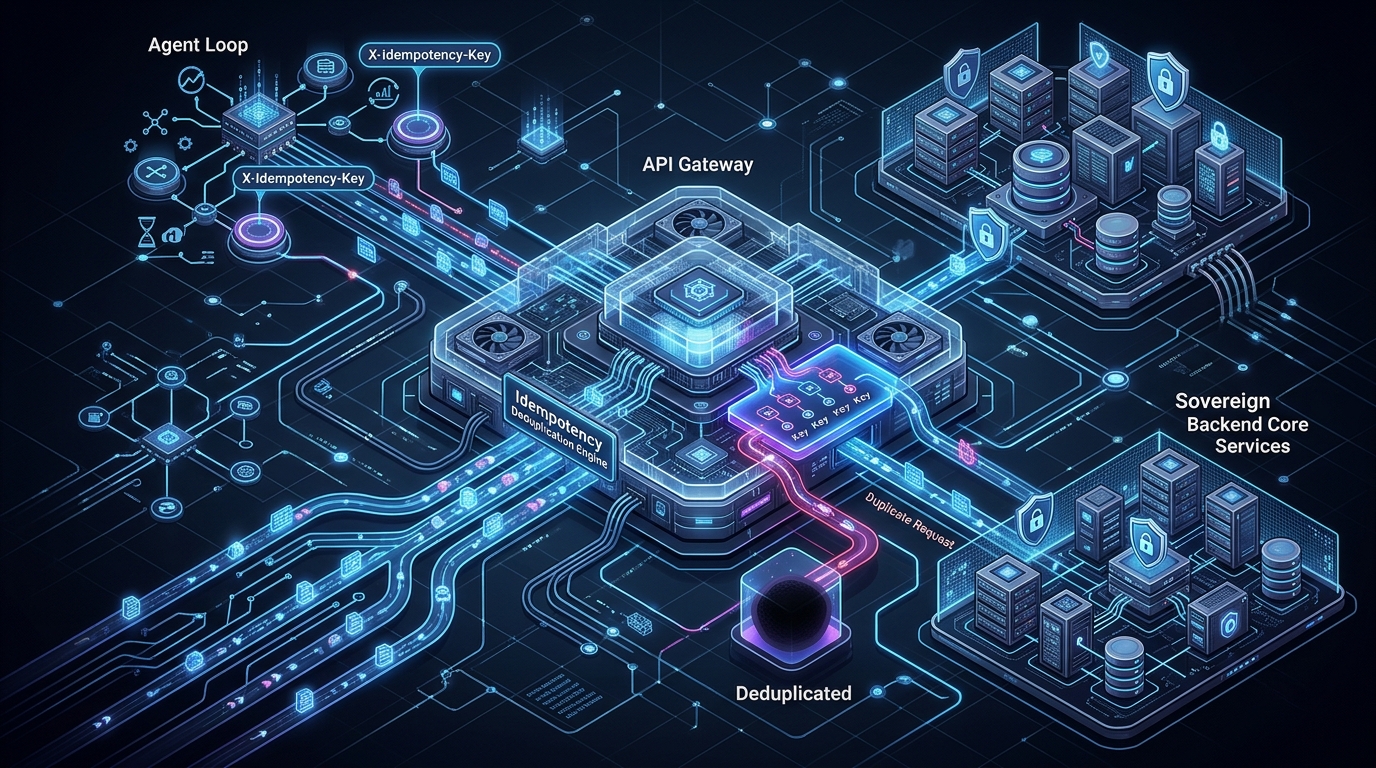
In the age of Large Language Models (LLMs), system design has transitioned from a niche technical skill to a critical governance tool. While LLMs can generate functional code and microservices in seconds, they fundamentally lack the architectural judgment required to build stable, scalable, and secure production environments. If an AI is asked to build inside a tightly-coupled system, it will generate highly sophisticated code that inadvertently scales architectural debt and complexity at an uncontrollable rate. AI can act as a massive complexity multiplier if used in a loose or poorly coupled environment, making strict boundaries a non-negotiable prerequisite.
To survive this fragmentation, core microservices must achieve absolute domain sovereignty. Core services must be completely decoupled from consumer semantics, exposing pure, headless domain capabilities bounded by strict context rules grounded in Domain-Driven Design. Whether a human is clicking a button or a Claude-powered agent is programmatically invoking an action via a Model Context Protocol (MCP) server, the core domain logic—inventory checks, pricing engines, transaction processing—must remain completely isolated and identical. This paradigm requires an Enterprise IT strategy centered entirely around isolation and zero-trust.
Most AI agent systems achieve this separation of concerns by segregating operations into three primary layers. First, a Perception Layer handles and preprocesses incoming data from users, APIs, or physical sensors. Second, a Memory Layer maintains context across interactions, spanning short-term execution memory to long-term memory via robust vector databases. Finally, the Tool & Action Layer enables agents to interact with external environments, such as executing Python code or querying proprietary SQL databases. To orchestrate these layers effectively, the industry is standardizing on frameworks like LangGraph, CrewAI, and the Microsoft Agent Framework to manage stateful, multi-agent workflows.
There are two primary paradigms when orchestrating these agents: Sequential Agent patterns and Parallel Agent architectures. Sequential patterns break down tasks into a rigid assembly line where one agent’s output becomes the next agent’s input, maximizing reliability for linear tasks. Conversely, Parallel architectures deploy multiple agents working concurrently on sub-tasks to drastically reduce latency and provide comprehensive coverage for broad, exploratory queries.
The Idempotency Moat and Zero Trust Guardrails
When humans use an application, the user interface acts as a natural stabilizer. A user rarely clicks a “Place Order” button five times in a millisecond, and if they try, client-side logic typically disables the button to prevent duplicate requests. AI agents, however, do not care about UI rules; they operate in asynchronous, relentless execution loops. If an LLM experiences a network hiccup, a transient gateway timeout, or a brief dip in parser confidence mid-workflow, its internal orchestration loop will instinctively retry the tool block without hesitation.
If your core microservices are not ruthlessly idempotent, an agent loop will accidentally double-charge a credit card, create duplicate database entries, or trigger ghost inventory allocations. In an LLM-ready architecture, the idempotency moat is a fundamental security and consistency boundary. Every transactional domain endpoint exposed to an agent or MCP server must require a unique client-side orchestration key (such as X-Idempotency-Key) managed by the API gateway or the Backend-for-Frontend (BFF) layer. If the agent repeats a request out of a failure loop, the backend serves the cached successful result instead of executing a destructive state change twice.
Beyond idempotency, the API validation layer is growing exponentially in both size and criticality. Agents bypass your frontend validation entirely. They look at an OpenAPI specification document, interpret the parameters, and construct a payload based on what they statistically infer is right. They can and will pass mutated types, missing fields, or heavily hallucinated arguments. Therefore, every endpoint must explicitly enforce strict type safety using Protocol Buffers or rigid JSON schemas with absolute boundaries (e.g., additionalProperties: false) to reject unexpected parameters immediately.
This is where resilient Networking & Cloud strategies come into play to protect system resources from infinite agent loops. Runaway token observability must be rigorously enforced. Validation layers must track not just standard network hops, but prompt versus completion token counts, cache-hit ratios, and financial cost-per-request using semantic OpenTelemetry tracing tags. If an agent goes rogue, your telemetry should automatically trip a circuit breaker before an infinite loop causes a catastrophic spike in your monthly cloud bill.
Market Impact & Deployment: Scaling the Unpredictable

Traditional infrastructure scaling is built around predictable human behavioral patterns—diurnal time-zone peaks, seasonal traffic waves, and linear, click-by-click navigation paths. Non-human traffic profiles shatter this paradigm entirely. When an autonomous agent attempts to fulfill a single, complex user prompt (e.g., “Find the best five component matches, verify their stock across three distribution hubs, and compute bulk shipping quotes”), it does not move step-by-step. It evaluates its toolset and programmatically unleashes an instantaneous, vertical spike of dozens of parallel API requests to your services. A single human consumer intent now carries a massive internal traffic amplification factor.
Scaling an LLM-ready architecture requires moving away from heavy edge-cache reliance and focusing deeply on high-throughput compute elasticity. System design for AI must account for unique bottlenecks such as GPU-bound compute limits, token-based billing metrics, context window constraints, and highly variable inter-token latency. Scaling LLMs in production requires a framework that perfectly balances latency, throughput, cost, and absolute reliability.
To maintain performance and control costs at scale, engineering teams must implement strategies like semantic caching, model routing, and dynamic batching. Model Cascading and Routing involves intelligently sending simple, deterministic queries to smaller, cheaper open-weight models while reserving expensive, large frontier models strictly for complex reasoning tasks. Implementing intelligent Layer 7 routing using the modern Kubernetes Gateway API distributes this traffic seamlessly based on backend metrics like active GPU queue depth.
Furthermore, KV Cache Management must utilize advanced techniques like PagedAttention to prevent memory fragmentation and massively improve LLM throughput. PagedAttention is inspired by operating system virtual memory management; it divides the KV cache into fixed-size blocks allocated dynamically, allowing the memory footprint to scale exactly with the generated sequence. This reduces wasted GPU memory to under 4% and enables significantly higher batch sizes, fundamentally altering the Total Cost of Ownership (TCO) for self-hosted LLM endpoints. For long-form text generation, Speculative Decoding uses a smaller model to generate draft tokens which are then verified in parallel by a larger model, drastically reducing latency. Observability for LLMs in production should also relentlessly track token-level metrics such as Time-to-First-Token (TTFT) to ensure the overarching AI & Machine Learning infrastructure operates at peak efficiency.
The Consumer Translation: Composable Server-Driven UI
If autonomous agents are bypassing traditional frontends, how do we build intuitive experiences for when a human is in the loop, but an LLM is driving the orchestration? The answer lies in Composable Server-Driven UI (SDUI) architectures. Traditional applications rely on rigid, hardcoded client-side components. But if an LLM is dynamically generating a highly personalized customer journey or responding to a complex natural language prompt, the user interface needs to adapt instantly without requiring a native client deployment or an app store update.
By treating the server as the layout mastermind, the backend does not just return raw domain data; it returns a structural JSON blueprint of native components along with their corresponding actions. When you pair Composable SDUI with GenAI, you unlock true Generative UI. The LLM interprets the user’s intent, pulls live data from your headless sovereign services, and constructs a robust SDUI JSON layout tree. The client application (whether web or mobile) instantly renders it as a highly tailored, beautiful, native experience at 60 FPS, completely adhering to your pre-defined design token guardrails and branding guidelines.
This dynamic approach necessitates designing for graceful semantic fallbacks. Traditional clients expect binary responses—a rigid 500 Internal Server Error or a standard 404 Not Found. But when an LLM orchestrates a user workflow and a downstream microservice drops offline, a raw, unhandled error payload completely breaks the agent’s context window. It doesn’t know how to recover, causing it to stall or hallucinate a fabricated failure screen. The modern BFF layer must be designed with semantic fallback mechanisms. If an inventory service fails, the BFF should return a structurally valid, degraded fallback payload. This essentially tells the LLM exactly what failed in natural language and how to gracefully pivot the conversation or automatically downgrade the UI experience seamlessly, preserving the user journey.
Cross-Industry Impact and the Red Team Audit
This architectural evolution disrupts far more than just standard B2B SaaS platforms. In the Financial Services sector, algorithmic trading and automated portfolio rebalancing are increasingly being handed over to autonomous agents. In these high-stakes environments, the Idempotency Moat is the only thing preventing an agent from repeatedly executing a million-dollar stock buy during a transient API timeout. In Healthcare, diagnostic agents evaluating live patient telemetry require absolute domain sovereignty and semantic fallbacks; if a secondary reference database drops, the agent must gracefully degrade to providing generalized physiological advice rather than hallucinating a critical, incorrect treatment protocol. In Global Supply Chain Logistics, autonomous procurement loops rely on Agent-to-Agent (A2A) networks to negotiate freight rates in real-time, demanding hyper-strict schema enforcement to prevent corrupted shipping manifests from bringing physical cargo movement to a grinding halt.
Despite the massive enthusiasm, technical executives must remain vigilant against pervasive marketing fluff. While industry proponents claim that LLMs can output functional, production-ready microservices in seconds, they often gloss over the reality that AI generates highly plausible but occasionally flawed code that lacks defensive programming fundamentals. A model might generate a perfectly formatted Python service, but omit critical database connection pooling, circuit breakers, or appropriate table indexing. Furthermore, Composable SDUI introduces substantial latency overhead. Waiting for an LLM to dynamically generate a JSON UI blueprint before the client can even begin to render it often violates the strict 100-millisecond threshold required for a native-feeling application experience. To succeed, modern system design must perfectly balance the endless flexibility of Generative UI with aggressive edge caching and optimistic UI state updates to successfully mask backend inference delays.
Think of traditional software like a passenger train on a fixed track—predictable, steady, and easy to dispatch. An LLM-driven application, however, is a fleet of autonomous delivery drones navigating in real-time. If you try to manage the drones using the train’s scheduling system, pure chaos ensues. You need an entirely new air traffic control infrastructure—one built for unpredictable swarms rather than linear schedules.
Frequently Asked Questions
Q1: What is Agentic System Architecture?
A1: It is a modern approach to system design built to support autonomous AI agents as the primary consumers of APIs. It emphasizes strict domain boundaries, idempotency, and high-throughput elasticity to handle unpredictable machine-to-machine workloads.
Q2: Why is idempotency critical for LLM-driven applications?
A2: AI agents operate in asynchronous execution loops and will automatically retry actions if they encounter network timeouts or parsing errors. Without strict idempotency, these retries can cause destructive “ghost actions” like double-charging credit cards.
Q3: How do you scale infrastructure for unpredictable agent traffic?
A3: Scaling requires moving away from traditional edge caching and adopting intelligent Layer 7 routing via Kubernetes Gateway API. Infrastructure must also utilize techniques like PagedAttention and speculative decoding to optimize GPU-bound compute and token throughput.
Q4: What is Composable Server-Driven UI (SDUI)?
A4: SDUI is an architecture where the backend returns a structural JSON blueprint of native UI components rather than just raw data. This allows an LLM to dynamically generate personalized, native-feeling interfaces on the fly without requiring client-side deployments.
Q5: How can teams control the cloud costs of autonomous agents?
A5: Implementing Model Cascading to route simple queries to smaller, cheaper models significantly reduces costs. Additionally, enforcing strict API schemas and observability for runaway tokens prevents infinite agent loops from spiking cloud billing.
TechNode HQ Verdict: Pros, Cons & Usability
- Pro (Engineering): PagedAttention and Layer 7 GPU routing can reduce LLM infrastructure TCO by up to 90% while preventing memory fragmentation.
- Pro (Consumer): Users receive hyper-personalized, 60 FPS Generative UI interfaces dynamically constructed to match their exact natural language intent.
- Con: Composable SDUI introduces severe latency overhead, often violating the 100ms interaction threshold if not aggressively masked by optimistic updates.
- Con: Migrating legacy monolithic codebases to enforce absolute domain sovereignty and idempotency across all transactional endpoints requires massive engineering resources.
Enterprise Usability: CTOs should immediately enforce X-Idempotency-Key checks across all transactional APIs and implement runaway token observability before deploying internal autonomous agents to production environments.
Everyday Usability: Consumers will directly benefit from the resulting resilient architectures, experiencing fewer errors, highly tailored interfaces, and zero risk of accidental duplicate billing caused by AI agent hiccups.