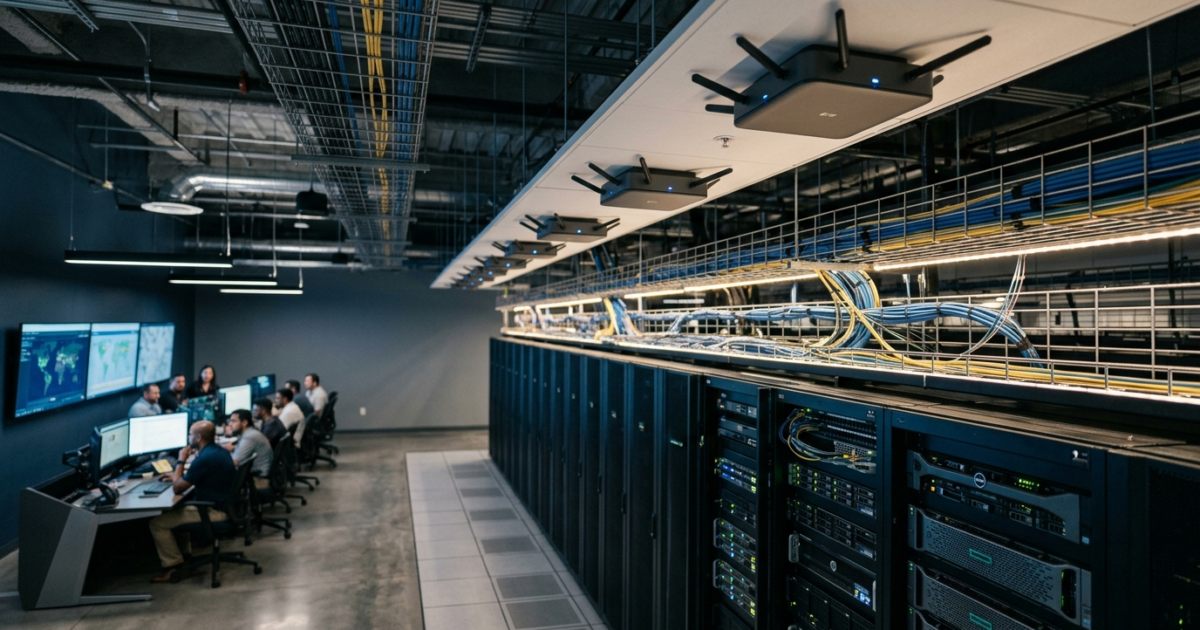
Key takeaways
- Cisco IT found enterprise security advancements significantly outpaced raw throughput gains during its global Wi-Fi 7 rollout.
- Hardware-enforced beacon protection and mandatory WPA3 encryption contributed to a 40% reduction in site security incidents.
- Cisco Identity Services Engine dynamically provisions microsegmentation at runtime, standardizing edge switch port configurations across campuses.
- Active network infrastructure replaces passive transport, embedding native firewalls into routing tiers and encrypting switching layers.
- Operational AgenticOps integrates AI agents with Splunk Cloud telemetry to autonomously triage anomalies and remediate edge exceptions.
When Cisco IT executed its global infrastructure refresh across multinational corporate campuses, engineering leadership initially benchmarked success against traditional physical-layer metrics: aggregate data throughput, channel bonding efficiency, and latency reduction under dense concurrent user loads. However, field data from production deployments quickly revealed an unexpected operational shift: the implementation of Wi-Fi 7 security delivered strategic protective gains that significantly outran the anticipated wireless speed improvements. Rather than acting as an incremental connectivity standard, the enterprise migration served as a structural catalyst to converge networking hardware and threat prevention into a unified, active defensive fabric.
For decades, enterprise networking operated under a historical legacy where connectivity came first and security was treated as an operational afterthought. Routers routed packets, switches bridged frames, and access points broadcasted radio frequencies, while security teams attempted to bolt defensive appliances, proxy inspection firewalls, and endpoint agents onto an inherently passive transport layer. As enterprise digital transformation accelerated, this decoupled paradigm created widening structural liabilities. The proliferation of unmanaged Internet of Things (IoT) sensors, ephemeral headless microservices, and autonomous software workers dramatically expanded corporate attack surfaces, while looming quantum decryption developments threaten legacy cryptographic primitives. In modern high-throughput environments, bolting standalone security appliances onto passive transit pipes creates unsustainable latency penalties and fragile blind spots.
Industry research validates this shifting architectural responsibility. Recent data from ZK Research indicates that 83% of network engineers now maintain enterprise security directly within their operational remit, reflecting a permanent realignment of IT duties. Cisco IT’s internal transition to Wi-Fi 7 demonstrated that treating networking and security as indivisible systems produces quantifiable resilience, resulting in as much as a 40% reduction in reported security incidents across multiple enterprise production facilities. This detailed analysis examines how hardware-enforced authentication, active infrastructure components, runtime zero-trust microsegmentation, and autonomous operations converge to redefine campus network defense.
Architectural Foundations of Enterprise Wi-Fi 7 Security
To understand why defensive gains eclipsed throughput metrics during the upgrade, IT leaders must examine the physical-layer and link-layer vulnerabilities that previously compromised wireless environments. Zero-trust access frameworks have dominated corporate cybersecurity strategies for nearly a decade, enforcing strict continuous verification of user identities, endpoint health postures, and contextual attributes before granting application access. However, enterprise architects faced a systemic architectural vulnerability hiding in plain sight: if the Layer 2 wireless association handshake itself can be spoofed, downgraded, or intercepted, the entire zero-trust foundation built at Layer 7 collapses before the user ever initiates a session.
In prior generations of wireless technology, pre-association management frames remained unencrypted and susceptible to manipulation. Attackers within physical proximity of enterprise campuses routinely deployed rogue transmitters, beacon spoofing, and deauthentication injections to trick client devices into connecting to malicious interception nodes. Cisco IT resolved this foundational exposure by coupling Wi-Fi 7 access points directly with the Cisco Identity Services Engine (ISE), enforcing mandatory Wi-Fi Protected Access 3 (WPA3) cryptographic authentication directly at the radio frequency association boundary.
Closing the Pre-Association Vulnerability Gap
Wi-Fi 7 specifications fundamentally mandate WPA3 Enterprise certification, preventing client connections from negotiating downgrade attacks back to legacy, vulnerable WPA2 handshakes. Under WPA3, Protected Management Frames (PMF) are strictly enforced by hardware radios, protecting unicast and broadcast management frames from being forged or captured. This cryptographic hardening at the physical association plane ensures that malicious actors cannot spoof access point identity, inject malicious disassociation packets, or perform eavesdropping on the initial four-way handshake.
Once cryptographic association is established, Cisco ISE orchestrates multi-layered identity validation, integrating directly with Cisco Duo multi-factor authentication and Cisco Secure Access to execute frictionless passwordless verification across the global enterprise. Rather than forcing mobile knowledge workers to navigate repetitive certificate challenges or cumbersome multi-step prompts whenever moving between physical conference rooms, the converged association layer validates client machine certificates, user security keys, and device hygiene metrics concurrently. By pushing mutual cryptographic authentication to the physical radio link, Cisco IT established an association boundary where zero trust does not merely inspect application payloads, but actively governs the initial electromagnetic handshake.
Active Infrastructure and Hardware-Enforced Perimeter Defense
Beyond securing the initial wireless link, the Wi-Fi 7 deployment transformed Cisco IT’s physical infrastructure from passive packet transit into an active, distributed defensive fabric. In conventional enterprise designs, switches, routers, and wireless controllers served purely as conduits, forwarding frames blindly to centralized security inspection appliances located in regional data centers. This legacy model introduces heavy backhauling overhead, creates single points of failure, and discards valuable context as packets traverse local network segments.
Under the converged Cisco Secure Networking architecture, every access point, access switch, and aggregation router functions as an active enforcement node. As documented in the Cisco Catalyst Wi-Fi 7 access points technical documentation, next-generation enterprise access points deploy dedicated scanning radios and automated beacon protection mechanisms. This continuous radio frequency monitoring closes the door on complex wireless attack vectors, including Evil Twin deployments, where rogue access points attempt to clone authorized corporate Service Set Identifiers (SSIDs) to siphon corporate credentials.
Turning Passive Plumbing into Active Defense
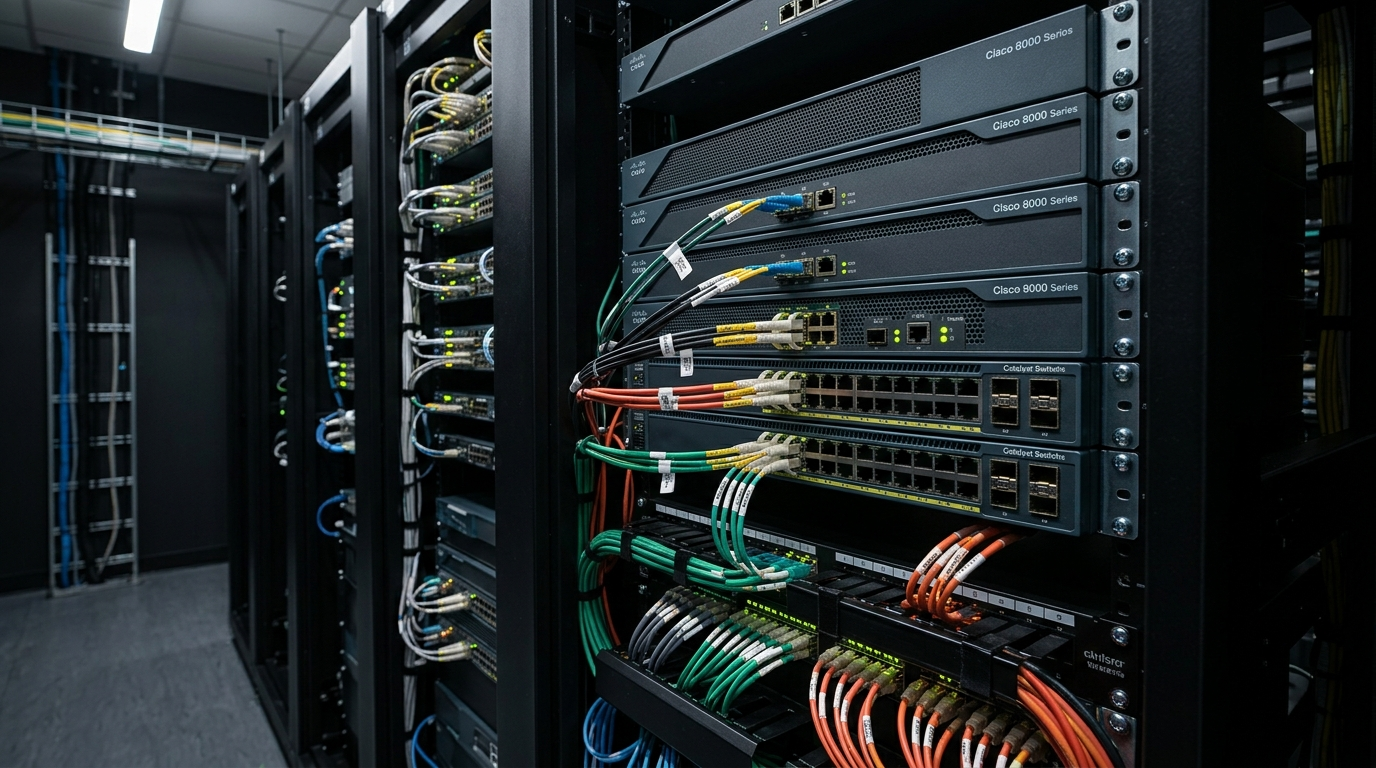
The active enforcement model extends directly into the campus switching and routing tiers, enabling comprehensive enterprise infrastructure modernization without requiring cumbersome bolt-on firewalls at every remote location. For distributed edge routing, Cisco 8000 Series enterprise routers embed native stateful firewalling capabilities directly into the routing silicon, enforcing boundary inspection, application visibility, and granular traffic filtering at the physical edge without deploying standalone security appliances at every branch office.
Simultaneously, Cisco Smart Switches introduce line-rate switching-layer encryption across physical ports, preventing physical wiretapping or packet sniffing within enterprise wiring closets. These smart switches integrate natively with Meraki Adaptive Policy frameworks, injecting metadata-based Security Group Tags (SGTs) directly into the Ethernet frame header. By carrying identity context and security classifications throughout the transit path, the switching fabric preserves endpoint policy awareness across the entire campus backbone, eliminating the historical visibility gap where Layer 2 access switches stripped authentication context upon packet forwarding.
Runtime Microsegmentation and Lateral Containment
A cornerstone of modern enterprise risk mitigation is designing network architectures that adhere to an explicit “assume breach” methodology. Even with rigorous endpoint posture assessment, enterprises must operate under the operational assumption that individual mobile devices, environmental IoT sensors, or autonomous software agents will eventually experience credential theft or malware compromise. When an edge breach occurs, the primary defensive objective is containing the blast radius to prevent malicious lateral traversal across critical corporate subnets.
Historically, isolating network traffic required network engineers to manually maintain sprawling, brittle Access Control Lists (ACLs), complex subnet divisions, and isolated Virtual Local Area Networks (VLANs) across hundreds of edge access switches. This static management approach suffered from severe operational friction, configuration drift, and human error. If an engineer misconfigured a single switch port profile during a routine office expansion, an untrusted contractor device could inadvertently bridge into an internal production development subnet.
Containment of the Lateral Blast Radius
Cisco IT fundamentally restructured this access model by deploying runtime dynamic microsegmentation managed centrally by Cisco ISE across high-density wireless switching architectures. Under this architecture, the physical edge is completely standardized: every access switch port and wireless basic service set identifier (BSSID) carries an identical baseline configuration. When an endpoint connects to the network—whether plugging an Ethernet cable into a conference room jack or associating with a 6-GHz Wi-Fi 7 radio—Cisco ISE queries policy profiles, evaluates the device’s cryptographic credentials, and dynamically injects specific segmentation rules at runtime.
If an authenticated endpoint exhibits anomalous lateral scanning behavior or communicates with unauthorized internal IP ranges, ISE immediately modifies the client’s downloadable ACL or reassigns its Security Group Tag on the fly. This runtime containment restricts the compromised device to an isolated quarantine enclave, preventing communication with peer workstations, administrative management interfaces, or database repositories. By decoupling access policies from physical ports and automating enforcement dynamically, enterprise network teams successfully eliminate the chronic trade-off between user mobility and strict zero-trust network segmentation.
AgenticOps and Autonomous Telemetry Orchestration
While cryptographic access control, active infrastructure, and dynamic segmentation protect the data plane, managing these interconnected defensive mechanisms across a global enterprise introduces massive operational scale challenges. In Cisco IT’s production estate, tens of thousands of Wi-Fi 7 access points, smart switches, and aggregation routers continuously generate astronomical streams of telemetry, NetFlow records, authentication syslogs, and environmental radio metrics. Historically, extracting actionable threat intelligence from this telemetry deluge required human network engineers to manually construct search queries, correlate timestamp anomalies, and execute manual corrective CLI commands.
To eliminate operational bottlenecks and alert fatigue, Cisco IT operationalized an emerging operational framework termed AgenticOps: deploying specialized, autonomous AI agents capable of executing delegated tasks across both networking and security domains. Operating on top of the Splunk Cloud Platform, which aggregates and indexes unstructured telemetry from across the entire global infrastructure, these AI agents continuously evaluate estate-wide performance and security health.
Scaling Operations Through AI Delegation
Rather than requiring human operators to spend hours manually correlating wireless disconnections with upstream RADIUS server timeouts, network engineers instruct autonomous agents to execute complex diagnostic routines via natural language and API orchestrations. Within seconds, AI agents query telemetry clusters, surface correlated anomalies, and recommend precise remediations. In approved operational scenarios, agents execute deterministic maintenance tasks directly, such as cycling switch port power to reset unresponsive edge hardware, purging stale MAC address tables, or flagging policy discrepancies across regional branch offices.
The transition toward automated agentic operations extends beyond basic triage, integrating with internal continuous integration pipelines and automated infrastructure-as-code platforms. By delegating high-volume, repetitive diagnostic overhead to autonomous agents, engineering teams reclaim valuable cognitive bandwidth, shifting their primary focus from reactive incident firefighting to strategic architectural resilience. The combination of hardware-enforced protection at the physical layer and autonomous machine intelligence at the operations layer directly produced Cisco IT’s observed 40% reduction in security incident escalations, establishing a reproducible blueprint for modern enterprise IT leadership.
Bottom line
Cisco IT’s global deployment delivers an unequivocal lesson for enterprise technology leaders: the historical model of building networks purely for bandwidth and treating security as a secondary, bolt-on appliance layer is no longer viable. As enterprises prepare infrastructure for distributed AI workloads, multiplying device identities, and increasingly sophisticated lateral exploits, the physical network must itself serve as the foundational security layer. Cisco’s Wi-Fi 7 upgrade proves that when security is embedded natively across access points, switches, and routers, organizations achieve superior defensive efficacy while simultaneously improving user experience through frictionless passwordless access.
From a Total Cost of Ownership (TCO) perspective, enterprise executives must evaluate Wi-Fi 7 not merely as a wireless speed refresh, but as an opportunity to consolidate sprawling security tooling. Embedding perimeter firewalling directly into routing tiers like the Cisco 8000 Series eliminates the capital expense and maintenance overhead of dedicated branch firewall appliances. Concurrently, standardizing switch port configurations through automated ISE runtime segmentation dramatically slashes manual provisioning hours and reduces costly human misconfiguration outages. While full modernization demands coordinated hardware upgrades and investments in advanced telemetry platforms like Splunk Cloud, the documented operational dividend—including a 40% drop in reported security incidents—presents a compelling business case for forward-looking CIOs and CTOs.
TechNode HQ Verdict: Pros, Cons & Usability
- Pro (Engineering): Eliminates unauthenticated pre-association attack vectors and centralizes dynamic identity policy across wired and wireless layers via ISE runtime enforcement.
- Pro (Consumer): Enables friction-free, passwordless device roaming across enterprise environments with zero re-authentication overhead or degraded throughput.
- Con: Demands synchronized end-to-end hardware upgrades spanning access points, smart switches, and routing backbones to realize full zero-trust microsegmentation.
- Con: Introduces operational dependency on automated AI agents and unified telemetry pipelines that require specialized engineering oversight to maintain.
Enterprise Usability: Enterprise infrastructure teams should prioritize upgrading high-density campus nodes where endpoint diversity and guest access create significant lateral threat surfaces, pairing Catalyst or Meraki Wi-Fi 7 access points directly with dynamic ISE runtime profiling.
Everyday Usability: Commercial organizations operating legacy Wi-Fi 5 or Wi-Fi 6 environments do not need immediate consumer-grade refreshes, but should align their next hardware lifecycle cycle with Wi-Fi 7 access points to capture mandatory WPA3 hardening and prevent credential compromise.