Key takeaways
- Community coalitions in Philadelphia and nationwide are demanding a municipal AI data center moratorium over air pollution, water use, and rising electric utility rates.
- The Philadelphia City Planning Commission identified the 1,300-acre Bellwether District and 2600 Grant Avenue as candidate sites capable of supporting hyperscale AI facilities.
- BloombergNEF projects that U.S. data centers could consume up to 18 billion cubic feet of natural gas per day by 2035 to circumvent electrical interconnection backlogs.
- Health advocates and environmental attorneys warn that hundreds of emergency backup diesel generators will worsen localized air quality during heat waves and peak grid strain.
- Municipal pauses enacted from New York to Denver highlight a widening policy divide between state-level economic development incentives and municipal resource protections.
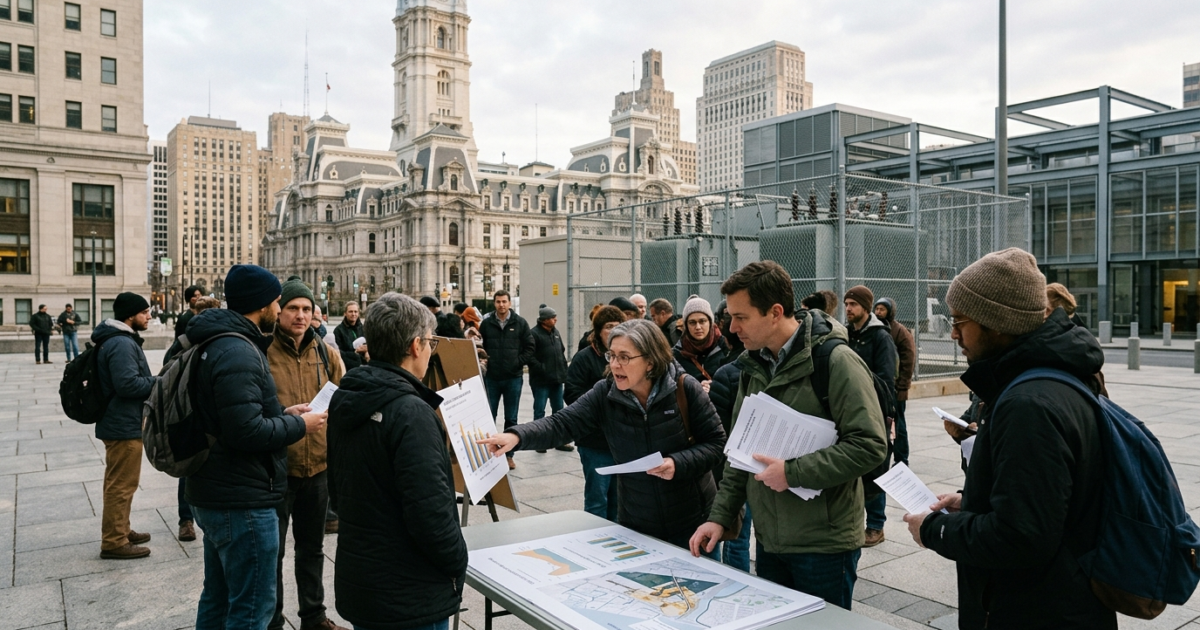
A growing civic pushback is challenging hyperscale compute expansion across the United States as community coalitions demand an AI data center moratorium to protect municipal power grids, public health, and local utility rates. On September 14, 2026, environmental justice organizers gathered outside Philadelphia City Hall to demand a three-year legislative halt on new server facilities after municipal planners identified potential development locations in frontline neighborhoods. The friction reflects a nationwide conflict between technology companies seeking massive electrical capacity for machine learning workloads and residents living in historically industrial districts. While technology operators frame computational infrastructure as an economic catalyst, municipal leaders increasingly confront public resistance rooted in energy consumption, air emissions, and infrastructure equity.
Philadelphia Campaign Sparks National AI Data Center Moratorium Debate
The mobilization in Philadelphia highlights how computational infrastructure planning directly intersects with legacy environmental burdens. More than one hundred residents and advocacy representatives attended the rally organized by community group Philly Thrive, petitioning members of City Council to introduce an emergency three-year freeze on facility permits. The grassroots action followed study disclosures from the Philadelphia City Planning Commission, which evaluated real estate capacity and designated two prospective parcels capable of hosting hyperscale data centers: the 1,300-acre Bellwether District in Southwest Philadelphia and an industrial parcel at 2600 Grant Avenue in Northeast Philadelphia.
For community organizers, the siting decisions reopened acute historic grievances. The Bellwether District occupies the footprint of the former Philadelphia Energy Solutions oil refinery, which processed 335,000 barrels of crude oil daily before closing after a catastrophic explosion in June 2019. Residents in the adjacent Grays Ferry neighborhood experienced decades of elevated cancer rates, respiratory illness, and chronic health conditions attributed to refinery emissions. As Philly Thrive managing co-director Shawmar Pitts and board president Sonya Sanders highlighted at the City Hall demonstration, residents view high-density computational campuses not as clean technology investments, but as an extension of industrial exploitation that promises negligible permanent neighborhood employment while imposing massive environmental overhead.
The municipal battle mirrors shifts documented in a national Gallup survey, which revealed that a clear majority of Americans oppose local data center construction within their communities. Public opposition is consistently driven by three interconnected anxieties: compounding increases in residential electric utility bills, industrial water extraction for cooling towers, and continuous noise pollution from mechanical chiller banks. As commercial operators race to deploy thousands of high-density graphics processing unit clusters, municipal authorities are discovering that local host communities are no longer willing to absorb unchecked infrastructure externalities.
Industrial Legacy Sites and the Bellwether District Friction
The selection of former manufacturing parcels for computational infrastructure represents an intentional commercial strategy across the hyperscale sector. Developers frequently target decommissioned industrial zones because these properties offer legacy heavy-power interconnections, high-capacity sub-transmission rights-of-way, and zoned setbacks distant from affluent residential suburbs. However, this land-use practice concentrates emerging computational infrastructure into environmental justice communities that have historically borne the heaviest burdens of industrial pollution.
In Southwest Philadelphia, community leaders noted that while a modern computer campus does not generate the sulfur dioxide and volatile organic compound plumes of a petroleum refinery, its secondary physical presence introduces severe neighborhood disruptions. Facility proposals for large compute campuses require multi-megawatt substations, high-voltage transformers, and extensive sound attenuation barriers to buffer continuous low-frequency hums generated by computer room air handler units and liquid-to-air cooling fans. Furthermore, public reporting from The Philadelphia Inquirer confirmed that the Planning Commission viewed the Bellwether District and Grant Avenue as the sole municipal sites capable of meeting hyperscale footprint and utility thresholds, limiting citywide development flexibility.
Health professionals and public interest organizations like WHYY reported that residents surrounding the Bellwether parcel already experience disproportionate burdens of cardiovascular and pediatric respiratory disease. Community speakers argued that municipal zoning must prioritize restorative community development, light manufacturing, and clean open spaces rather than automated server warehouses that consume municipal resources without providing meaningful career pathways for local residents.
Power Generation, Diesel Emissions, and Utility Cost Escalation
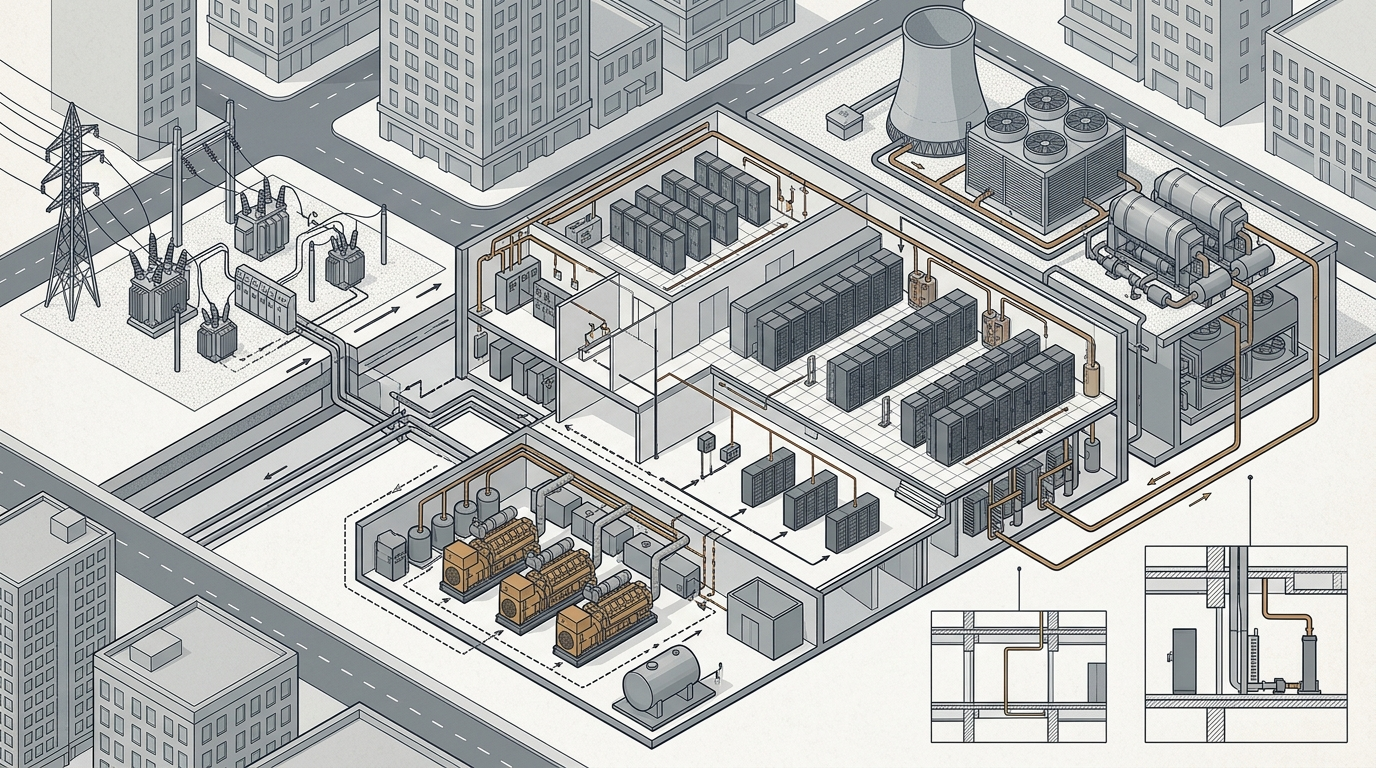
Beyond localized zoning disputes, the rapid expansion of artificial intelligence infrastructure is destabilizing regional energy planning. Training frontier foundation models and serving real-time inference workloads require power densities ranging from 40 to 100 kilowatts per server cabinet, pushing modern data center campuses toward gigawatt-scale requirements. Because regional electric transmission operators face interconnection queues extending beyond five to seven years, data center developers are increasingly turning to dedicated fossil fuel generation to bridge supply shortfalls.
According to market analysis from BloombergNEF, U.S. data center operators are projected to consume up to 18 billion cubic feet of natural gas per day by 2035. This demand trajectory represents a dramatic doubling of estimates published nine months prior, exceeding the combined natural gas consumption of Germany and Japan. While natural gas produces lower particulate emissions than coal or oil, burning one cubic foot of natural gas emits approximately 60 grams of carbon dioxide equivalent. The projected expansion could generate an additional 1 million metric tons of greenhouse gas emissions daily, accounting for roughly 12 percent of total contemporary U.S. greenhouse gas pollution.
Simultaneously, air permit filings reveal an intensifying reliance on backup power generation. As Clean Air Council attorney Annie Fox cautioned at the Philadelphia demonstration, a standard hyperscale facility deployment incorporates dozens to hundreds of multi-megawatt diesel generation units designed to provide operational continuity during grid failures. Under regional grid stress conditions, transmission operators and state environmental regulators have permitted data centers to run emergency diesel generators to reduce grid draw during extreme summer heat waves. Harvard University public health research in 2021 established that particulate pollution from fossil fuels causes one in five premature deaths globally, meaning that running diesel engines in densely populated urban centers poses measurable mortality risks to vulnerable populations.
For residential utility customers, the infrastructure surge carries immediate financial consequences. Grid operators must finance multi-billion-dollar substation construction, transformer replacements, and high-voltage transmission lines to accommodate commercial data centers. When public utility commissions approve rate-base capital expenditure plans, fixed infrastructure costs are broadly socialized across commercial and residential rate classes, directly inflating monthly electric bills for household consumers.
Municipal Bans and State-Level Regulatory Fragmentation
In response to rising civic pushback, local and state governments are pursuing sharply divergent regulatory postures. While state executive branches often compete aggressively to attract technology investment through tax subsidies, municipal governments are increasingly using land-use authority and zoning moratoriums to impose pauses on rapid infrastructure deployment.
| Jurisdiction | Regulatory Action | Stated Policy Objective | Primary Mechanism |
|---|---|---|---|
| Philadelphia, PA | Proposed three-year moratorium | Protect grid reliability, limit diesel emissions, evaluate health impact | City Council legislative ordinance pausing zoning approvals |
| New York State | Executive permit freeze | Halt large project permits pending utility and water impact reviews | Gubernatorial executive order governing environmental permits |
| Denver, CO | Enacted municipal moratorium | Assess municipal water consumption and electric capacity limits | Zoning code temporary suspension for commercial compute |
| Reno, NV | Enacted municipal moratorium | Review municipal power constraints and neighborhood acoustic levels | City planning review freeze on hyperscale building permits |
| Pennsylvania (State) | Executive administrative guidance | Establish uniform operating baselines for noise, water, and power | Governor executive directives balancing growth and standards |
In New York, Governor Kathy Hochul issued an executive order placing a temporary halt on state approvals for large-scale energy projects, explicitly warning that technology expansion must not compromise drinking water supplies or escalate consumer electric rates. Similar municipal pauses have been enacted in Denver, Reno, Indianapolis, Asheville, and Charlotte. These moratoria provide municipal planning boards with designated operational windows to commission independent acoustic studies, evaluate aquifer draw, and assess transmission line capacity before approving permanent zoning classifications.
Conversely, state-level executives often attempt to mitigate public friction through standardized regulatory baselines. In Pennsylvania, Governor Josh Shapiro issued administrative guidance establishing statewide guardrails for data center acoustic limits, water conservation metrics, and renewable power utilization. However, reporting in The Daily Pennsylvanian noted that local environmental coalitions consider state guidance insufficient, asserting that without binding municipal ordinances, regional grid operators will continue approving rapid compute deployments that prioritize technology earnings over community stability. The contrast between blue-collar job creation narratives explored in AI data center construction analysis and the reality of minimal permanent post-construction employment continues to fuel local skepticism.
Bottom line
The push for an AI data center moratorium in Philadelphia signals an inevitable structural reckoning for the artificial intelligence industry: compute expansion is no longer an isolated technical or commercial endeavor, but a major public policy and civic infrastructure challenge. When commercial facilities consume regional electrical capacity comparable to mid-sized industrial cities while deploying diesel generators near residential neighborhoods, community resistance ceases to be a localized anomaly and becomes a predictable operational hurdle.
For cloud architects, platform engineers, and corporate technology leaders, navigating this landscape requires fundamental changes to infrastructure procurement. Organizations can no longer assume that rural or industrial zoning guarantees frictionless permitting. Technology buyers must integrate transparent community benefit agreements, rigorous water-neutral cooling architectures, on-site zero-emission generation, and explicit utility rate protections into initial facility designs. Without meaningful community engagement and binding environmental safeguards, enterprise compute roadmaps will face compounding legal challenges, municipal delays, and legislative moratoriums across the country.
Sources
- The AI data center boom is colliding with cities scarred by big industry | TechCrunch
- Planning Commission considers how — and if — data centers should be built in Philly
- The anti-data center fight reaches Philadelphia amid spreading AI fear and calls for a slowdown
- Gas Is Letting Data Centers Grow Beyond the Grid | BloombergNEF
- Philly protesters demand data center moratorium – WHYY
- Philadelphia advocacy groups call for citywide moratorium on data centers – The Daily Pennsylvanian
- Americans Oppose AI Data Centers in Their Area