Google Uses Gemini and Fuzzing to Rewrite C into Rust
Google used Gemini and differential fuzzing to rewrite the C library giflib into Rust, eliminating memory flaws while preserving binary performance and parity.
Supporting visual for Google Uses Gemini and Fuzzing to Rewrite C into Rust.
Key takeaways
tail latency after removing legacy operating system process isolation sandboxes.
The Rust rewrite proved structurally immune to CVE-2026-26740, an unpatched heap write zero-day, prior to its public cataloging and disclosure.
Verification proved to be the primary engineering effort, requiring 200 million differential fuzzing cycles across six continuous days and decoding 30 million real-world GIF assets.
Engineering discussions highlight that foreign function interface pointer lifecycles require human domain expertise, and forking C libraries creates persistent upstream maintenance divergence.
Google security engineers have demonstrated that large language models combined with differential fuzzing can reliably convert legacy C libraries into memory-safe Rust. Using Gemini alongside an automated verification framework, the team translated giflib—a 3,000-line C image-processing library handling untrusted inputs—into an ABI-compatible drop-in Rust library named giflib-rs. Production telemetry confirmed runtime parity and lower p99 latency after decommissioning legacy process isolation sandboxes, while neutralizing an unpatched heap write zero-day cataloged as CVE-2026-26740. However, the pilot underscored that AI translation requires substantial human verification and continuous differential testing to prevent regressions at C foreign function interface boundaries.
Category: AI & Machine Learning
Intent: analysis_explainer
Google Uses Gemini and Fuzzing to Rewrite C into Rust
Category: AI & Machine Learning
Tags: Cybersecurity, DevSecOps, Enterprise AI
C to Rust rewrite
Google deployed Gemini and automated differential fuzzing to translate giflib, a 3,000-line C image-processing dependency, into a drop-in Rust library named giflib-rs.
Production telemetry confirmed runtime performance parity and reduced p99 tail latency after removing legacy operating system process isolation sandboxes.
The Rust rewrite proved structurally immune to CVE-2026-26740, an unpatched heap write zero-day, prior to its public cataloging and disclosure.
Verification proved to be the primary engineering effort, requiring 200 million differential fuzzing cycles across six continuous days and decoding 30 million real-world GIF assets.
Engineering discussions highlight that foreign function interface pointer lifecycles require human domain expertise, and forking C libraries creates persistent upstream maintenance divergence.
Google used Gemini and differential fuzzing to rewrite the C library giflib into Rust, eliminating memory flaws while preserving binary performance and parity.
Google security engineers have demonstrated that large language models combined with differential fuzzing can reliably convert legacy C libraries into memory-safe Rust. Using Gemini alongside an automated verification framework, the team translated giflib—a 3,000-line C image-processing library handling untrusted inputs—into an ABI-compatible drop-in Rust library named giflib-rs. Production telemetry confirmed runtime parity and lower p99 latency after decommissioning legacy process isolation sandboxes, while neutralizing an unpatched heap write zero-day cataloged as CVE-2026-26740. However, the pilot underscored that AI translation requires substantial human verification and continuous differential testing to prevent regressions at C foreign function interface boundaries.
The Memory Safety Challenge in Legacy C Stacks
Memory corruption flaws have persisted as the primary source of critical vulnerabilities across production infrastructure for decades. Historical telemetry across mature software stacks indicates that memory safety errors, such as buffer overflows, use-after-free conditions, and out-of-bounds writes, account for approximately 70 percent of severe security vulnerabilities in C and C++ codebases. For web-scale systems processing millions of untrusted media files daily, even a minor parsing error can allow remote code execution or unauthorized data exfiltration.
Historically, organizations faced two difficult options to mitigate these risks: invest years in labor-intensive manual rewrites or encase untrusted C binaries in heavy process isolation sandboxes. Manual rewrites require immense engineering hours and often introduce subtle regressions, whereas operating system sandboxes impose measurable context-switching overhead and memory footprint penalties. Automated transpilers, while deterministic, frequently generate unidiomatic Rust code littered with unsafe pointer arithmetic, merely relocating C vulnerabilities into Rust without establishing compile-time memory safety.
To break this trade-off, Google security engineers Bastian Kersting and Max Hils developed an automated migration workflow centered on an autonomous feedback loop. Rather than attempting a manual line-by-line conversion, the engineers used Google’s Gemini model to synthesize safe Rust logic directly, combining generative artificial intelligence with automated verification pipelines to ensure semantic and operational equivalence.
The Three-Stage Gemini Migration Pipeline
The automated migration pipeline developed for the giflib-rs project operated through three distinct phases designed to move code safely across language boundaries:
Single-Shot Translation: The engineers supplied Gemini with single-shot prompts containing the entire C source of giflib. The prompt instructed the model to translate the core image-parsing and decompression logic into safe, idiomatic Rust while preserving all existing exported C function signatures, struct layouts, and symbol definitions to ensure application binary interface (ABI) compatibility.
FFI Boundary Construction: To function as a true drop-in replacement, the resulting Rust library had to expose external C interfaces without corrupting pointer lifecycles. Initial translations produced by Gemini introduced unsound raw pointer semantics. The engineers resolved this by integrating the safer_cffi crate, establishing strict boundary types, and employing human review to reconstruct safe Rust handles from raw pointers using abstractions like Box::from_raw.
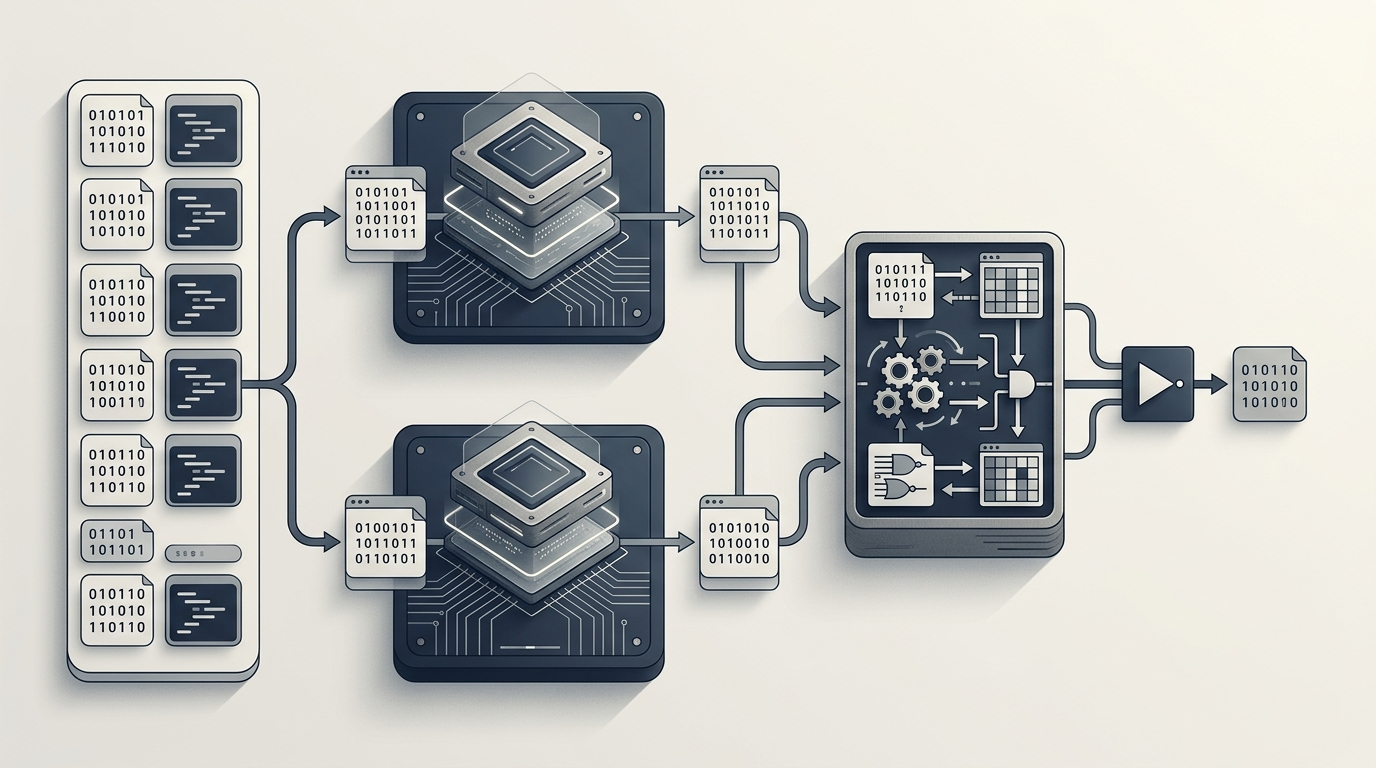
Autonomous Feedback and Iterative Patching: The compiled Rust code was linked into an automated differential testing harness alongside the original C binary. When the test runner detected runtime discrepancies or compilation failures, the error logs and execution traces were fed back into Gemini to generate targeted code patches.
This closed-loop system minimized manual intervention during syntax migration, but the human role remained indispensable at the foreign function interface boundary. Ensuring that pointer ownership, reentrancy guarantees, and thread-safety invariants remained unviolated required domain experts who understood both C pointer models and Rust borrow mechanics.
Verifying Semantic Parity with Differential Fuzzing
Deploying AI-generated code directly into critical infrastructure requires verification that goes far beyond traditional unit test suites. Because image decoders process complex binary formats where subtle parsing differences can cause silent corruption or rendering artifacts, the engineering team constructed a massive multi-layered validation framework.
First, the team subjected both the legacy C library and the Rust candidate to mass-scale regression decoding across more than 30 million real-world GIF assets collected from production environments. This validation ensured bit-for-bit rendering parity across varied color tables, interlaced frames, and corrupted inputs. Any visual discrepancy or unexpected decoder termination triggered an immediate failure trace.
Second, the engineers deployed an automated differential fuzzer that executed continuous side-by-side iterations of the C and Rust binaries. Operating uninterrupted for six consecutive days, the differential fuzzer executed 200 million iterations without recording functional divergence between the implementations. The harness actively probed edge cases in memory allocation and frame boundary handling.
Get the Weekly Brief
Curated analysis for tech leaders. Every Thursday.
Finally, the team integrated adversarial LLM evaluation prompts tasked with analyzing both the C and Rust source repositories to identify potential behavioral bifurcations. This multi-tiered verification pipeline proved its utility by surfacing an unhandled edge case within the LZW decompressor. More notably, the pipeline flagged a pre-existing out-of-bounds write flaw in Google’s own legacy internal C patch, highlighting that rigorous differential fuzzing can expose legacy bugs that escaped years of manual audits.
Production Telemetry and Zero-Day Neutralization
Supporting visual for Production Telemetry and Zero-Day Neutralization.
Engineers often worry that migrating system software to Rust will degrade runtime efficiency due to mandatory array bounds checking and runtime panic handlers. However, telemetry collected across Google global image decoding clusters confirmed that the compiled Rust library operated at complete runtime parity with the historical C binary.
Because Rust type system enforces memory safety at compile time, infrastructure teams were able to decommission the restrictive operating system process isolation sandboxes previously required to shield host systems from giflib vulnerabilities. Eliminating this sandbox layer removed recurring inter-process communication overhead, leading to a demonstrable reduction in p99 tail latency across production workloads.
Comparison of Legacy C giflib and AI-Migrated giflib-rs
Evaluation Metric
Legacy C Implementation
Migrated giflib-rs (Rust)
Memory Safety Model
Manual pointer management; vulnerable to heap and stack corruption
Compile-time borrow checker and safe type abstractions
Isolation Requirements
Required OS process isolation sandbox for untrusted decodes
Elevated due to sandbox context switching and process boundaries
Measurably lower due to removed sandbox overhead
Zero-Day Exposure (CVE-2026-26740)
Vulnerable to out-of-bounds heap write flaw
Structurally immune prior to public disclosure
Validation Baseline
Historical static analysis and standard regression tests
30 million real assets and 200 million differential fuzzing cycles
The definitive test of the migration occurred during staging. An independent security researcher discovered an unpatched out-of-bounds heap write vulnerability in upstream C giflib, subsequently cataloged as CVE-2026-26740. Production instances running Google compiled Rust replacement were found to be structurally immune to the zero-day prior to public disclosure. This outcome aligns with broader industry observations regarding automated defensive engineering, as detailed in TechNode HQ analysis of Google machine-speed defenses and threat monitoring.
The Limits of LLM Ports and Upstream Divergence
Despite the success of the giflib-rs pilot, Google engineers and open-source contributors have cautioned against viewing AI-driven translation as a universal solution for legacy modernization. The approach introduces specific technical and organizational trade-offs that engineering leaders must evaluate before adopting similar pipelines.
The most immediate operational hurdle is long-term upstream divergence. When an organization rewrites an open-source C dependency in Rust, it creates a persistent fork. If the upstream C project publishes bug fixes, performance optimizations, or new feature flags, those modifications cannot be merged cleanly via standard version control tooling. Platform maintainers must either manually backport changes into Rust or re-run migration pipelines, creating sustained maintenance overhead.
Technical communities on Hacker News and Reddit have also debated the boundaries between LLM code generation and deterministic transpilation. While commentators widely commended the differential testing framework, many engineers questioned the reliability of single-shot prompting for larger, tightly coupled codebases. In complex libraries spanning tens of thousands of lines, AI translations can generate subtle semantic regressions that evade detection if fuzzing suites lack absolute branch coverage.
Consequently, many systems engineers argue that a hybrid methodology may prove more dependable at enterprise scale: using deterministic transpilers like c2rust to generate a baseline Rust syntax tree, followed by specialized AI agents tasked with refactoring unsafe blocks into idiomatic, safe Rust. Google has published giflib-rs on GitHub as a reference implementation to help the open-source community study these architectural boundaries.
Bottom line
The giflib-rs project provides concrete evidence that generative AI, when combined with automated differential fuzzing and rigorous FFI modeling, can successfully eliminate memory vulnerabilities from critical infrastructure dependencies without sacrificing throughput or latency. The structural neutralization of CVE-2026-26740 underscores the security dividend of transitioning foundational C utilities into memory-safe languages.
However, enterprise platform teams should recognize that the model accounted for only a fraction of the engineering effort. The true defense mechanism was the verification apparatus: 200 million fuzzing iterations, 30 million asset decodes, and meticulous manual inspection of raw pointer lifecycles. Organizations aiming to replicate this workflow must invest heavily in automated testing infrastructure and upstream maintenance strategies before deploying AI-translated code into production environments.