
Key takeaways
- Snowflake CoWork rebrands Snowflake Intelligence into a fully autonomous personal work agent.
- Cortex Sense boosts AI query accuracy to 86% by providing a shared enterprise context layer.
- Viral Nation leverages CoWork to process unstructured social media data for real-time brand strategy.
- Model Context Protocol (MCP) connectors allow agents to execute tasks directly in Slack and Salesforce.
- Cortex Training enables enterprises to customize open-weight LLMs on fully managed GPUs.
The era of passive business intelligence is officially over. With the launch of Snowflake CoWork Agentic AI at Snowflake Summit 2026, the data cloud giant has signaled a definitive shift from analytical dashboards to autonomous, action-oriented enterprise agents. For years, knowledge workers have been trapped in a fragmented loop of querying data, interpreting dashboards, and manually coordinating execution across disparate applications. Snowflake’s latest platform overhaul aims to collapse that chain entirely. By rebranding Snowflake Intelligence to CoWork and introducing a robust shared context layer known as Cortex Sense, the company is transforming AI from a mere summarization tool into an active participant in daily business operations.
Speaking to a record-breaking crowd of over 20,000 data leaders and developers at the Moscone Center in San Francisco, Snowflake CEO Sridhar Ramaswamy outlined a vision for the “Agentic Enterprise.” The core thesis is simple yet profound: AI is accelerating consumption in the core platform because customers are migrating workloads faster to access the data, context, and governance needed to power AI securely at scale. The real prize is no longer just answering questions; it is moving from prompts to pipelines, and from ideas to production workflows.
This transition represents a fundamental rewiring of how modern businesses operate. Instead of relying on a slow, manual pipeline of data engineers and marketing analysts to translate data into decisions, solutions like Snowflake CoWork are closing the gap between data insight and real-world execution. As the enterprise software market races to build the ultimate system of intelligence, Snowflake’s aggressive push into agentic workflows places it at the forefront of a technological revolution that will redefine the future of work.
Snowflake CoWork Agentic AI: The Architectural Reality
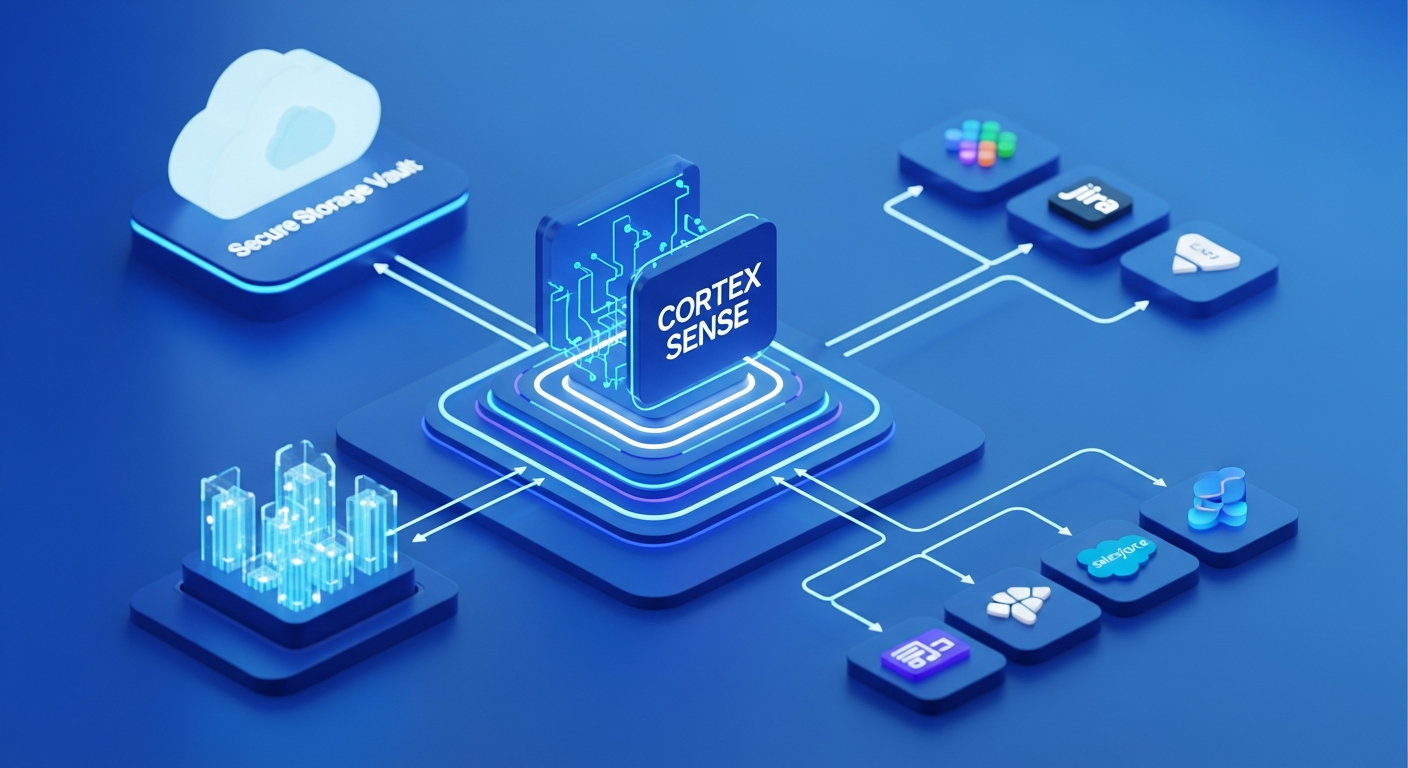
Under the hood, the transition to an agentic control plane requires more than just bolting a large language model onto a database. The architectural foundation of this shift relies on Cortex Sense, a new runtime context layer currently entering private preview. Historically, the Achilles’ heel of enterprise AI has been the semantic gap. Large Language Models (LLMs), no matter how advanced, lack the intrinsic operational context of a specific business. They do not inherently know that “Q3 Revenue” in a specific enterprise excludes deferred SaaS contracts, or that a “Churned Customer” is defined by a 90-day lapse in login activity rather than a canceled subscription.
Cortex Sense bridges this gap by functioning as a dynamic runtime for context. It ingests the enterprise data estate—including structured tables, unstructured documents, semantic views, and explicit business glossaries—and compiles it into a unified knowledge graph that agents can query in real-time. According to benchmark data revealed at the summit by theCUBE Research, this shared context layer dramatically reduces hallucinations and improves reasoning. While frontier coding agents alone answer hard structured-data questions with roughly 24% accuracy, and standard semantic models achieve about 47%, Cortex Sense pushes that accuracy to approximately 86% out of the box. This is achieved by grounding the AI in the specific operational realities of the business, eliminating the manual setup historically required to build production-ready agents.
To support the massive influx of multimodal data required to feed these agents, Snowflake also introduced Openflow. Built on Apache NiFi, Openflow is a fully managed integration service that connects any data source to any destination, supporting structured text, images, audio, video, and sensor data. Coupled with Snowflake Datastream—a new Kafka-compatible streaming service built natively into the platform—enterprises can now achieve near real-time unstructured data ingestion without the need for external clusters or complex connectors.
Furthermore, Snowflake introduced Cortex Training, a feature that allows enterprises to customize foundational models on fully managed GPUs. This ensures that domain-specific models can be trained securely on proprietary data without data movement risks. Coupled with Model Context Protocol (MCP) connectors, CoWork agents can execute multi-step workflows directly within external applications like Slack, Jira, Salesforce, and Gmail. The system also features “Deep Research,” an orchestration capability that runs multiple agents in parallel to synthesize external context and internal data into fully cited, actionable reports in minutes.
The Agentic Control Plane: Security & Governance
The concept of autonomous AI agents executing tasks across enterprise applications is inherently terrifying to Chief Information Security Officers (CISOs). The risk of prompt injection, data exfiltration, and unauthorized access to Personally Identifiable Information (PII) scales exponentially when AI is granted write-access to business systems. Snowflake’s approach to mitigating these risks is rooted in its foundational architecture: keeping the compute exactly where the data lives.
By executing agentic workflows within the Snowflake AI Data Cloud, all operations inherently adhere to Snowflake’s robust Role-Based Access Control (RBAC). This means that a CoWork agent operating on behalf of a marketing analyst cannot access financial data if that analyst does not possess the requisite permissions. The LLM inference remains entirely within Snowflake’s security perimeter, protected by layered guardrails, prompt logging, query tagging, and comprehensive usage monitoring.
For developers and data engineers, Snowflake introduced CoCo (formerly Cortex Code), a native AI coding agent designed specifically for data work. Recognizing the need for secure development environments, CoCo features a secured local sandbox that allows agents to operate in isolated local environments before deploying code to production. Whether accessed via the new native desktop app for Windows and macOS, or through plugins for VS Code and Cursor, CoCo acts as a governed control plane for developers working with modern data stacks.
Additionally, the introduction of Horizon Context enhances Snowflake’s Horizon Catalog by delivering a single version of the truth across the enterprise. This ensures that when a CoWork agent performs Deep Research or executes a multi-step skill, it is drawing from a trusted, governed foundation. The integration of these security layers transforms agentic AI from a theoretical vulnerability into a practical, enterprise-grade deployment.
Market Impact & Deployment

The enterprise software market is currently in an arms race to build the ultimate “system of intelligence.” Snowflake’s aggressive push into agentic workflows places it in direct competition with Microsoft’s ontologies, Salesforce’s metadata-driven AI layers, and ServiceNow’s workflow context models. As Dion Hinchcliffe, principal analyst at Moor Insights and Strategy, noted, all major vendors are converging toward a shared realization: enterprise AI systems require persistent organizational context to scale effectively. However, Snowflake’s distinct advantage lies in its data gravity; with over 13,900 customers already storing their most critical data in Snowflake, executing AI workflows where the data already resides significantly lowers Total Cost of Ownership (TCO).
The deployment of these tools is already yielding measurable performance gains that outpace the broader LLM ecosystem. According to the ADE-Bench framework—a rigorous benchmark created by Mode founder Benn Stancil in collaboration with dbt Labs to evaluate AI agents on real-world data engineering tasks—Snowflake’s CoCo is setting a new standard. CoCo achieved a 72.1% pass rate, surpassing Anthropic’s Claude Code and OpenAI’s Codex, which both scored 65.1%. Critically, CoCo achieved this lead with greater efficiency, using 51% fewer tokens and taking 8% less time than Claude Code. For Chief Information Officers (CIOs), this translates directly into faster time-to-value and drastically reduced compute costs.
The partner ecosystem is also rapidly adapting to this new paradigm. Eric Walk, Vice President of AI Data Platforms at Perficient, highlighted that Snowflake is building a truly unified data platform that brings together streaming, governance, and AI context. “It’s huge for creating context to power AI,” Walk stated, emphasizing that the flexibility to take action on data regardless of the underlying cloud infrastructure is a massive selling point for enterprise clients.
However, deploying Snowflake CoWork at scale is not without its strategic challenges. Embedding business semantics, workflow intelligence, and agent skills into a single vendor’s orchestration layer risks creating high switching costs. Enterprises must carefully weigh the immediate operational velocity gained through Cortex Sense against the long-term implications of vendor lock-in at the cognitive layer of their business. As Sridhar Ramaswamy aptly put it, “There is a little bit of a gold rush here in terms of who is able to create value for companies faster.”
The Consumer Translation
While the underlying architecture of Cortex Sense and Openflow is deeply technical, the real-world impact of Snowflake CoWork is most visible in how it transforms consumer-facing industries, particularly social media marketing. Viral Nation, a leading global social media agency, exemplifies this shift. The agency relies on processing massive volumes of unstructured data—ranging from video transcripts to real-time social conversations—to guide brand strategy and coordinate thousands of creator partnerships.
Historically, analyzing this data required a slow, manual pipeline. Data engineers would extract API metrics from TikTok, Instagram, and YouTube; analysts would clean the data and pipe it into a BI tool; and account managers would eventually interpret the static dashboards to make strategic recommendations days after a trend had peaked. With Snowflake CoWork, this latency is eradicated. As Nicolas Doyen, Vice President of Product and Data Strategy at Viral Nation, explained during the summit, the agency is now embedding AI decision-making directly into its operational heartbeat.
“CoWork’s that next step where it’s now not just BI inside of our business, but it’s actually guiding the way in which we make decisions across the whole business and we actually work and operate,” Doyen said. By leveraging Snowflake’s computing power to analyze unstructured transcripts and social sentiment, CoWork agents can autonomously detect a shift in consumer behavior, cross-reference it with historical campaign performance, and immediately draft a strategic pivot via Slack to the creative team.
For the everyday consumer, this means brand interactions and marketing campaigns will become hyper-personalized and highly reactive. When a live event goes viral, brands equipped with agentic AI can participate in the cultural moment within minutes rather than days. The AI is no longer just reading the room; it is actively participating in the conversation. As knowledge workers at companies like Synopsys, Whoop, and Under Armour adopt these personal work agents, the fundamental speed of digital culture and commerce will accelerate, rewiring how consumers experience the brands they love.
TechNode HQ Verdict: Pros, Cons & Usability
- Pro (Engineering): Cortex Sense dramatically improves the accuracy of complex structured data queries, jumping from 47% with standard semantic models to 86% out of the box by utilizing a shared enterprise context runtime.
- Pro (Consumer): Enables real-time, hyper-personalized brand interactions by allowing AI agents to instantly process unstructured social media data and execute strategic pivots.
- Con: High switching costs and potential vendor lock-in at the cognitive layer; embedding business semantics deeply into Snowflake makes migrating away exceedingly difficult.
- Con: Requires a highly mature, pre-existing data governance framework (RBAC) to prevent autonomous agents from accessing siloed or sensitive PII.
Enterprise Usability: CTOs and data leaders should aggressively pilot Snowflake CoWork for non-technical business units to reduce the SQL bottleneck. Starting with marketing, sales, and customer success data will yield the fastest time-to-value, provided that strict RBAC guardrails are already established within the Snowflake environment.
Everyday Usability: While the general public will not purchase or interact with Snowflake CoWork directly, consumers will immediately feel its effects. Expect faster customer service resolutions, hyper-relevant marketing campaigns, and brands that react to cultural moments in near real-time as agentic AI replaces sluggish corporate bureaucracy.