Key takeaways
- Microsoft and the Information Technology Industry Council (ITI) met with White House and National Security Council officials to oppose a proposed FCC import ban on Chinese optical transceivers.
- Industry representatives warn that cutting off imports could halt U.S. AI data center expansion, leaving newly purchased accelerators unutilized in server racks.
- Chinese manufacturers control roughly 56% of global optical transceiver contract manufacturing, while domestic producers Coherent and Lumentum lack the scale to absorb an immediate supply deficit.
- A floated policy compromise could restrict only ultra-fast 3.2 Tbps transceivers, deferring strict enforcement until domestic fabrication scales around 2028.
Microsoft and the Information Technology Industry Council (ITI) have launched a high-level lobbying effort targeting the White House and the National Security Council to oppose a proposed Federal Communications Commission (FCC) import ban on Chinese optical transceivers. Microsoft, which is currently constructing 35 artificial intelligence data centers across the United States with blueprints for 134 more, argues that an immediate regulatory embargo would cripple ongoing cloud infrastructure buildouts. Trade representatives warn that without these essential optical interconnects, high-performance computing clusters cannot function, leaving newly delivered graphics processing units idle in server racks while domestic manufacturers struggle to bridge the production shortfall.
Microsoft and ITI challenge FCC optical import ban
The pushback follows reports that the FCC is preparing import restrictions against Chinese-manufactured optical transceivers, mirroring previous national security restrictions applied to telecommunications networking providers. Federal officials have raised concerns that optical gear sourced from Chinese suppliers could theoretically be exploited by Beijing to monitor network traffic, install malicious firmware, or remotely disrupt critical American data center infrastructure. According to reporting from BusinessWorld Online and The Japan Times, Microsoft met directly with the White House Office of Science and Technology Policy and the National Security Council alongside ITI representatives to outline the economic and technical repercussions of an abrupt import halt.
Industry leaders caution that treating commodity optical components like proprietary telecommunications switches overlooks basic supply chain dependencies. John Miller, Executive Vice President of Policy and General Counsel at ITI, emphasized the severity of the proposed rules, stating that the policy threatens to grind data center rollouts to a halt. Miller noted that advanced AI chips, without optical transceivers to connect them together, could sit completely unutilized until compatible networking hardware arrives. For cloud operators managing massive capital expenditure programs, stranded accelerator capacity represents a severe operational bottleneck that cannot be solved quickly through alternate procurement channels.
Why optical transceivers are essential for AI clusters
Optical transceivers serve as the foundational physical interface in modern hyperscale clusters. These compact, hot-pluggable modules plug directly into server network interface cards (NICs) and top-of-rack switches, converting electrical signals from silicon into high-frequency light pulses carried over fiber optic strands. While copper cables remain viable for short intra-rack connections over a few meters, distributed training clusters require high-speed inter-rack and spine-layer connectivity across thousands of accelerators. Optical links deliver significantly higher bandwidth density, lower latency, reduced thermal output, and lower power consumption across the longer distances required to link massive data halls.
The technical exposure also extends beyond traditional pluggable transceivers. Any forthcoming FCC ruling could potentially reach into next-generation networking topologies, including co-packaged optics (CPO) and near-packaged optics (NPO) integrated directly into switch ASICs, as reported by Tom’s Hardware. As models grow and interconnect speeds migrate toward 800 gigabits per second (Gbps) and 1.6 terabits per second (Tbps), hyperscalers cannot simply substitute optical modules with passive copper wiring without incurring prohibitive signal degradation and thermal penalties. These infrastructure dependencies intersect with wider political scrutiny surrounding data center buildouts, amplifying deployment risks for major cloud operators.
Supply chain imbalance and domestic manufacturing limits
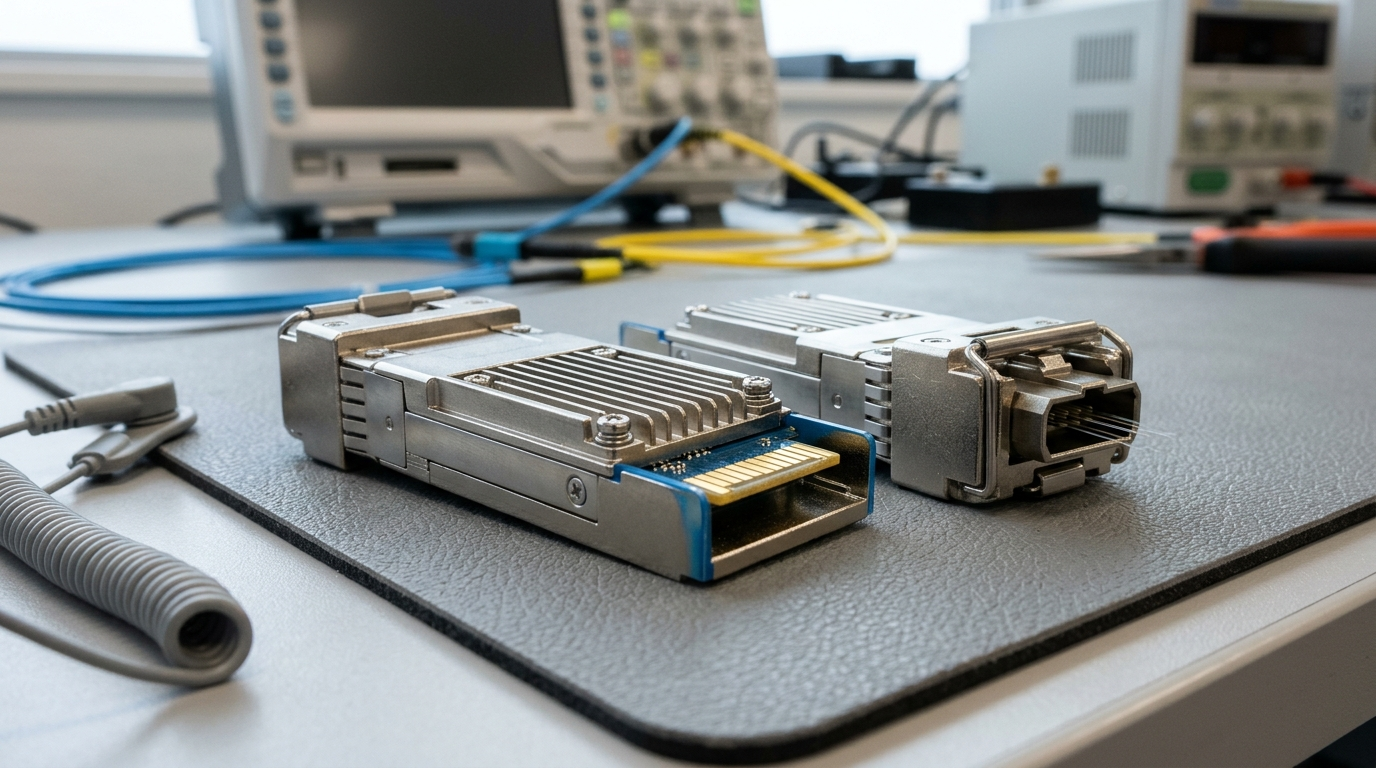
The primary concern raised by enterprise lobbyists is the severe concentration of global optical manufacturing. According to market data from TrendForce, Chinese optical module manufacturers represent approximately 56% of global contract manufacturing capacity in 2026. Top export suppliers, including Innolight, Eoptolink, and Cambridge Industries Group (CIG), account for roughly 46% of worldwide capacity, providing the bulk of 400G and 800G modules currently being installed in American data center expansions.
| Supplier Tier / Region | Key Manufacturers | Global Production Share | Strategic Supply Chain Constraints |
|---|---|---|---|
| Chinese Export Leaders | Innolight, Eoptolink, Cambridge Industries Group | ~56% total contract manufacturing (~46% top export share) | Primary source of volume manufacturing for 400G and 800G pluggables; high assembly scale. |
| United States Domestic | Coherent, Lumentum | Significant intellectual property, limited packaging volume | Possess advanced optical component R&D, but lack fabrication capacity to absorb sudden 50%+ supply deficit. |
| Next-Gen (3.2 Tbps) | Global merchant silicon & optical ecosystem | Sampling and early pilot phase | Volume commercial deployment not expected until 2028-2029; domestic fab ramp required. |
Unlike previous bans on telecommunications equipment where established European and Asian competitors could absorb equipment orders, only two major United States companies—Coherent and Lumentum—manufacture comparable optical modules for enterprise data centers. While both firms maintain advanced component engineering, market reports from TradingView indicate that domestic vendors currently lack the fab capacity and packaging infrastructure necessary to absorb an immediate embargo of Chinese hardware. Abruptly disqualifying over half of global supply would trigger severe procurement backlogs across enterprise and cloud sectors.
What happens next
To avoid a catastrophic supply squeeze, administration officials are weighing a targeted policy compromise. Under this alternative framework, the FCC would restrict imports solely on next-generation optical transceivers capable of speeds up to 3.2 terabits per second (3.2 Tbps), while permitting ongoing imports of existing 400G and 800G modules, as detailed by MLQ.ai. Because 3.2 Tbps transceivers are not expected to scale production until 2028 or see widespread data center installation until 2029, this phase-in would provide domestic producers like Coherent and Lumentum several years to expand local fabrication, packaging lines, and substrate procurement.
For cloud architecture and network engineering teams, the regulatory debate introduces immediate planning requirements:
- Inventory audit: Procurement teams must quantify current lead times and inventory buffers for 400G and 800G OSFP and QSFP-DD optics across primary and secondary suppliers.
- Assembly diversification: Platform leaders should monitor vendor qualification for transceivers packaged in alternative regions, including Southeast Asian facilities outside of mainland China.
- Regulatory tracking: Network architects must track formal FCC rulemaking dockets to evaluate whether draft text includes optical sub-assemblies, near-packaged optics, or co-packaged switch silicon.
While the administration deliberates the final scope of the restrictions, hyperscale operators are expected to continue lobbying federal agencies to ensure that national security directives do not outpace the domestic industrial base required to sustain them.
Sources
- Microsoft lobbies against potential ban on Chinese optical networking gear for AI data centers as FCC mulls restricting imports — industry group says move could grind data center rollout to a halt | Tom’s Hardware
- Microsoft presses Trump to scuttle ban on Chinese data center tech – BusinessWorld Online
- China Accounts for 56% of Global Optical Module Manufacturing; Short-Term Supply Chain Decoupling Unlikely Under Potential U.S. Restrictions, Says TrendForce
- Microsoft presses Trump to scuttle ban on Chinese data center tech – The Japan Times
- Microsoft Warns a New Trade Crackdown Could Derail America’s AI Boom — TradingView News
- Microsoft is pressing the Trump administration to drop an expected ban on Chinese optical transceivers for data centers, Reuters reports | MLQ.ai
- FCC proposes import ban on Chinese optical transceivers — blockade targets key AI interconnects as China holds 56% global market share | Tom’s Hardware