Key takeaways
-
- Broadcom announced two open-source initiatives at KubeCon: contributing the declarative VM API project to the CNCF Sandbox and co-chairing a new Kubernetes Workload Conformance Working Group.
- Kubernetes is transitioning from a maturing container orchestrator into an enterprise agent substrate designed to host and manage autonomous AI systems.
- Autonomous agent execution revives network perimeter defense and micro-VM compute isolation to mitigate risks from rogue or compromised AI processes.
- Upstream workload conformance establishes standard runtime expectations to eliminate repetitive, distribution-specific validation across multi-cloud environments.
Kubernetes is expanding beyond its traditional role as a container orchestrator to become the enterprise Kubernetes agent substrate for orchestrating autonomous artificial intelligence workloads. At KubeCon + CloudNativeCon North America, Broadcom announced two major open-source initiatives designed to bolster this foundation: donating its declarative VM API project to the Cloud Native Computing Foundation (CNCF) Sandbox and co-chairing a newly established Kubernetes Workload Conformance Working Group. According to Dilpreet Bindra, senior director of engineering in Broadcom’s VMware Cloud Foundation (VCF) division, running autonomous AI agents requires rethinking infrastructure isolation and portability. Infrastructure providers are now introducing micro-virtual machine compute boundaries and perimeter security controls to safely isolate agent runtimes across hybrid and multi-cloud environments.
Open-source initiatives anchor Kubernetes for AI
For several years, Kubernetes had settled into a period of stabilization and maturity. Many infrastructure engineering teams viewed the core orchestrator as an established foundation focused on operational hardening and incremental maintenance. However, the rapid emergence of enterprise AI agents has disrupted that quiet phase, driving new operational demands into cloud-native environments.
Speaking in an interview on SiliconANGLE’s theCUBE broadcast at KubeCon, Dilpreet Bindra noted that the conference marked a distinct turning point. While some observers previously assumed Kubernetes was leveling off, Bindra emphasized that artificial intelligence has re-energized the ecosystem, transforming the platform into the primary execution substrate for autonomous agents.
To support that role, Broadcom announced two open-source contributions aimed at reducing infrastructure friction and standardizing runtime behavior. The first contribution is the VM API project, which has been formally accepted into the CNCF Sandbox. Built upon VMware’s established VM Operator technology, VM API introduces a provider-neutral Kubernetes API modeled on Cluster API (CAPI). It allows platform engineers to manage virtual machines using declarative Kubernetes manifests and Custom Resource Definitions (CRDs). The second initiative is Broadcom’s co-chairing of the new Workload Conformance Working Group under the Kubernetes project.
| Initiative | Governing Body | Scope and Focus | Primary Operational Benefit |
|---|---|---|---|
| VM API | Cloud Native Computing Foundation (Sandbox) | Declarative virtual machine lifecycle management | Enables platform teams to provision and orchestrate VMs via Kubernetes Custom Resource Definitions alongside containers. |
| Workload Conformance Working Group | Kubernetes SIG Architecture and SIG Apps | Runtime workload behavioral standards | Eliminates redundant distribution-specific validations by creating a vendor-neutral benchmark for application behavior. |
Securing the agent substrate with defense in depth

Autonomous AI agents present fundamentally different runtime profiles compared to conventional microservices. Traditional cloud-native workloads generally follow predictable stateless patterns, receiving requests, processing data, and emitting responses. By contrast, autonomous agents maintain state, carry working memory, dynamically generate code, and query external data sources or tools to complete complex tasks.
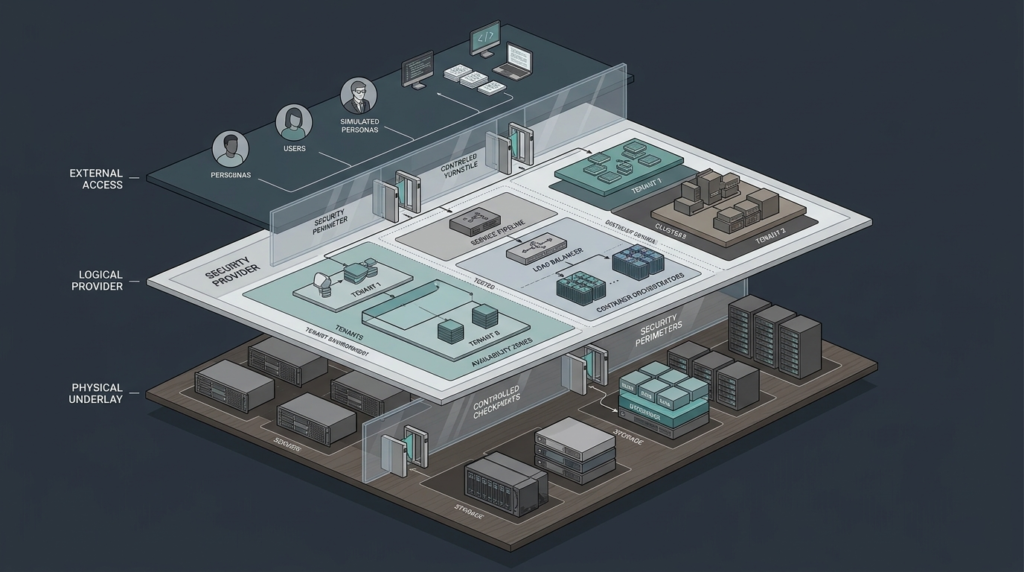
These dynamic behaviors introduce security risks that challenge standard container runtime assumptions. If an autonomous agent encounters malicious prompt injections or begins executing aberrant workflows, shared-kernel container boundaries may fail to provide adequate containment. As Bindra explained, agentic workloads are reviving security practices that the cloud era previously downplayed, particularly network perimeter controls and layered defense in depth.
To prevent rogue agents from compromising neighboring workloads, infrastructure architectures are pairing compute isolation with active network controls:
- Hardware-isolated compute boundaries: Workloads run inside dedicated micro-virtual machines, such as vSphere Pods, preventing compromised processes from exploiting the shared kernel of a host operating system.
- Perimeter and internal micro-segmentation: Stateful firewalls such as VMware vDefend operate at the hypervisor layer, establishing network boundaries that can immediately sever connectivity when an agent deviates from authorized behavior.
- Unified identity tracking: Network filtering policies follow workload identities rather than transient pod IP addresses, maintaining visibility as agent instances scale.
Standardizing workload conformance across clouds
Multi-cloud portability represents the other critical obstacle facing enterprise AI adoption. While existing Kubernetes conformance tooling verifies that underlying cluster infrastructure conforms to standard APIs, no vendor-neutral mechanism has verified how applications behave when executing on those clusters.
Historically, independent software vendors (ISVs) and internal enterprise platform teams have had to run separate, manual validation suites for each target environment. Deploying workloads across VMware vSphere Kubernetes Service (VKS), managed cloud Kubernetes distributions, and on-premises bare-metal setups required testing how individual applications responded to node drains, API deprecations, storage mounts, and resource quotas. This fragmentation slowed release cycles and increased infrastructure overhead.
The newly formed Workload Conformance Working Group, co-chaired by Broadcom under Kubernetes SIG Architecture and SIG Apps, seeks to establish an objective upstream specification for runtime workload behavior. This work directly aligns with broader ecosystem efforts to standardize modern environments, including the Kubernetes AI Conformance subproject and Google’s collaborative work on an open AI-native Kubernetes stack. Bindra noted that establishing consistent behavioral standards ensures that software developers validate their applications once against upstream Kubernetes rather than maintaining separate certification matrices for each commercial distribution.
What happens next
The acceptance of VM API into the CNCF Sandbox marks the beginning of broader community engagement, with contributors expected to develop hypervisor drivers beyond vSphere. Platform engineering teams should monitor the repository as provider implementations expand to evaluate unified VM and container management within their existing CI/CD pipelines.
Concurrently, the Workload Conformance Working Group will draft behavioral guidelines and automated testing tools for upcoming Kubernetes minor versions. Enterprise platform architects should participate in the working group’s community meetings to ensure that common enterprise resilience requirements, such as grace periods during rolling maintenance and automated eviction policies, are represented in the core specifications.
For organizations deploying autonomous AI agents, platform teams should begin auditing runtime isolation policies. Comparing bare container runtimes against hardware-isolated micro-VM pods and evaluating automated network kill switches will be crucial steps as AI agents assume greater autonomy in production environments.