
Key takeaways
- Recoverflow utilizes a 9-agent team across 3 strict architectural layers to manage receivables.
- The “weak doers, strong guardians” paradigm prevents critical LLM hallucinations and compliance breaches.
- Target focus is the $3K-$40K cross-border B2B receivables middle-market gap.
- Hardcoded safety protocols automatically halt operations for 988 welfare signals and bankruptcy mentions.
- The system was designed in just 6 days during the lablab.ai “Band of Agents” Hackathon.
The enterprise financial sector has long struggled with the middle-market gap in accounts receivable. Traditional collections agencies operate on rigid Standard Operating Procedures (SOPs) that often fracture crucial client relationships, while cross-border litigation for invoices under $40,000 remains mathematically unviable for specialized legal teams. Enter Recoverflow, a revolutionary project born out of the lablab.ai “Band of Agents” Hackathon. In a staggering design and development journey documented by Judy AI Lab, engineers constructed an intricate multi-agent framework designed specifically to put Autonomous B2B Collections on autopilot. By replacing brute-force algorithms with a highly choreographed 9-agent team coordinating across multiple platforms—including Slack, Voice, and USDC settlement—Recoverflow establishes a completely new paradigm for managing cross-border B2B receivables.
The central ethos of this system shifts the metric of success entirely away from pure monetary recovery toward long-term relationship preservation. In the sensitive world of corporate finance, an AI hallucination or an emotionally deaf automated response can permanently destroy a vendor-client bond. To combat this, the architecture prioritizes strict regulatory compliance and human-in-the-loop safeguards over unchecked automation. By meticulously defining what the system must not do—such as never hallucinating bank account details and strictly avoiding welfare-sensitive conversational triggers—Recoverflow presents an authoritative blueprint for how artificial intelligence can safely navigate the complex, high-stakes environment of corporate debt recovery.
The Architectural Reality

Most contemporary generative AI deployments rely heavily on the “super-agent” paradigm: developers write a monolithic, encyclopedic prompt and trust a single large language model (LLM) to navigate a multitude of tasks without faltering. Recoverflow intentionally abandons this approach in favor of a “weak doers, strong guardians” philosophy. In the collections industry, a single hallucination—whether an unintended violation of the Fair Debt Collection Practices Act (FDCPA) or a fabricated SWIFT code—represents an unacceptable catastrophic failure that opens the firm to massive liability. Thus, Recoverflow splits its computational workload across a 9-agent team organized into three distinct, highly specialized layers to ensure maximum operational safety.
Layer 1: Gatekeepers
At the tip of the spear is a single agent known as Pre-flight. Utilizing efficient models like Gemini 2.5 Flash-Lite, this agent is exclusively responsible for parsing inbound contracts and original invoices. Its singular mission is to extract critical clauses related to governing state or international law, arbitration requirements, late fee percentages, and prior deposit records. Based on these parameters and the calculated outstanding balance, Pre-flight routes the entire case down one of three distinct paths: the ‘Lite’ path for balances under $3,000 (where the system limits itself to minimal friendly reminders), the ‘In-Spot’ path for the $3,000 to $40,000 sweet spot, and the ‘Attorney-Recommended’ path for balances exceeding $40,000, which are routed directly to vetted human attorneys. Pre-flight’s absolute accuracy is non-negotiable, as an error here cascades throughout the entire Agentic AI pipeline.
Layer 2: Doers
The second layer consists of five specialized agents: Investigator, Diplomat, Voice, Payment, and Escalator. These entities perform the ordinary, repetitive heavy lifting of the operation. The Investigator, powered by Featherless’s Qwen model, analyzes up to six months of customer behavioral patterns and CRM records to tag debtors as reliable payers, slow payers, or historically hostile. The Diplomat drafts the ongoing email communications with varying degrees of urgency. The Voice agent, utilizing ElevenLabs conversational AI bridged with Twilio APIs, conducts live outbound calls. The Escalator leverages powerful models like Llama 70B to draft formal demand letters if initial negotiations completely stall. Crucially, these “Doer” agents are functionally castrated; they cannot execute independent outbound actions and merely generate drafts while queuing them for rigorous inspection.
Layer 3: Guardians
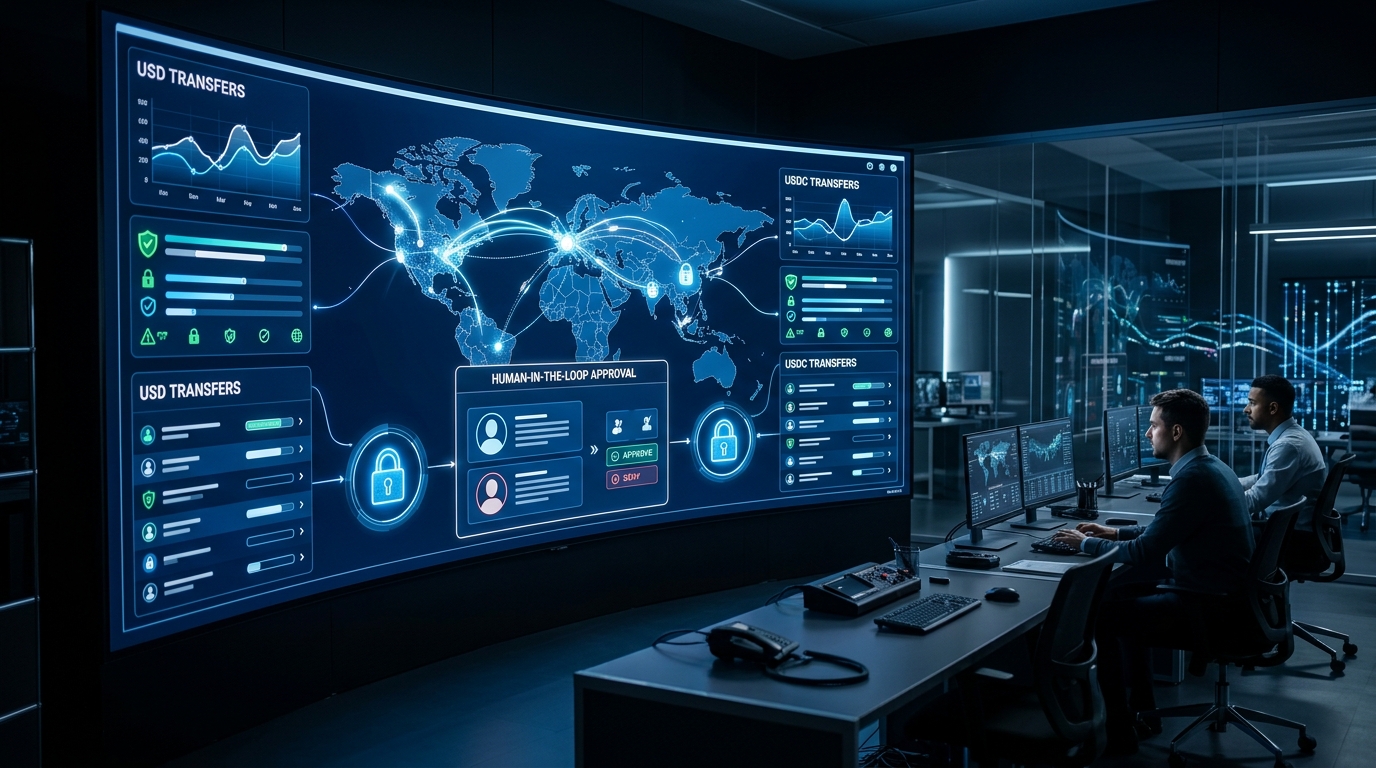
The final layer serves as the system’s immune response and legal firewall, consisting of the Concierge, Tone Coach, and the AAA Specialist. The Concierge acts as the single outbound choke point for the entire architecture. No email or phone call ever occurs unless a human operator explicitly presses “APPROVE” within a localized Slack integration. The Tone Coach, driven by the blazing-fast Claude Haiku, aggressively scans Diplomat and Voice drafts in real-time, blocking any sentence that strays into FDCPA-violating territory or adopts an overly aggressive posture. If a case ages past 65 days without resolution, the Band Platform dynamically injects the AAA Specialist—using Claude Sonnet—into the workflow via `tools.lookup_peers` and `tools.add_participant`. This agent polishes the legal wording before any final action is recommended. If a Doer makes a mistake, the Guardians catch it. If the Guardians are uncertain, the entire system immediately halts and flags a human operator.
Market Impact & Deployment
The traditional cross-border collections industry often misallocates immense resources by viewing cases exclusively through the lens of the “Gross Invoice.” Recoverflow fundamentally redesigns this approach by adopting a strict “outstanding-not-gross” perspective, a protocol identified internally as D-038. For instance, a US-based lawyer looking at a $47,000 gross invoice might immediately dismiss it, knowing that standard cross-border litigation costs could easily exceed $30,000. However, if the customer has already paid a 50% upfront deposit, the actual outstanding balance is $23,500. This smaller, mathematically precise figure falls squarely within Recoverflow’s target middle-market gap, making it a prime candidate for automated, highly targeted Enterprise IT recovery strategies. By pinning the routing logic exclusively to the outstanding balance, the system effectively captures massive market share that traditional legal agencies routinely ignore.
Furthermore, Recoverflow completely isolates the LLM from actual banking infrastructure to eliminate hallucination risks. The AI is strictly prohibited from writing, generating, or transmitting bank account numbers (protocol D-019). Instead, all outbound communications include a hard-coded paylink that directs the debtor to a secure Next.js checkout page. This checkout page integrates directly with the company’s internal `payment_methods.json`, pulling in verified SWIFT codes, Stripe links, and USDC wallet information. The integration of stablecoins is a particularly forward-thinking design choice; when a customer selects USDC, the funds are transferred directly to Recoverflow’s Circle ARC wallet. A receipt poller scans the blockchain every 10 seconds, and upon detecting the transaction, automatically triggers the Payment agent for real-time reconciliation against the outstanding balance.
The Technical Integration & Workflows
To fully grasp the sheer sophistication of Recoverflow’s agentic orchestration, one must deeply observe its 12-step end-to-end operational pipeline. The workflow initiates the moment a human operator uploads a contract PDF into the system interface. The Pre-flight agent immediately ingests the document, pulling out the governing jurisdiction (whether Texas, California, or New York), late penalty clauses, and deposit requirements. Once the corresponding invoice is uploaded, the system mathematically marries the two documents, locking in the precise due date and computing the exact outstanding balance, logging all state changes natively.
What follows is a masterclass in autonomous Networking orchestration. The system automatically populates a localized internal calendar, scheduling a friendly Day -7 pre-notice, a Day 7 reminder, a firmer Day 30 notice, a Day 55 Voice call, and a Day 65 legal escalation. Because the scheduling is driven entirely by backend cron triggers, human operators are completely relieved of manual calendar management. As the due date approaches, the Diplomat agent drafts the corresponding emails, which the Tone Coach painstakingly audits for legal compliance. The communication is then pushed to a Slack channel where the human operator simply clicks “APPROVE” to securely dispatch it via the Resend API, logging the event in an append-only `audit_trail.jsonl` database that eventually exceeds 21,000 rows.
If the operational sequence reaches Day 55 without financial resolution, the Voice agent initiates a Twilio-backed phone call. It intelligently checks the customer’s local timezone to ensure absolute compliance with Telephone Consumer Protection Act (TCPA) dialing windows (strictly adhering to Tuesday, Wednesday, or Thursday between 10-11 AM or 2-3 PM), explicitly avoiding any US federal holidays. The live conversation is fully dynamic: if the customer commits to paying on a specific date, the agent schedules a sub-cycle tracking event. If the customer becomes hostile, the call is gracefully concluded, and the Concierge instantly pages human counsel.
The Consumer Translation
While the backend architectural engineering is fiercely technical, the system’s true market viability and success lie in its real-world, consumer-facing behavioral protocols. The designers recognized early in the 6-day sprint that “ideal scenarios always lose to real scenarios.” Through rigorous iteration and analyzing 26 potential edge cases, Recoverflow was specifically trained to handle four critical “hidden cases” that typically break naive AI conversational agents.
First, it seamlessly manages “Partial Payments” (protocol D-028). If a struggling buyer pays half and promises the rest the following month, the system does not short-circuit or erroneously close the file. Instead, it resets the outreach cadence for the remaining balance, granting the customer vital breathing room without surrendering the claim. Second, if a “Customer Yells at AI,” the system is hard-coded to never respond emotionally. The Tone Coach blocks any retaliatory response, the ConvAI logs the hostility pattern, and the system immediately escalates to a human, preserving the brand’s professionalism. Third, in the devastating event of a “Welfare Signal”—such as a customer mentioning depression, self-harm, or explicitly referencing 988—the system triggers an absolute anomaly halt. The case is frozen instantly before the Concierge is even paged, prioritizing human life over debt collection. Finally, if a customer explicitly mentions “Bankruptcy” (e.g., filing Chapter 11), the agent gently confirms the legal status, triggers immediate claim-filing deadlines, and pulls human counsel into the loop. These are not mere LLM prompt suggestions; they are ironclad, unbreakable codebase rules designed to protect both the business integrity and the vulnerable human being on the other end of the phone line.
Frequently Asked Questions
Q1: What is the primary purpose of the Recoverflow system?
A1: Recoverflow is designed as an autonomous solution for cross-border accounts receivable on autopilot, directly targeting the middle-market gap of balances between $3,000 and $40,000.
Q2: What is the “weak doers, strong guardians” architecture?
A2: It is a multi-agent paradigm where specialist agents (“doers”) draft communications while separate, highly restricted agents (“guardians”) review and approve them to prevent FDCPA violations and hallucinations.
Q3: How does the system handle financial transactions securely?
A3: Recoverflow never allows the LLM to write bank account numbers. Instead, it uses hard-coded paylinks directing customers to a checkout page that supports USDC wallet transfers and Circle ARC wallet reconciliation.
Q4: What happens if a customer exhibits signs of extreme financial distress?
A4: If a customer mentions a welfare signal like 988 or bankruptcy, the system’s strict unit tests immediately freeze the case and halt automated communication prior to human intervention.
TechNode HQ Verdict: Pros, Cons & Usability
- Pro (Engineering): The rigid architectural separation of “Doer” and “Guardian” agents effectively neutralizes the severe risk of LLM hallucinations during highly sensitive corporate financial negotiations.
- Pro (Consumer): The empathetic, hardcoded handling of real-world edge cases—like partial payments, emotional distress, and 988 welfare signals—ensures that automated collection efforts do not destroy long-term business relationships.
- Con: The system architecture requires substantial API overhead, seamlessly integrating Band, Anthropic, ElevenLabs, Featherless, and Twilio, which may introduce latency and external points of failure during mass deployment.
- Con: Enterprise deployment remains highly complex, demanding customized state-level legal frameworks and dynamic prompt adjustments to safely navigate the varying nuances of cross-border financial law.
Enterprise Usability: For CFOs, finance directors, and accounting firms managing a high volume of $3K-$40K cross-border invoices, Recoverflow represents a sheer masterclass in risk-mitigated AI automation. By keeping humans squarely in the final approval loop via Slack while completely automating the laborious investigative, drafting, and scheduling phases, enterprise IT teams can deploy this architecture to drastically lower the Total Cost of Ownership without exposing the overarching organization to crippling FDCPA legal liabilities.
Everyday Usability: While small business owners and freelancers will not interact directly with the backend multi-agent architecture, the resulting service output is highly recommended. The system’s innate programmatic ability to handle delicate, stressful financial disputes with absolute emotional detachment and algorithmic precision protects the vendor-client relationship far better than traditional, heavy-handed debt collection agencies.