
Key takeaways
- Agentic AI served as the primary engineer, writing the core Godot engine architecture from scratch.
- The game’s multi-pass 2D raycasting engine acts as a programmable optical computer simulation.
- A procedural BFS Backwards Solver guarantees puzzle layouts are mathematically solvable before deployment.
- The dynamic “Solstice Toggle” mechanic fundamentally shifts light sources between day and night cycles.
- Narrative progression relies on conversational Turing Tests to determine if decrypted entities are human or AI.
The Architectural Reality of Agentic AI
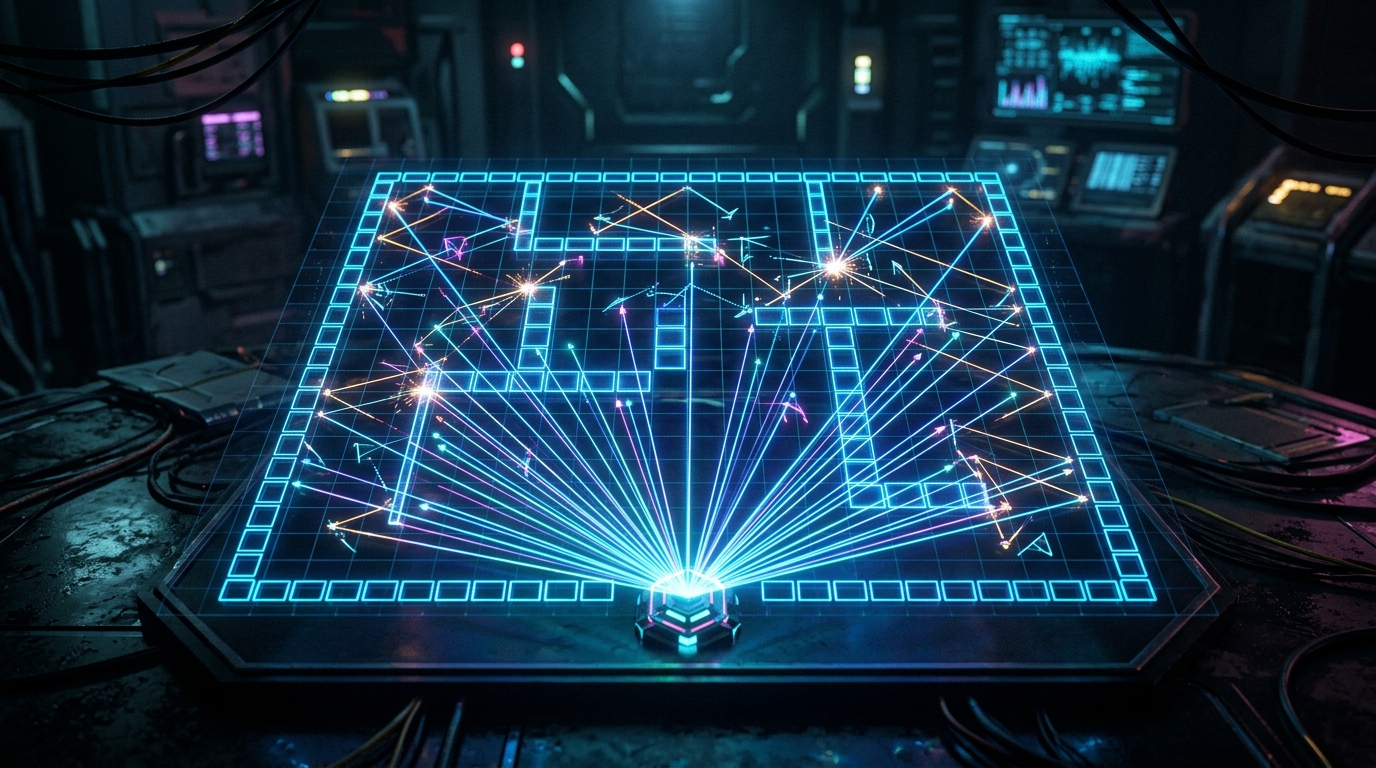
The role of the developer is undergoing a seismic shift. In a remarkable demonstration of this evolution, the browser-based puzzle and narrative game Solstice Cipher: Routing Light to Crack Codes was created for the June Solstice Game Jam 2026 without its human creator writing a single line of GDScript by hand. Instead, the heavy lifting was outsourced to Google Antigravity—a powerful Agentic AI acting as the lead programmer and Godot 4.6 engine specialist. The game’s mechanics rely on an intricate multi-pass 2D raycasting system built on Godot’s PhysicsDirectSpaceState2D. Every time a player moves an optical tool—such as a mirror, prism splitter, or RGB color filter—the engine recalculates the entire light path from scratch. This architecture acts as a deterministic logic circuit, snapping optical tools to 15-degree increments to transform freeform placement into rigid puzzle constraints.
The raycasting system utilizes a propagation queue that resolves in up to ten passes, accommodating combiners that must accumulate inputs from separate beam branches before emitting a blended output. This transforms the puzzle board into a programmable optical computer, deeply inspired by the history of Alan Turing and Bletchley Park. To ensure that procedurally generated puzzles are always mathematically viable, the Agentic AI co-developed a BackwardsSolver. Utilizing a Breadth-First Search (BFS) pathfinding algorithm on the grid, it maps valid routes from the light source to each glyph and enforces strict tool budget constraints before the layout is finalized.
Market Impact & Deployment
Translating this technical milestone into an Enterprise IT context reveals massive implications for Total Cost of Ownership (TCO) and developer bandwidth. By leveraging an autonomous coding agent to construct complex state machines and validation algorithms, the human creator effectively operated as a Game Director, focusing purely on architecture constraints, code review, and high-level design. This paradigm shift drastically reduces developer hours, lowering the barrier to entry for robust system development and accelerating time-to-market for complex software projects.
Beyond indie game development, the underlying logic routing and procedural validation models have vast cross-industry applications. In EdTech, similar optical constraint mechanics can be utilized as gamified cryptographic teaching tools. In logistics, the node-based routing visualization provides an intuitive framework for supply chain management. Furthermore, the game’s integration of a “Solstice Toggle” mechanic—which allows players to dynamically shift the environment between day and night cycles—proves that AI-driven development can seamlessly handle dynamic state changes and real-time environment updates without compromising performance.
The Consumer Translation
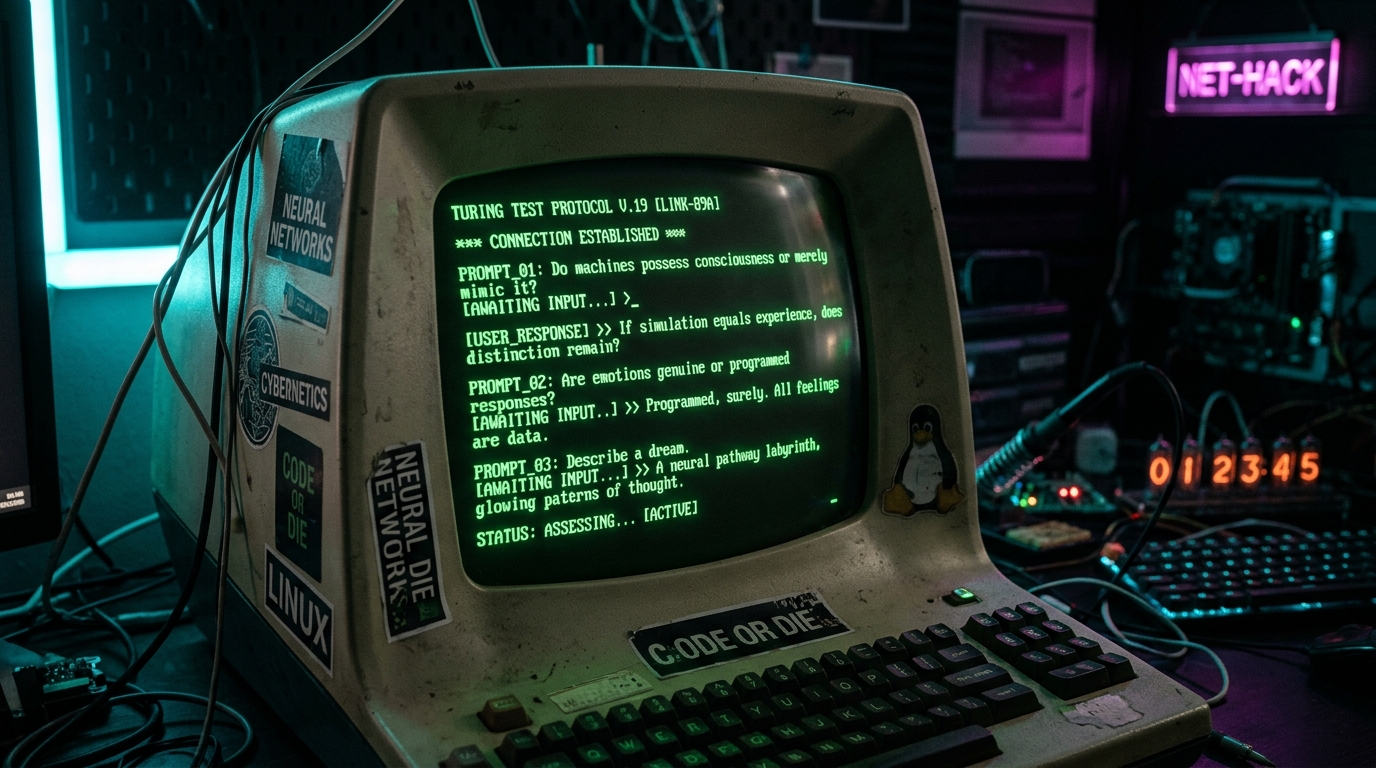
For the everyday user, this highly technical back-end translates into a deeply polished, intellectually stimulating experience. As players calibrate the light beams and complete the optical circuits, they decrypt hidden digital messages or fragments of digital consciousness. The decrypted content is then explored through a vintage-style computer terminal interface. Here, the game transcends spatial logic and enters the realm of interactive narrative, as players engage in conversational Turing Tests to determine whether the entity they are communicating with is a simulated AI or a reconstructed human consciousness.
Think of the game’s raycasting network like a global supply chain logistics network. The light emitter is a factory producing raw materials, and the mirrors and prisms act as distribution hubs directing packages across the map. The color filters and combiners are specialized processing centers that only accept specific materials. If the logistics routing is flawed, the end consumer—the cipher glyph—remains dark, and the circuit fails. This intuitive design, coupled with a seamless contextual UI tutorial that teaches mechanics naturally without breaking flow, ensures that complex Consumer Tech is accessible and highly engaging.
Frequently Asked Questions
Q1: What is Solstice Cipher?
A1: Solstice Cipher is a browser-based optical puzzle and narrative game created for the June Solstice Game Jam 2026. Players route light beams to decrypt hidden digital messages.
Q2: How was the game’s core architecture developed?
A2: The creator used Google Antigravity as an autonomous lead programmer to write the entire Godot 4.6 codebase, including a multi-pass raycasting engine and a procedural validation solver.
Q3: How does the “Solstice Toggle” mechanic work?
A3: The Solstice Toggle allows players to dynamically shift the game between day and night cycles, which updates the light sources and alters the puzzle challenges in real-time.
Q4: What is the narrative significance of the puzzles?
A4: Successfully routing the light decrypts digital consciousness. Players then participate in conversational Turing Tests via a vintage terminal interface to assess the entity’s nature.
TechNode HQ Verdict: Pros, Cons & Usability
- Pro (Engineering): The BFS Backwards Solver mathematically guarantees level solvability, eliminating the need for manual trial-and-error playtesting.
- Pro (Consumer): Blends challenging spatial logic puzzles with a compelling, Turing-inspired conversational narrative interface.
- Con: A multi-pass raycasting engine calculating up to 10 propagation passes on every DOM/state change could introduce performance bottlenecks on lower-end WebGL devices.
- Con: Relying entirely on an AI agent for foundational engine architecture requires aggressive code review to prevent technical debt scaling.
Enterprise Usability: CTOs and engineering directors should view this as a blueprint for Agentic AI integration. By assigning autonomous agents to handle procedural generation algorithms and unified polymorphic interfaces, human developers can pivot to high-level system orchestration.
Everyday Usability: Highly recommended for puzzle enthusiasts and coding aficionados. The game runs natively in the browser with zero downloads, making it an immediately accessible demonstration of modern web game capabilities.