Key takeaways
- Modern generative voice architectures such as Fish Audio Drama 3 synthesize full multi-character scenes in a single request, eliminating manual multi-track stitching.
- Edge-based script parsers use regular expressions combined with a five-word length heuristic to separate dialogue from descriptive prose while assigning speakerless lines to a default Narrator.
- User input must be sanitized against internal control delimiters like speaker tags to prevent unauthorized voice reassignment and index corruption.
- Omitting the model header when querying the Fish Audio API silently routes traffic to an alternate fallback model rather than raising an HTTP error.
- Enforcing constant bitrate audio output (128 kbps CBR) enables accurate duration calculation and credit settlement directly from raw byte lengths without running an audio decoder.
Parsing screenplay scripts for multi-speaker text-to-speech (TTS) APIs allows developers to generate complete multi-voice audio scenes in a single inference request. Modern neural voice systems like Fish Audio Drama 3 synthesize dialogue for up to 16 distinct characters alongside inline acting directions, replacing multi-track audio stitching workflows. By deploying parsing logic to serverless edge platforms like Cloudflare Workers, teams can transform human-written scripts into structured speaker payloads while neutralizing control tag injection attacks, automating voice casting, and managing audio streaming constraints.
The shift to unified multi-speaker voice synthesis
Traditional text-to-speech architectures process a single voice per payload. Generating an episodic dialogue or dramatic scene previously required engineering pipelines that split text into individual character turns, made sequential API calls across distinct synthetic voices, and aligned the resulting audio buffers in an external digital audio workstation or server-side media processing job. This multi-pass approach introduced latency, accumulated compounding silence gaps, and lacked contextual emotional interplay between speaking characters.
Recent generative models handle conversational scenes as a unified generation task. In models such as Fish Audio Drama 3, speech generation considers preceding dialogue turns and acts upon inline performance cues such as emotional delivery tags, variable pacing, and textual emphasis. Implementing an application on top of this capability shifts the primary engineering burden away from audio assembly and onto input normalization, strict edge security, and payload orchestration.
A lightweight edge architecture built on Cloudflare Workers, D1 database storage, and R2 object storage demonstrates how these pipelines operate in production. Rather than deploying heavyweight orchestration servers, a single edge worker accepts plain text, extracts dialogue turns, validates structural constraints, coordinates with external inference endpoints, and writes the generated MP3 asset directly to object storage.
Script parsing mechanics and delimiter sanitization
Accepting free-form scripts from users introduces edge cases in text parsing. Standard screenplay conventions follow a readable pattern where lines specify a character name, optional acting instructions, and dialogue:
Narrator: [calm, low voice] The lighthouse had been dark for forty years.
Mara: [whispering] Did you see that? <emphasis>Someone</emphasis> is up there.
Jonas: [nervous laugh] It's the wind, Mara.
A deterministic parser evaluates each line against a structured regular expression that captures the speaker name and bracketed instructions preceding the colon delimiter. However, free-form prose frequently contains natural colons that do not represent character turns. For instance, descriptive sentences like “The plan she whispered was simple: run before dawn” must not register as an individual character named “The plan she whispered was simple”.
To prevent false character extraction, the parser enforces two structural boundaries:
- Character name length guard: The extracted character name cannot contain angle brackets, colons, or pipes, and must contain five words or fewer.
- Narrator fallback: Any line lacking an explicit speaker name defaults automatically to a Narrator role instead of throwing a validation failure. This ensures that stage directions, descriptive paragraphs, and narrative bridges remain intact.
- Standalone performance beats: Lines composed solely of delivery cues, such as
[long silence], are preserved as independent turns to maintain dramatic timing.
Security validation is equally critical when mapping user text to model inputs. Multi-speaker inference protocols designate character transitions using internal delimiter tokens, such as <|speaker:0|>, corresponding to positional voice identifiers in a reference array. If an application concatenates raw user text into the prompt payload, malicious or accidental input containing control tokens could alter speaker assignments mid-sentence or reference unassigned indices.
To neutralize delimiter injection, the edge worker applies an input sanitization pass that strips any pattern matching internal control markers (/<\|[^>]*\|>/g) prior to payload construction. Legitimate performance tags like square brackets and emphasis tags remain untouched, ensuring user control over acting style without exposing the model’s delimiter structure.
Deterministic voice allocation and API header governance
An API request to multi-speaker synthesis models requires a positional array of speaker identifiers matching the order of character appearance. When users do not manually configure every character’s voice, the edge worker executes a round-robin assignment against a vetted catalog of curated stock voices. This auto-casting routine reserves a dedicated narrator voice, respects explicitly chosen character mappings, and allocates unused voices sequentially, preventing duplicate voice profiles until the pool is exhausted.
Interfacing with third-party generative voice APIs requires strict header discipline. During integration with the Fish Audio API, platform engineers discovered that omitting or misspelling the model header does not trigger an HTTP 4xx validation error. Instead, the inference service quietly falls back to an alternate baseline model. This silent degradation can result in passing test suites while generating degraded, single-voice audio. Engineering teams must pin the model header explicitly and monitor incoming responses for anomalies.
| Pipeline Stage | Operational Challenge | Engineering Mitigation |
|---|---|---|
| Script Ingestion | Prose colons mistaken for character names | Enforce 5-word boundary on speaker names; fallback to Narrator |
| Tag Sanitization | Prompt injection using delimiter tokens | Regex strip of control tokens; preserve bracketed acting cues |
| Voice Assignment | Duplicate voices in multi-character scenes | Round-robin allocation across vetted stock voice IDs |
| Model Dispatch | Silent fallback on missing model headers | Pin model header in fetch calls; reject responses under 1 KB |
| Audio Egress | Mobile Safari playback failure | Implement HTTP 206 Partial Content byte-range handler |
Edge billing models and byte-range streaming for mobile clients
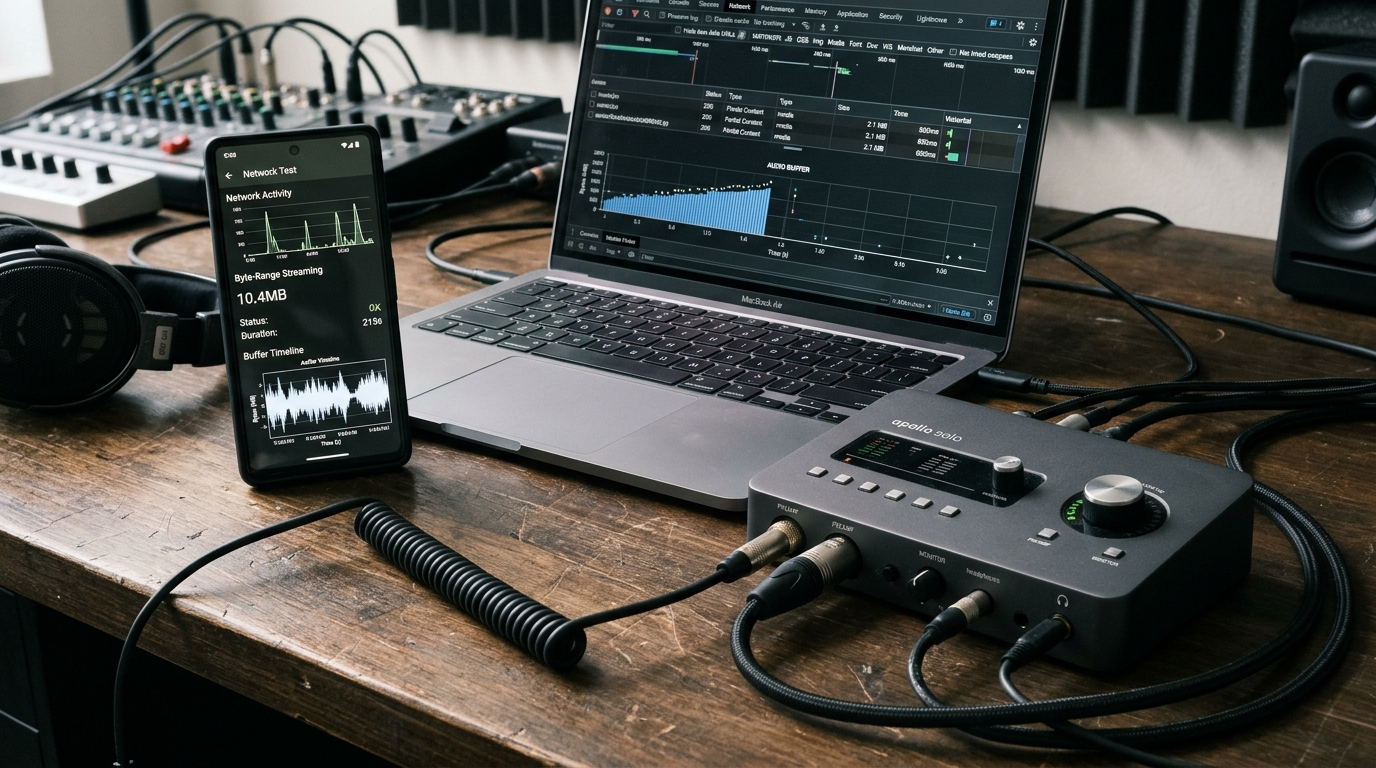
Accurate cost estimation for generative audio workloads requires tracking both character volume and synthesized duration. Many TTS platforms charge per input character, but scripts containing detailed stage directions consume significant token length while producing variable audio duration. Measuring input text via UTF-8 byte encoding (new TextEncoder().encode(text).length) provides an exact size benchmark that accounts for multibyte non-Latin characters.
When charging end users by audio second, calculating output duration usually demands native audio decoders that introduce heavy dependencies into serverless edge environments. This overhead can be bypassed by pinning the audio generation format to a constant bitrate, such as 128 kbps constant bitrate (CBR) MP3. At 128 kbps, audio consistently yields 16,000 bytes per second. An edge worker can calculate duration accurately by measuring byte length directly:
const seconds = Math.max(1, Math.ceil(audio.byteLength / 16000));Delivering generated audio files to end users reveals another operational obstacle: mobile media playback. While desktop browsers typically accept standard HTTP 200 responses when streaming media files, Safari on iOS requires HTTP 206 Partial Content responses to HTTP Range requests (bytes=start-end) before initializing HTML5 <audio> elements.
Standard static asset handlers on serverless edge networks often return full HTTP 200 responses to Range requests. According to Cloudflare Cache documentation, the edge cache supports and slices cached 206 responses, but origin endpoints and custom worker routes must explicitly parse incoming Range headers, calculate valid byte slices, and return HTTP 206 with matching Content-Range and Content-Length headers to maintain mobile compatibility.
Architectural trade-offs of synchronous edge generation
Executing multi-speaker synthesis entirely within a synchronous edge request simplifies system design by avoiding message queues, polling loops, and complex job state machines. In this architecture, a single HTTP call from the browser triggers script validation, credit reservation, the remote model API invocation, R2 storage writing, and final database settlement.
However, synchronous execution introduces operational constraints:
- Connection timeouts: Long screenplay inputs risk exceeding edge worker execution windows or client-side socket timeouts if inference latency spikes. Enforcing a strict 6,000-character input ceiling prevents long-running requests.
- Client disconnects: If a user navigates away mid-generation, an edge worker can be abruptly terminated. Implementing concurrency guards in the database prevents users from triggering overlapping generations while an existing request is pending.
- Observability boundaries: Because edge workers handle raw user content, error handling must redact input scripts and API credentials, logging only sanitized status codes to internal telemetry. For broader architectural observability across edge proxies, teams often reference practices detailed in Cloudflare Traces proxy telemetry to isolate edge latency.
For workloads expanding beyond individual scenes into multi-chapter audiobooks, transitioning to an asynchronous worker queue becomes necessary. But for single-scene generation, synchronous orchestration provides a resilient, zero-maintenance runtime when paired with strict input boundaries and defensive network checks.
Bottom line
Modern multi-speaker text-to-speech APIs streamline dialogue generation into a single request, but reliable deployment requires rigorous edge orchestration. Platform engineers must implement robust text normalization, sanitize internal control delimiters, pin critical API headers to prevent silent degradation, and support HTTP 206 byte-range responses for mobile clients. By combining serverless workers with constant bitrate duration math, teams can deliver performant voice applications that keep operational overhead and compute costs tightly controlled.