
Key takeaways
- Autonomous agents are emerging as the next evolution of internal developer platforms, replacing static catalog UIs like Backstage with conversational workflows.
- Effective platform semantic search depends on proper text chunking and continuous ingestion rather than vector database or embedding model choice.
- Real-time Kubernetes cluster state must never be embedded in vector stores; agents must query dynamic infrastructure live through dedicated tool APIs.
- Because LLM agent executions are non-deterministic, OpenTelemetry distributed tracing serves as the definitive audit trail for tool invocations and token costs.
Developer platform agents are replacing static service catalogs with autonomous conversational interfaces, executing infrastructure tasks by combining natural language developer requests with contextual engineering knowledge. While traditional internal developer platforms relied on rigid web portals to provision resources and display service ownership, modern developer platform agents dynamically retrieve context, select appropriate infrastructure tools, and execute workflows across cloud-native environments. However, because large language models introduce non-deterministic execution paths, deploying autonomous agents across production infrastructure requires strict operational guardrails, disciplined semantic chunking, and comprehensive distributed tracing to maintain security, govern resource expenditures, and preserve reliable developer self-service.
The evolution of platform engineering has consistently focused on reducing developer cognitive friction. Over the past decade, organizations invested heavily in developer portals such as Backstage to centralize documentation, catalog microservices, and provide templated scaffolding. While these portals improved visibility, they remained fundamentally passive: developers still had to navigate complex forms, locate configuration files, and manually translate documentation into infrastructure commands. As reported in InfoQ’s analysis of AI internal developer platforms, the rise of autonomous agents shifts developer platforms from passive directories into active execution engines.
While frontend teams increasingly utilize coding assistants to build applications—as explored in TechNode HQ’s analysis of building a Thor Commerce storefront with AI coding tools—applying agentic systems across platform engineering presents distinct operational challenges. A coding assistant operates in a bounded local workspace. Conversely, a developer platform agent navigates shared infrastructure, interprets ambiguous team practices, interacts with live Kubernetes clusters, and executes stateful operations across production systems.
The Transition From Static Portals to Conversational Agents
The core premise behind developer platform agents is transforming developer self-service from UI navigation into conversational intent resolution. In their presentation at KubeCon & CloudNativeCon Europe, platform technologists Whitney Lee and Viktor Farcic highlighted this transition as the next major platform paradigm. Rather than forcing engineers through manual dashboards, platform teams can deploy agents that interpret requirements, enrich them with repository context, and execute underlying infrastructure actions.
In this architecture, an agent coordinates between the engineer and cloud infrastructure through a four-stage execution loop:
- Input Interpretation: The agent parses the developer’s prompt to identify the target service, intended operation, and operational constraints.
- Context Retrieval: Using semantic search, the agent queries engineering repositories to retrieve relevant architecture decisions, manifests, and team policies.
- Model Reasoning: The enriched context and request are processed by an LLM, which evaluates tool schemas to plan an execution sequence.
- Tool Execution: The agent invokes approved platform APIs, executes CLI commands, or prompts human operators when high-privilege authorization is required.
This model bridges the gap between organizational policy and infrastructure execution. However, an agent is only as dependable as its retrieved context and operational guardrails. Without rigorous retrieval boundaries, agents quickly generate invalid manifests or trigger unauthorized mutations.
Structuring Semantic Search for Engineering Context
Semantic search provides the retrieval mechanism that grounds an agent in an organization’s specific technical ecosystem. However, engineering teams frequently misjudge what governs search accuracy. As Farcic explained, retrieval quality is rarely determined by the vector database or embedding model, both of which are commoditized. Instead, effectiveness depends on what sources are indexed, how text is chunked, and how metadata is maintained.
A primary pitfall is assuming official documentation represents the primary source of truth. In practice, centralized wikis are often outdated. High-fidelity operational context resides across distributed, unstructured communication channels:
- Git Repositories: Kubernetes manifests and infrastructure-as-code files reflect the actual desired state of running environments.
- Pull Request Discussions: Code reviews document the explicit engineering rationale behind architectural trade-offs.
- Chat Channels: Slack threads frequently capture operational context, such as why a particular database or design pattern was rejected.
- Issue Trackers: Jira tickets and incident retrospectives contain valuable troubleshooting heuristics and historical precedents.
Extracting accurate context from these sources requires disciplined chunking. Embedding a forty-page architecture guide as a single vector produces an undifferentiated representation that is vaguely about everything and specifically about nothing. Ingestion pipelines must split documents into discrete, self-contained functional units—such as an individual resource definition or utility function—while retaining essential metadata, including originating repository, team ownership, and commit timestamps.
Furthermore, index maintenance requires continuous ingestion rather than periodic batch migrations. When an index goes unrefreshed, the agent confidently provides outdated answers based on obsolete code. Deletions and deprecations in source repositories must propagate immediately to prevent agents from recommending deprecated configurations.
Separating Historical Knowledge From Live Infrastructure State
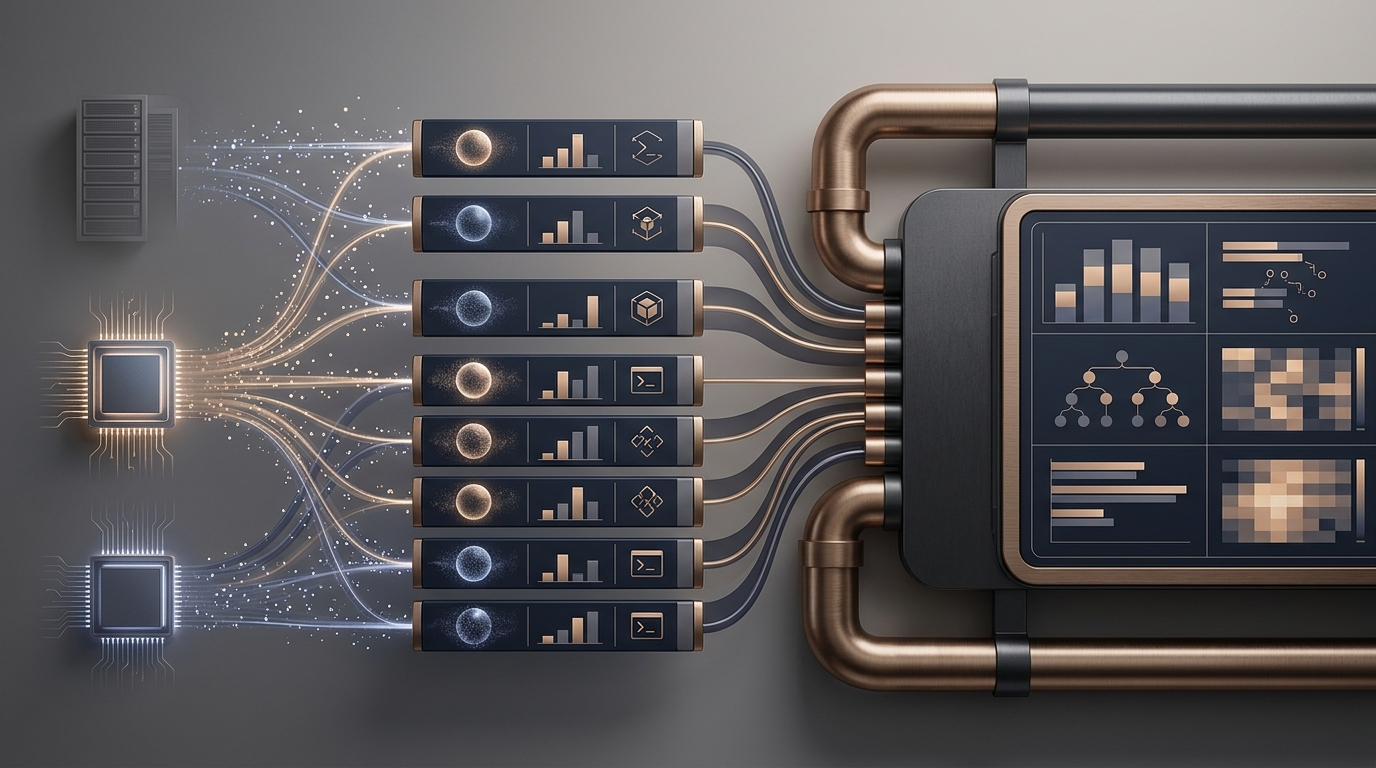
A critical architectural principle when deploying developer platform agents is maintaining a strict separation between static knowledge and dynamic infrastructure state. Confusing these two data domains is a primary cause of agent failure in production.
Semantic search is suited for stable, semi-static knowledge: how services are configured, which security standards apply, and how infrastructure templates are defined. Conversely, the operational state of a Kubernetes cluster—such as pod phases, resource saturation, and active network routes—changes continuously. Indexing cluster state into a vector database guarantees stale hallucinations, as live telemetry diverges from vector representations within seconds.
| Dimension | Engineering Knowledge (Vector Store) | Infrastructure State (Live Tools) |
|---|---|---|
| Data Nature | Architectural conventions, runbooks, Git manifests, policy guidelines | Active pod phase, replica counts, node metrics, ephemeral network routes |
| Storage Backend | Vector databases and dense embedding indexes | Kubernetes API, control plane metrics, live service registries |
| Ingestion Cadence | Continuous event-driven pipeline on Git or ticket mutations | On-demand polling via tool calls; zero vector persistence |
| Primary Risk | Chunk dilution, missing metadata, outdated documentation | State staleness, hallucinated API arguments, unauthorized mutations |
| Agent Access Pattern | Semantic retrieval injected into prompt context | Direct function calling executing read-only or authorized CLI tools |
Rather than embedding cluster metrics, platform teams must equip agents with live inspection tools. When diagnosing a service failure, an agent should query semantic search for architecture runbooks and then invoke real-time tools—such as Kubernetes API wrappers or Prometheus query interfaces—to retrieve current logs and health status. This ensures the model reasons over verifiable operational reality.
Agent Observability and OpenTelemetry GenAI Conventions
Operating autonomous agents across internal infrastructure introduces distinct observability challenges. In conventional applications, bugs can be reproduced deterministically by supplying identical inputs. With generative models, identical inputs frequently produce divergent tool invocations and reasoning paths. Distributed traces therefore serve as the definitive factual record of agent behavior.
As Whitney Lee emphasized, agent traces provide value across two horizons. Locally, an individual trace enables engineers to debug failed workflows by inspecting prompt inputs, model latency, and tool parameter payloads. Across an entire organization, aggregating traces transforms observability into platform discovery. Platform teams can evaluate which tasks developers repeatedly delegate to agents, identifying missing platform abstractions and recurring operational bottlenecks.
To standardize telemetry across heterogeneous AI systems, teams are adopting the OpenTelemetry GenAI semantic conventions. These standards establish vendor-neutral span attributes for generative AI workflows:
// OpenTelemetry GenAI Span Attributes
gen_ai.operation.name: "chat"
gen_ai.request.model: "claude-3-5-sonnet"
gen_ai.provider.name: "anthropic"
gen_ai.usage.input_tokens: 1420
gen_ai.usage.output_tokens: 285
gen_ai.tool.name: "kubectl_get_pods"
gen_ai.tool.arguments: "{\"namespace\": \"staging\", \"label\": \"app=web\"}"
Standardized telemetry allows organizations to ingest agent metrics into existing backends—such as Jaeger, Grafana Tempo, Prometheus, and Loki, or enterprise platforms including Datadog, Dynatrace, Honeycomb, and Elastic. Furthermore, real traces serve as empirical evaluation datasets. Analyzing real developer prompts and agent decision paths provides a far more accurate benchmark for model performance than synthetic test scenarios.
Runtime Guardrails and Auditability Constraints
Deploying autonomous agents without execution boundaries introduces substantial operational risk. Because developer inputs are unrestricted and model outputs are probabilistic, platform teams must implement policy guardrails that dictate which operations an agent may execute autonomously versus which require human verification.
A robust guardrail framework divides execution permissions into three tiers:
- Automated Read-Only Operations: Harmless operations—such as retrieving logs, checking resource health, or reading manifests—execute automatically.
- Conditional Mutation Gates: Low-risk environment changes—such as scaling non-production deployments or restarting development pods—execute if predefined policy checks pass.
- Mandatory Human Approvals: High-impact mutations—including production deployments, database migrations, and IAM policy changes—require explicit human sign-off before execution.
Guardrails also control token consumption and infrastructure expense. An unconstrained semantic retrieval can pull tens of thousands of tokens of irrelevant documentation into context, dramatically increasing inference latency and costs. Farcic noted that one badly scoped search can drag 50,000 tokens into prompt context, increasing expenses and diluting model attention.
Finally, comprehensive guardrails and distributed tracing satisfy governance requirements. When an agent modifies production infrastructure, teams cannot point to an autonomous model to evade accountability. Traces establish an auditable record documenting the requesting developer, the prompt context, the specific tool arguments passed, and the digital signature of the operator who authorized execution.
Bottom line
Developer platform agents offer a compelling evolution beyond static internal developer portals, replacing rigid catalog navigation with conversational workflow automation. Grounding agents in engineering repositories enables platform teams to accelerate onboarding, automate routine infrastructure requests, and streamline troubleshooting.
However, successful adoption requires engineering discipline over AI optimism. Platform teams must structure semantic search with fine-grained chunking and continuous ingestion, isolate dynamic cluster state within real-time tool calls, establish strict tiered guardrails, and implement OpenTelemetry distributed tracing from the initial rollout.