Key takeaways
- Margaret Hamilton, director of the Software Engineering Division at the MIT Instrumentation Laboratory for NASA’s Apollo program, died on September 30, 2026, at age 90.
- Hamilton coined the term “software engineering” to establish software architecture and verification as a formal discipline equal to hardware engineering.
- Her design of an asynchronous executive and priority-scheduling architecture prevented an abort during Apollo 11’s lunar descent when unexpected radar telemetry overloaded the computer.
- Following Apollo, Hamilton advanced formal methods and system reliability models by co-founding Higher Order Software and Hamilton Technologies.
Margaret Hamilton, the pioneering computer scientist who directed the software engineering team for NASA’s Apollo program at the MIT Instrumentation Laboratory and coined the term software engineering, died on September 30, 2026, at age 90. Her passing was confirmed by the Massachusetts Institute of Technology (MIT News announcement). Hamilton led the development of onboard flight software for the Apollo Guidance Computer (AGC), architecting the asynchronous executive and priority-scheduling mechanisms that allowed the Apollo 11 lunar module to land safely on July 20, 1969. Over an influential career spanning academic research and commercial systems modeling, Hamilton transformed software development from an uncodified craft into a rigorous, mission-critical engineering discipline.
The MIT Announcement and Hamilton’s Historical Impact
The Massachusetts Institute of Technology announced Hamilton’s death on October 7, 2026, noting that she authored more than 130 scientific publications and fundamentally shaped the structure of modern digital systems. Olivier de Weck, the Apollo Program Professor and interim head of the MIT Department of Aeronautics and Astronautics, highlighted her dual legacy as a hands-on developer and an exceptional engineering director who organized complex systems when digital computing had no established blueprints.
Born in Paoli, Indiana, in 1936, Hamilton completed a degree in mathematics with a minor in philosophy at Earlham College in 1958. She joined MIT in 1959, initially writing meteorology software for professor Edward Lorenz on the LGP-30 and PDP-1 computers. Hamilton subsequently transitioned to the Lincoln Laboratory to work on the Semi-Automatic Ground Environment (SAGE) project, writing software to identify potentially hostile aircraft. Her ability to identify systemic edge cases and make complex software operational led directly to her appointment at the MIT Instrumentation Laboratory (later Draper Laboratory), where she eventually directed the Software Engineering Division for NASA’s Apollo and Skylab missions.
In 2016, President Barack Obama awarded Hamilton the Presidential Medal of Freedom, the highest civilian honor in the United States. The official White House citation emphasized that Hamilton’s software architecture produced giant leaps for humankind, creating the foundations for modern computing infrastructure while helping astronauts navigate safely to the lunar surface.
Asynchronous Architecture and the Apollo 11 Landing
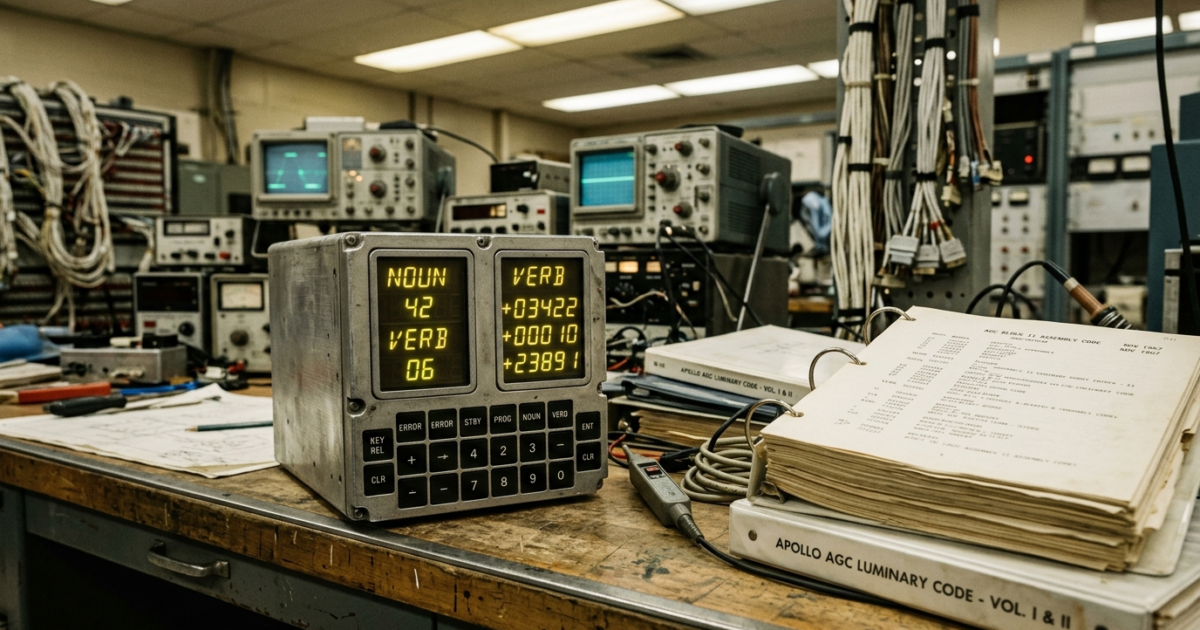
Hamilton’s most celebrated technical triumph occurred during the final descent of the Apollo 11 Lunar Module Eagle on July 20, 1969. Three minutes prior to touching down on the lunar surface, astronauts Neil Armstrong and Buzz Aldrin were alerted by repetitive 1201 and 1202 program alarms displayed on the DSKY (Display and Keyboard) console. In Houston, flight controllers quickly consulted guidance officer Steve Bales and the MIT support team to determine whether the descent should be aborted.
The alarms signaled an executive overflow: the radar rendezvous switch had been positioned incorrectly, flooding the computer with high-frequency telemetry interrupts that consumed roughly 15 percent of its processing capacity. The Apollo Guidance Computer possessed only 2,048 words of erasable magnetic-core RAM and 36,864 words of read-only core rope memory, running at a clock speed of approximately 1.024 MHz. A conventional batch architecture would have frozen or crashed entirely under this computational overload.
Because Hamilton and her engineering team had implemented an asynchronous executive system with strict priority scheduling, the flight computer did not halt. Instead, the real-time software detected the resource exhaustion, shed lower-priority tasks such as the unneeded radar processing, and preserved high-priority threads controlling descent propulsion, guidance calculations, and pilot attitude commands. This deliberate design for graceful degradation prevented a mission abort and permitted the historical landing.
| Apollo Guidance Mechanism | Operational Function in 1969 | Modern Enterprise Equivalent |
|---|---|---|
| Asynchronous Executive | Cooperative multitasking that scheduled real-time flight routines dynamically. | Event loops, asynchronous runtimes, and distributed message queues. |
| Priority-Based Load Shedding | Dropped non-vital telemetry interrupts during the 1202 overload state. | Rate limiting, circuit breakers, and backpressure mechanisms. |
| Read-Only Core Rope Memory | Hardwired instructions physically woven into magnetic ferrite cores. | Immutable infrastructure, read-only root filesystems, and static verification. |
| DSKY Diagnostic Telemetry | Displayed explicit numerical alarms (1201/1202) directly to the flight crew. | Telemetry alerting, actionable observability, and real-time incident dashboards. |
Codifying Software Engineering as a Discipline
During the early 1960s, computing was predominantly viewed as a hardware challenge. Programmers were often regarded as clerical workers whose job was simply to transcribe mathematical algorithms onto punch cards. Hamilton actively pushed back against this culture, coining the term “software engineering” to demand that software receive the same intellectual rigor, systematic methodology, and academic respect accorded to hardware engineering.
Her focus on systemic verification stemmed from the physical constraints of the era. Because Apollo flight code was permanently woven into magnetic core rope memory modules by factory technicians, software fixes could not be deployed after production without costly rewiring. Testing required exhaustive simulation in ground laboratories, modeling astronaut missteps, sensor disruptions, and asynchronous race conditions before the code was manufactured into hardware.
Following the Apollo program, Hamilton translated these principles into commercial enterprise architecture. In 1976, she co-founded Higher Order Software (HOS), developing formal approaches to software specification that aimed to eliminate software errors before code execution. Later, in 1986, she founded Hamilton Technologies, creating the Universal Systems Language (USL) and the 001 Tool Suite, which demonstrated how preventative system design and formal modeling reduce production vulnerabilities. Enterprise IT architects dealing with modern software supply chain and dependency management continue to encounter the fundamental challenges Hamilton addressed: balancing rapid development with verifiable system integrity.
What happens next
Following the confirmation of Hamilton’s death, MIT and institutional partners in the aeronautics sector plan to host retrospective symposia honoring her foundational contributions to computer science and systems architecture. Archival materials from the MIT Instrumentation Laboratory, including historic Apollo Guidance Computer source listings, remain accessible to researchers studying early fault-tolerant operating systems.
For modern enterprise architects, platform engineers, and engineering leaders, Hamilton’s passing provides a clear reminder of core software truths. While modern developers deploy across distributed cloud environments and experiment with autonomous code generation, mission success still depends on deterministic error handling, rigorous architecture, and defensive design. The systems Hamilton built six decades ago established the baseline that keeps production computing running today.