
Key takeaways
- Generative AI has drastically lowered the technical barrier and cost to deploy multi-stage, highly personalized phishing attacks.
- Flawless grammar and overly professional tones in unexpected contexts are now primary indicators of synthetic text generation.
- Voice cloning only requires a few seconds of public audio to synthesize convincing, real-time imposter calls.
- Scammers exploit legitimate cloud infrastructure to bypass legacy spam and security filters effectively.
- Mismatched lip-syncing and unnatural blinking remain the critical technical glitches exposing video deepfakes.
The Architectural Reality of AI Fraud Detection
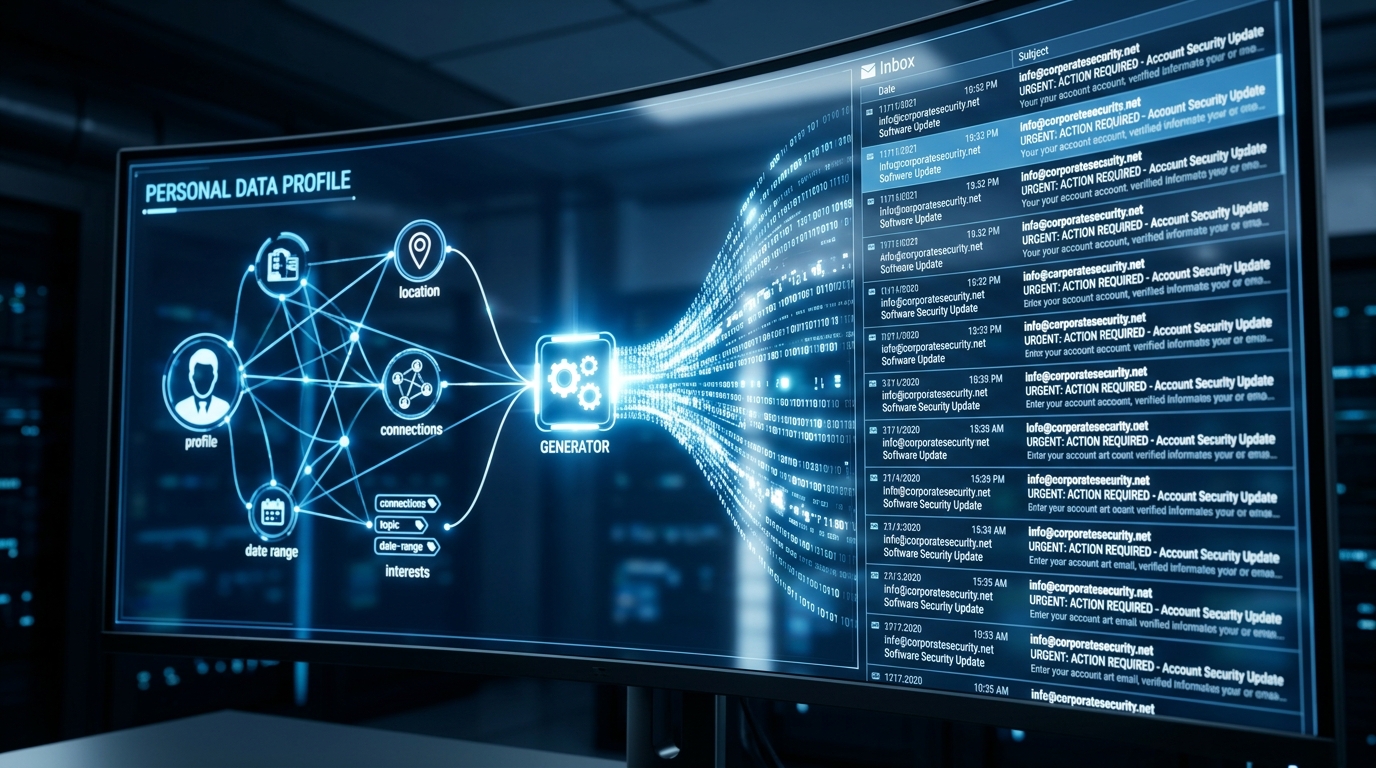
The landscape of digital security has fundamentally shifted, making proactive AI fraud detection an absolute necessity for both corporate networks and individual users. The days of easily identifiable spam emails riddled with grammatical errors and bizarre formatting are rapidly drawing to a close. Today, the convergence of machine learning algorithms and vast datasets has birthed an era of automated, hyper-personalized deception. For Chief Information Security Officers (CISOs) and IT administrators, understanding the underlying architectural mechanics of these AI-driven threats is the first critical step toward defending high-value infrastructure and sensitive data assets.
At the core of this transformation is the weaponization of Large Language Models (LLMs) and advanced neural rendering networks. Threat actors are no longer manually crafting spear-phishing campaigns. Instead, they operate what can be likened to a fully automated, global logistics network for fraud. By deploying sophisticated web scraping scripts, attackers extract behavioral data, professional histories, and personal connections from social media platforms, public directories, and breached databases. This structured data is fed dynamically into generative models, yielding highly contextual and personalized attack vectors at an unprecedented scale. Incorporating advanced AI frameworks, these malicious pipelines operate with a frightening degree of autonomy and precision.
The sophistication of AI text generation represents a profound shift in threat detection. Traditionally, security awareness training emphasized looking for poor spelling and awkward phrasing as primary indicators of malicious intent. However, the paradigm has inverted. Communications with perfectly flawless grammar and an overly professional tone can be a sign of AI generation. Threat actors leverage commercial and open-source models to synthesize executive communications, vendor invoices, and internal memorandums that mimic the corporate lexicon flawlessly. When these synthesized messages originate from compromised accounts or perfectly spoofed domains, they bypass legacy heuristic filters with ease.
Beyond text, the auditory domain has been severely compromised by Zero-Shot Neural Text-to-Speech (TTS) models. The architectural reality of modern voice cloning is that it requires minimal training data. Scammers harvest target voice samples from public online sources like social media and podcasts. A mere three seconds of clear audio is often sufficient for a neural network to extract the acoustic profile and synthesize new speech in the victim’s exact vocal timbre. Despite this advancement, there are persistent technical anomalies. AI-cloned voices often sound flat, robotic, or overly perfect. Forensic audio analysis frequently reveals that frequent slight mispronunciations or monotone delivery are signs of synthetic voices. Furthermore, odd background noises during a phone call and unnatural pauses in conversation flow can be a telltale sign of a voice cloning scam, as the computational latency of real-time generation introduces minute delays.
The visual domain is similarly under siege via Generative Adversarial Networks (GANs) and diffusion models used to create deepfakes. While the algorithms are highly adept at generating static photorealism, temporal coherence across video frames remains computationally challenging. Mismatched lip-syncing is a common technical glitch indicating a deepfake video, occurring when the synthesized phonemes fail to align perfectly with the rendered visemes. Security analysts also note that unnatural blinking and shifts in skin tone or lighting can reveal AI video manipulation. These rendering artifacts provide crucial indicators for AI fraud detection systems trained to spot synthetic media.
Market Impact & Deployment

The economic dynamics of cybercrime have been irrevocably altered by generative AI. By drastically lowering the marginal cost of creating high-quality, targeted lures, the Return on Investment (ROI) for fraudulent campaigns has skyrocketed. For Enterprise IT environments, the Total Cost of Ownership (TCO) associated with robust cybersecurity postures is expanding rapidly to counter these scalable threats. Organizations must now invest heavily in behavioral analytics, cryptographic provenance for internal communications, and advanced filtering mechanisms capable of identifying machine-generated anomalies.
One of the most concerning developments in deployment tactics is the abuse of legitimate infrastructure. Generative AI allows for the continuous, automated rewriting of malicious payloads and the construction of complex, multi-step attacks. To ensure delivery, attackers increasingly route their campaigns through trusted cloud networks, leveraging services like Microsoft 365, Google Workspace, and AWS. Because enterprise environments are whitelisted to accept traffic from these ubiquitous platforms, AI-generated lures successfully land in executive inboxes, evading traditional perimeter defenses.
The financial sector is experiencing a massive influx of AI-optimized fraud. The traditional Business Email Compromise (BEC) attack has been supercharged. Sudden changes to payment instructions or bank details indicate a potential scam, often delivered via a synthesized voice message from a purported CEO or an immaculate email from a compromised vendor account. The cryptocurrency ecosystem is particularly vulnerable to these advanced methodologies. Approval phishing is a tactic where victims unknowingly grant scammers access to drain their crypto wallets, often disguised as routine smart contract interactions.
To facilitate these financial crimes, fraudsters create fake websites and trading platforms to display fabricated account balances to victims, engendering a false sense of security. These platforms are increasingly marketed through sophisticated synthetic media campaigns. AI investment scams often feature deepfaked celebrities endorsing products on social media, lending unwarranted credibility to fraudulent schemes. These operations share structural similarities with traditional confidence games but operate at a terrifying digital scale. Scam investment firms frequently lack registration or licensing with official financial regulatory bodies, and investment opportunities claiming guaranteed high returns with no risk are typical of AI investment scams. Often, these schemes require the recruitment of new investors, which is characteristic of pyramid or Ponzi schemes.
The Consumer Translation
For the average consumer, the abstract architectural shifts in neural networks manifest as highly personalized, emotionally manipulative attacks. The barrier to entry for executing a targeted social engineering attack against a civilian has dropped to zero. Using data scraped from public social media profiles, AI systems can craft hyper-specific narratives that bypass human skepticism by appealing directly to the victim’s unique life circumstances, relationships, and vulnerabilities.
Imposter scams have evolved from generic mass emails into frighteningly intimate phone calls and texts. Scammers fabricate family emergencies, such as arrests or accidents, to cause panic. Utilizing voice-cloned audio of a child or grandchild, the attacker relies on the resulting emotional hijack to override the victim’s rational decision-making processes. In these scenarios, scammers use extreme urgency or pressure to force immediate action or payment. They exploit the human instinct to protect loved ones, weaponizing empathy through synthetic media.
To ensure the success of the deception, isolation is a critical tactic. Scammers often request secrecy from the victim to prevent them from verifying the situation with others. They might claim that contacting law enforcement or other family members will endanger the supposed victim. When evaluating these situations, any requests that seem out-of-character for the supposed sender are a major red flag. Consumers must be vigilant and attempt to verify identities through secondary, established channels.
The financial culmination of these consumer-targeted attacks usually involves requests for non-reversible asset transfers. Scammers frequently request payment via untraceable methods like gift cards, wire transfers, or cryptocurrency. Once the funds are transferred through these decentralized or anonymous channels, recovery is nearly impossible. This applies equally to sophisticated “pig butchering” scams, where AI is used to maintain months-long conversations, predicting the victim’s risk tolerance before extracting maximum financial value under the guise of cryptocurrency investments, as well as romance scams powered by automated, highly responsive conversational agents.
Frequently Asked Questions
Q1: How can I identify an AI-cloned voice on a phone call?
A1: AI-cloned voices often sound flat, robotic, or overly perfect, and you might notice unnatural pauses in the conversation flow or odd background noises. Scammers only need a few seconds of audio harvested from social media or podcasts to create these clones.
Q2: What are the main red flags of an AI-generated phishing email?
A2: Look for flawlessly perfect grammar combined with an overly professional tone, which is often characteristic of AI text generators. Additionally, be wary of sudden changes to payment instructions or demands for untraceable payment methods like cryptocurrency.
Q3: How are scammers bypassing traditional spam filters?
A3: Fraudsters are increasingly using legitimate, trusted infrastructure like Google Drive and Microsoft 365 to host malicious files and construct multi-step attacks. This makes the emails appear highly credible to both automated filters and human targets.
Q4: What is approval phishing in the context of cryptocurrency?
A4: Approval phishing is a sophisticated tactic where victims unknowingly sign a malicious smart contract, granting scammers access to drain their crypto wallets. Fraudsters often use fake trading platforms to display fabricated account balances and build false trust.
Q5: What are the visual indicators of a video deepfake?
A5: Unnatural blinking, shifts in skin tone or lighting, and mismatched lip-syncing are common technical glitches that indicate video manipulation. These visual artifacts occur because the neural networks struggle to perfectly render temporal consistencies across video frames.
TechNode HQ Verdict: Pros, Cons & Usability
- Pro (Engineering): Generative AI enables rapid, automated security simulations and red-teaming to proactively stress-test corporate network defenses.
- Pro (Consumer): Increased awareness of AI fraud is driving the adoption of stronger personal security habits, such as family safe words and multi-factor authentication.
- Con: The proliferation of zero-shot voice cloning drastically undermines the reliability of biometric voice authentication systems currently deployed by financial institutions.
- Con: Detecting flawless, AI-generated text requires computationally expensive behavioral analysis that legacy email security gateways cannot support.
Enterprise Usability: CTOs and security leaders must urgently deprecate security models that rely solely on textual analysis or voice verification. Deploying cryptographically signed internal communications, zero-trust architectures, and robust, hardware-based multi-factor authentication (like FIDO2 keys) is mandatory to combat AI-scaled fraud.
Everyday Usability: The public must adopt a “zero-trust” mindset for digital communications. Never authorize financial transfers based on unexpected calls or emails, verify out-of-character requests via a secondary communication channel, and establish predetermined “safe words” with family members to quickly expose synthetic imposter scams.