Key takeaways
- Lenovo detailed global supercomputing deployments pairing traditional HPC simulation clusters with AI training workloads.
- The 6th Generation Neptune direct water-cooling system supports 100kW+ rack densities, capturing up to 98% of heat to reduce facility cooling power by up to 40%.
- Deployments span major research installations, including Italy’s 9 PFLOPS CRESCO8 cluster for fusion modeling, Germany’s PIK cluster for climate policy, and the University of Florida’s 17.49 PFLOPS HiPerGator system.
- Direct liquid cooling is transitioning from an optional HPC upgrade to a mandatory requirement as processor thermal loads exceed the dissipation limits of air-cooled facilities.
On November 9, 2026, Lenovo outlined a global expansion of its high-performance computing (HPC) and artificial intelligence infrastructure, detailing enterprise server deployments across academic and governmental research institutions. Centered on the vendor’s 6th Generation Neptune direct water-cooling technology, the installations address increasing thermal densities exceeding 100kW per rack as scientific labs combine conventional numerical modeling with compute-intensive AI training and inference. Deployments at organizations including Italy’s ENEA, Germany’s Potsdam Institute for Climate Impact Research, and the University of Florida reflect how hardware operators are revamping thermal architectures to sustain high compute densities without exceeding regional electrical and cooling thresholds.
Addressing Hybrid AI and Simulation Workloads
Modern scientific computing is undergoing an architectural transition where high-performance simulation environments must concurrently host heavy deep learning pipelines. Traditional supercomputers were engineered primarily for double-precision floating-point arithmetic to solve differential equations in climate dynamics, astrophysics, and materials science. However, modern research workflows increasingly combine traditional physics simulations with neural network surrogate models, requiring heterogeneous clusters loaded with dense accelerator modules alongside general-purpose multi-core CPUs.
According to Lenovo’s infrastructure disclosure, research facilities require higher density and compute scaling, but face severe thermal constraints. The integration of high-draw accelerators and dense multi-socket servers rapidly escalates power consumption past the physical cooling capabilities of standard forced-air data center cooling. Air cooling systems experience steep thermal resistance when handling processors dissipating upwards of 400 to 700 watts each, leading to thermal throttling or requiring oversized computer room air handler (CRAH) equipment that inflates operational overhead.
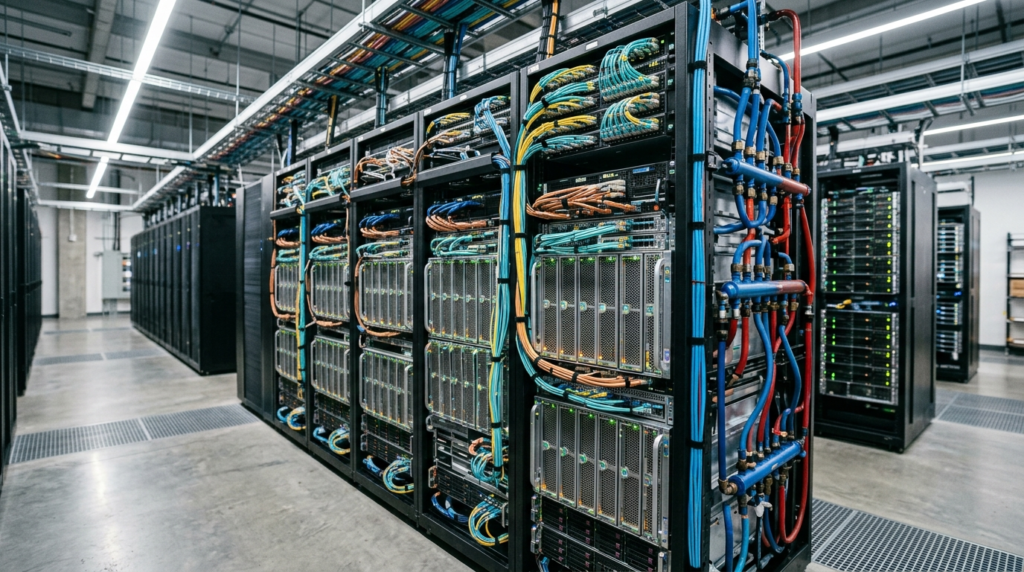
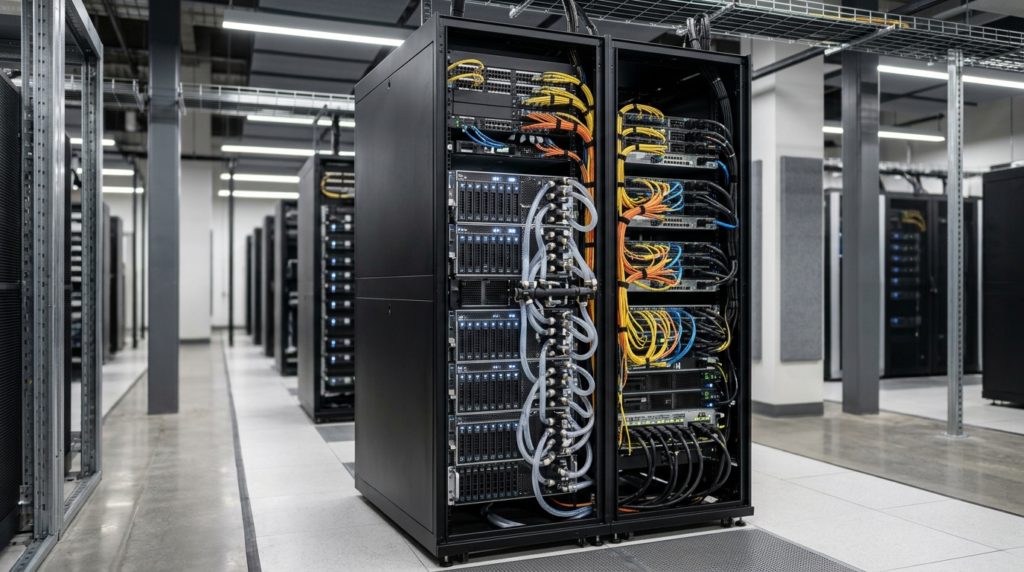
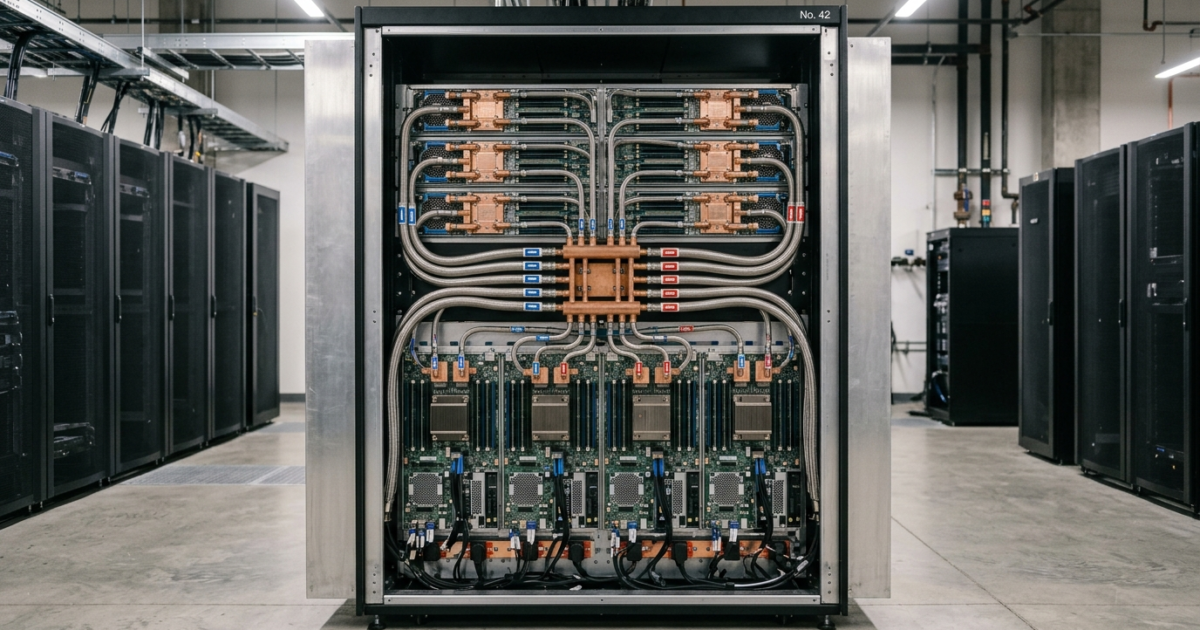
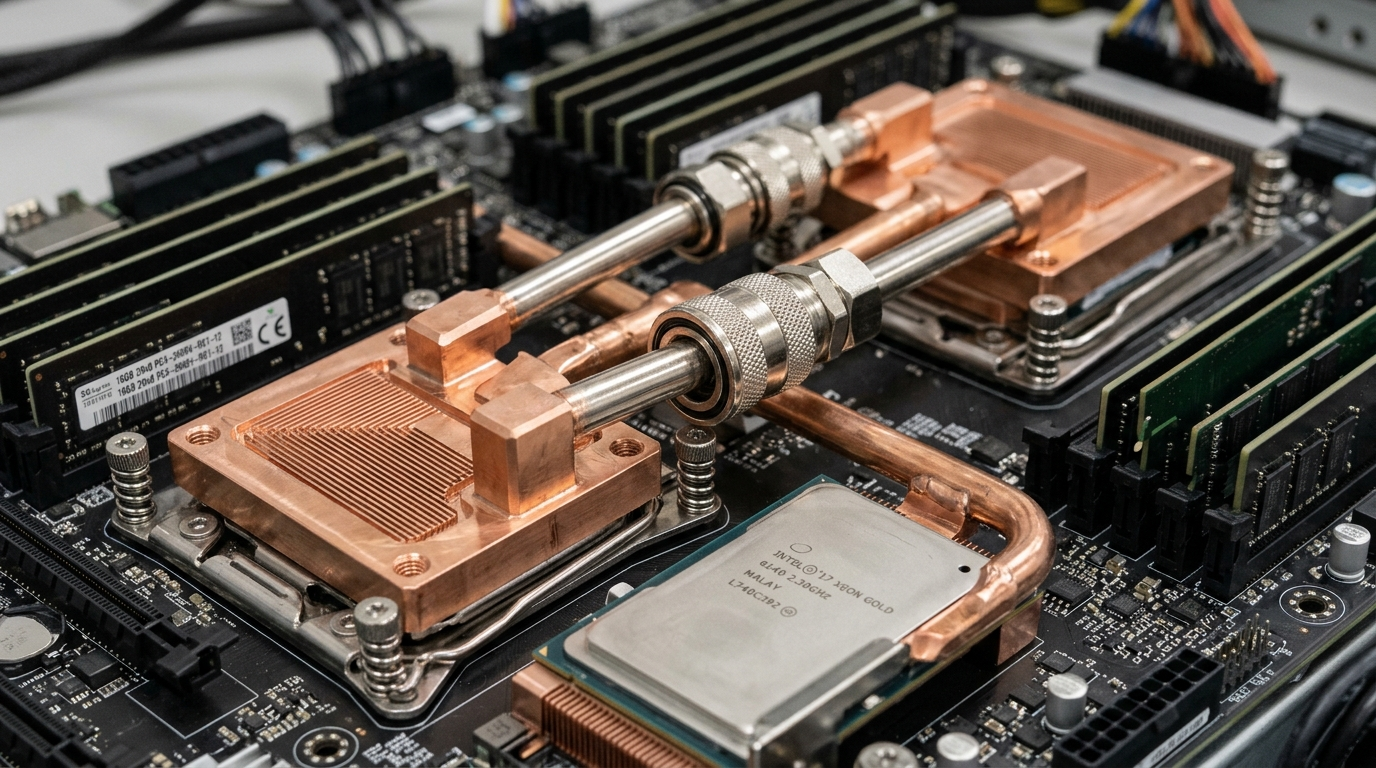
To support sustained clock rates across high-density nodes, the vendor’s updated architectures incorporate direct-to-chip liquid cooling loops capable of servicing server racks rated beyond 100kW. By directing warm water directly over processors, system memory, and voltage regulator modules, cooling infrastructure eliminates high-velocity chassis fans and lowers data center power usage effectiveness (PUE) ratings.
Thermal Architecture and Hardware Performance
The engineering core of these deployments rests on direct water-cooling manifolds. Lenovo cites that its 6th Generation Neptune liquid cooling extracts up to 98% of server-generated heat directly through closed-loop liquid cold plates, reducing overall facility cooling power demand by up to 40% compared to traditional air-cooled environments. Operating with warm water eliminates the requirement for energy-intensive mechanical chillers, allowing facilities to rely primarily on dry coolers or ambient heat exchangers even during warmer seasonal cycles.
Maintaining lower, stable junction temperatures directly impacts silicon reliability and performance consistency. Liquid-cooled nodes mitigate localized hot spots, preventing thermal throttling across sustained simulation runs that span several days. Furthermore, the captured thermal energy provides opportunities for facility-level heat recapture, turning waste heat into usable hot water for surrounding campus facilities.
| Institution | Hardware Architecture | Demonstrated Compute Scale | Primary Research Workload |
|---|---|---|---|
| ENEA (CRESCO8) | 758 Lenovo ThinkSystem SD650 V3 nodes, Intel Xeon Scalable CPUs | Expanded from 2 PFLOPS to 9 PFLOPS | Nuclear fusion reactor plasma modeling |
| Potsdam Institute for Climate Impact Research | Water-cooled Lenovo ThinkSystem servers, AMD EPYC CPUs, NVIDIA H100 accelerators | 5x compute capacity increase, 5-10x workload speedup | Iterative climate simulations and economic shock models |
| University of Florida (HiPerGator 4th Gen) | Lenovo ThinkSystem supercomputing cluster | 17.49 PFLOPS (ranked top university system by IO500) | AI training (3x faster) and AI inference (15x faster) |
| National Laboratory for High Performance Computing (Chile) | 7,000+ AMD EPYC server CPU cores | Doubled performance per watt | Atacama Desert astronomical telescope data classification |
| Korea Meteorological Administration (KMA) | 300,000+ Intel Xeon Scalable processor cores | 50 PFLOPS compute capacity | Decade-scale climate modeling and weather prediction |
Institutional Deployments and Operational Trade-offs
The operational realities across global research centers illustrate how these hardware specifications translate to production environments. In Italy, national research body ENEA deployed the CRESCO8 supercomputer in Portici, utilizing 758 liquid-cooled ThinkSystem SD650 V3 nodes. By scaling compute capacity from 2 PFLOPS to 9 PFLOPS—a 350% increase—ENEA reported that plasma simulation codes for its Fusion Energy Development division execute five times faster than on previous platforms.
In Germany, the Potsdam Institute for Climate Impact Research (PIK) transitioned to an 8th-generation cluster designated ‘foote’. Built using water-cooled ThinkSystem nodes powered by AMD EPYC processors alongside NVIDIA H100 GPUs, the installation delivers five times the capacity of its predecessor while directing captured coolant heat into campus heating loops. Similarly, Chile’s National Laboratory for High Performance Computing deployed Leftraru Epu, employing over 7,000 AMD EPYC cores to analyze sky surveys from Atacama Desert telescopes, doubling compute output per watt.
In the United States, the University of Florida implemented the fourth-generation HiPerGator supercomputer, achieving 17.49 PFLOPS. Across 500 active research projects, administrators measured a 3x speedup in deep learning training and a 15x improvement in inferencing throughput. Meanwhile, the Mass Open Cloud (MOC) Alliance partnered with Lenovo to construct a shared, liquid-cooled GPU cloud, providing academic researchers with fractional GPU instances on a utility-billed model to avoid upfront capital expenditure.
Despite efficiency gains, direct liquid cooling introduces distinct infrastructure trade-offs. Organizations must evaluate primary loop plumbing, coolant distribution units (CDUs), fluid chemistry maintenance, and leak detection systems. While warm-water cooling simplifies chiller requirements, retrofitting older data center floors with liquid piping requires substantial initial facility engineering compared to standard air-cooled server racks.
What happens next
As rack power densities continue climbing past 100kW, facilities planning high-performance AI and simulation deployments are treating liquid cooling as a baseline requirement rather than an optional efficiency upgrade. The convergence of large language models, structural biology simulations, and high-resolution climate modeling will force infrastructure teams to retire legacy air-cooling systems in favor of closed-loop direct-to-chip designs.
According to TOP500 supercomputing trends, high-density warm-water designs are capturing a growing share of global research installations due to strict enterprise power envelopes and regional grid caps. In the coming quarters, enterprise IT and research facility managers will focus on deploying modular coolant distribution units and establishing standardization around fluid manifolds to reduce deployment complexity across multi-vendor server estates.
Sources
- Accelerating scientific discovery worldwide with Lenovo HPC and AI infrastructure – Lenovo StoryHub
- HPC Services Overview — Potsdam Institute for Climate Impact Research
- Nuclear: ENEA installs supercomputer CRESCO8 to boost nuclear fusion research
- Leftraru Epu: The New Supercomputer in Chile that Quadruples Existing Computational Power – CMM
- Lenovo case study: Integrating AI into education and researchUFIT Research Computing
- Driving Climate Science at PIK with AMD Performance
- Lenovo is Transforming HPC & AI for All | TOP500