Key takeaways
- billion.
- Under the fixed 4.500 exchange ratio, Marvell stockholders will own approximately 67% and Lumentum stockholders will own 33% of the combined entity upon completion.
- The acquisition addresses the physical limits of copper interconnects by pairing Marvell’s custom silicon, DSPs, and switching ASICs with Lumentum’s indium phosphide (InP) fabrication, high-power lasers, and MEMS-based optical circuit switching.
- Integrating Lumentum’s R300 300×300 optical circuit switch allows data center fabrics to establish direct photonic paths between endpoints, eliminating optical-electrical-optical (OEO) conversions and significantly cutting switching latency and power consumption.
- The transaction has been approved by both boards of directors and is targeted to close in the first half of calendar 2028, subject to regulatory approvals and shareholder votes.
Marvell Technology has entered into a definitive agreement to acquire optical component and switching manufacturer Lumentum Holdings in an all-stock transaction valued at an implied enterprise value of approximately $115 billion. The proposed mega-merger unites Marvell’s custom compute silicon, digital signal processors (DSPs), and high-radix switching ASICs with Lumentum’s indium phosphide (InP) manufacturing, high-power continuous-wave lasers, and optical circuit switching (OCS) systems. The combined entity aims to deliver integrated, co-designed optical AI connectivity across distributed data centers and within advanced semiconductor packaging, directly addressing the physical bandwidth and thermal limits of electrical copper cabling in hyperscale artificial intelligence clusters.
Merger terms and the $115 billion all-stock transaction structure
The transaction is structured as an all-stock exchange rather than a cash acquisition, effectively functioning as a strategic merger. Under the terms of the definitive agreement, Lumentum stockholders will receive a fixed exchange ratio of 4.500 shares of Marvell common stock for each share of Lumentum common stock they own. The ratio implies a valuation of approximately $1,132 per Lumentum share, representing a 23.9 percent premium over Lumentum’s unaffected closing share price as of October 28, 2026.
Upon settlement of the transaction, current Marvell stockholders will hold approximately 67 percent of the combined company on a fully diluted basis, while Lumentum stockholders will hold approximately 33 percent. To coordinate joint governance, three members of Lumentum’s board of directors, including Chief Executive Officer Michael Hurlston, will join Marvell’s board, expanding it to 10 members. Marvell Chairman and Chief Executive Officer Matt Murphy will continue to lead the combined enterprise.
| Dimension | Marvell Technology | Lumentum Holdings | Combined Enterprise Post-Close |
|---|---|---|---|
| Implied Valuation & Ownership | ~$175 billion market valuation; ~67% equity ownership | ~$115 billion implied transaction value; ~33% equity ownership | ~$290 billion combined equity base; $550 billion target TAM |
| Core Silicon & Manufacturing | CMOS switching ASICs, PAM4 DSPs, custom AI compute silicon | InP compound semiconductor foundries, high-power CW lasers | End-to-end electrical and photonic manufacturing pipeline |
| Interconnect & Switching Focus | TX9190 CPO switches, COLORZ 800 coherent DCI modules | R300 300×300 OCS systems, optical transceivers, MEMS arrays | Hybrid packet-circuit fabrics spanning packaging to campus scale |
| Governance & Leadership | Matt Murphy (CEO & Chairman); 7 board seats | Michael Hurlston (CEO); 3 board seats | 10-member unified board of directors |
The companies project that the combination will expand their total addressable market to $550 billion while generating more than $1 billion in annual run-rate cost synergies. Marvell management expects the transaction to be accretive to non-GAAP earnings per share within the first year post-close.
Bridging the copper wall with co-packaged optics and optical circuit switching
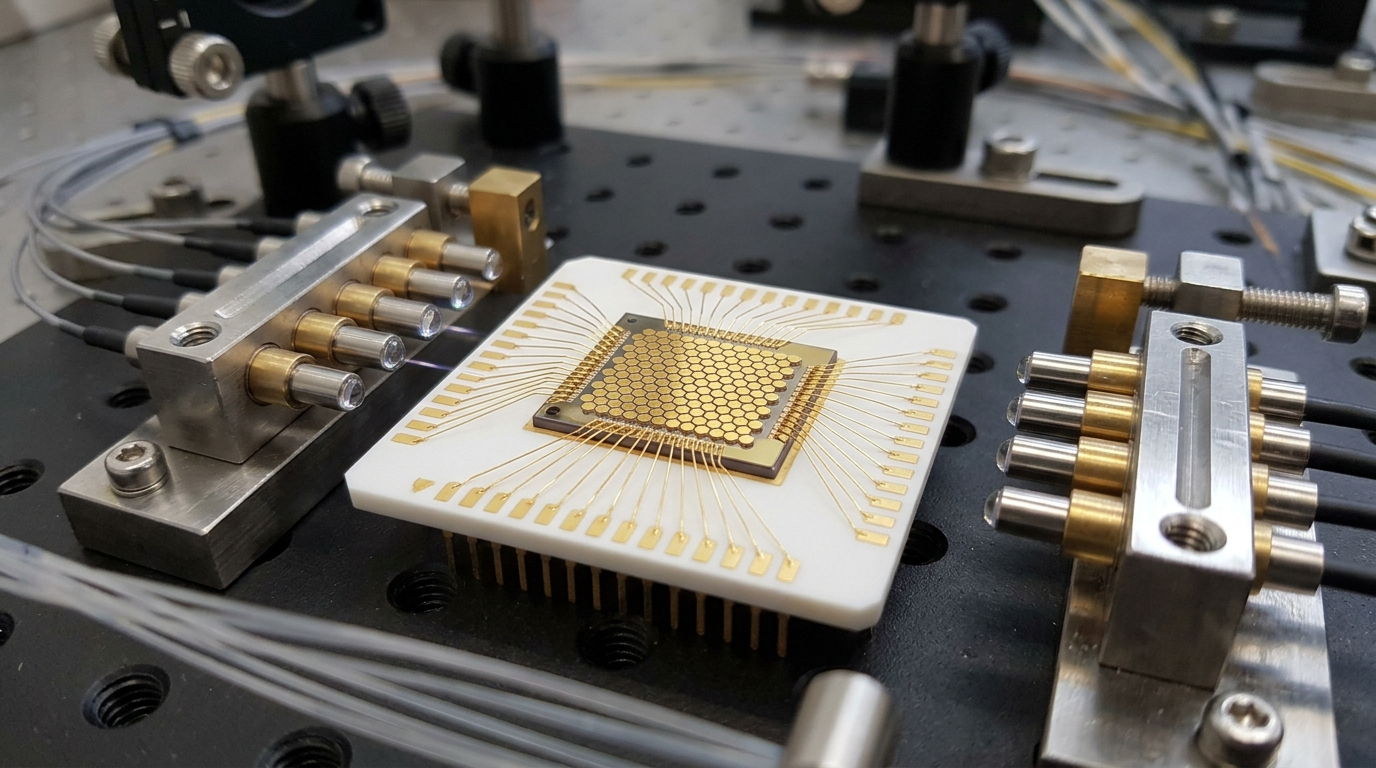
The primary technical driver behind the deal is the accelerating collision with the “copper wall” in AI data centers. As accelerator interconnects scale to 200 Gbps and 400 Gbps per electrical lane, copper conductors encounter severe high-frequency attenuation, crosstalk, and heat dissipation challenges. The distance copper cables can reliably span while preserving signal integrity has contracted from rack-level runs to mere fractions of a meter, forcing system architects to deploy power-hungry retimers and thick cabling assemblies.
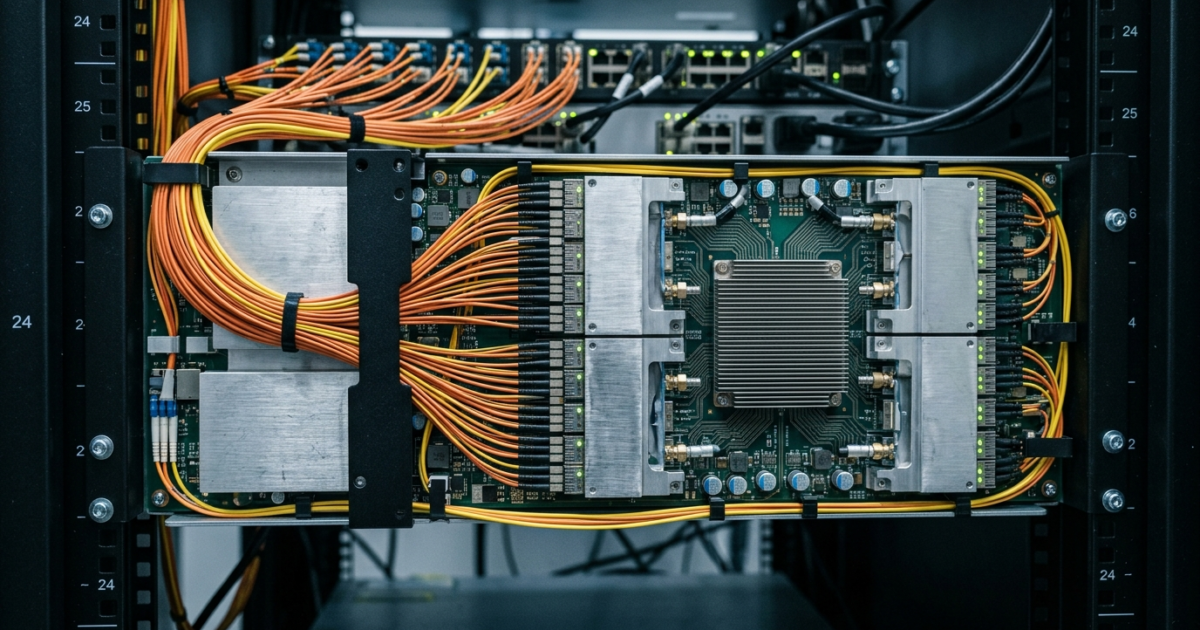
Marvell has addressed scale-out connectivity through products such as its COLORZ 800 modules, which package coherent DSPs into OSFP form factors for data center interconnects spanning up to 1,000 kilometers. At the rack level, Marvell has demonstrated liquid-cooled architectures like the TX9190 co-packaged optics (CPO) switch, which brings optical engines directly alongside the switch silicon to shorten electrical trace lengths. However, CPO architectures require reliable, high-power external laser sources and specialized photonic components that Marvell historically procured from third-party suppliers.
Lumentum provides the required physical-layer manufacturing assets, specifically dedicated indium phosphide wafer fabrication and high-power continuous-wave laser arrays. Crucially, Lumentum also contributes optical circuit switching hardware through platforms like the Lumentum R300. The R300 employs Micro-Electro-Mechanical Systems (MEMS) mirror arrays to establish a 300×300 port matrix of direct, transparent light paths between networking endpoints.
Unlike conventional Ethernet and InfiniBand switches that perform optical-electrical-optical (OEO) conversions at every switch hop—re-encoding light into voltage to read packet headers before converting it back to photons—optical circuit switches redirect light beams purely in the optical domain. By bypassing intermediate packet buffers and serialization logic along established paths, MEMS-based OCS hardware delivers a 5x to 10x reduction in network latency and slashes switching power consumption across large GPU training topologies.
Impact on AI hyperscalers and data center network architecture
Hyperscalers and cloud service providers are shifting from homogeneous packet-switched fabrics toward hybrid network architectures that blend packet switching with dynamic circuit switching. In these topologies, persistent high-bandwidth flows between GPU model partitions travel across direct optical circuits, while control traffic and dynamic micro-bursts use conventional packet switches.
Integrating Marvell’s switching silicon and DSP telemetry directly with Lumentum’s OCS and laser optics allows cloud operators to procure pre-validated, vertically co-designed subsystems. Instead of integrating discrete optics, lasers, packaging substrates, and switch ASICs from separate vendors, infrastructure teams can deploy coordinated optical engines designed for shared thermal and optical tolerances. This dynamic echoes broader infrastructure trends where semiconductor consolidation must keep pace with escalating capital requirements, a balance examined in TechNode HQ’s analysis of whether enterprise AI monetization can support surging infrastructure costs.
The combination also intensifies competition with Broadcom and Nvidia. While Broadcom has advanced its own Bailly CPO platforms and optical transceivers, and Nvidia continues to integrate optical interconnects within its NVLink scale-up clusters, a combined Marvell-Lumentum controls both custom silicon design and captive compound semiconductor fabrication, establishing an independent, end-to-end photonic supply chain for merchant customers.
What happens next
Although the definitive agreement has been approved by the boards of directors of both companies, the acquisition is subject to a protracted closing timeline. The transaction is targeted for completion in the first half of calendar 2028, reflecting the regulatory scrutiny anticipated for a $115 billion semiconductor transaction.
Regulatory authorities in the United States, the European Union, China, and other jurisdictions are expected to examine the concentration of optical transceivers, laser manufacturing, and optical switching assets, given their strategic role in AI infrastructure. In parallel, the deal requires the formal approval of both Marvell and Lumentum stockholders at upcoming special meetings.
Until regulatory approvals are secured and the transaction closes, Marvell and Lumentum will continue to operate as independent corporate entities. In the interim, both companies plan to pursue customer-level interoperability demonstrations, advancing joint reference designs that align Marvell’s coherent DSPs and CPO switch trays with Lumentum’s MEMS-based OCS hardware.