Key takeaways
- delivers 4K video monitoring through interior window glass, bypassing lease restrictions against drilling exterior walls.
- A magnetic adhesive mounting plate paired with a manually tiltable spherical lens allows residents on higher floors to monitor ground-level driveways and porches.
- Onboard artificial intelligence classifies people, vehicles, and pets locally without requiring a monthly cloud subscription.
- Local video storage is handled through a microSD card slot supporting capacities up to 512GB, keeping video recordings off third-party servers.
- Low-light color night vision operates without infrared illumination to eliminate glass glare, though it requires ambient exterior light to function effectively.
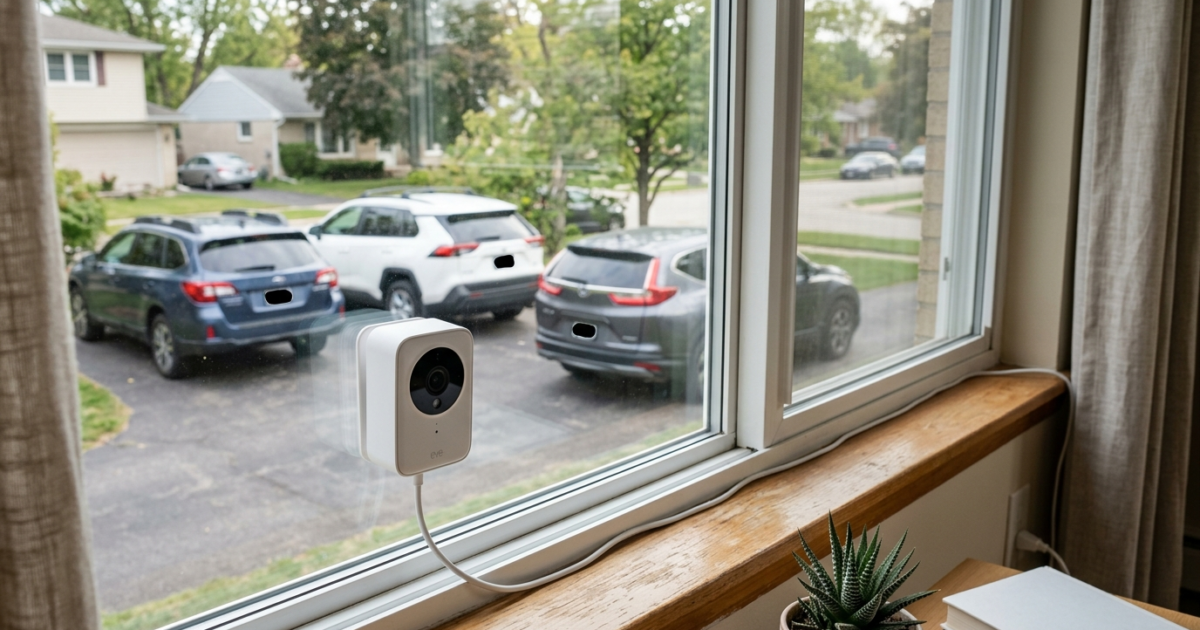
The Baseus PrimeSentinel W1 is a $100 indoor security camera engineered to monitor outdoor areas directly through window glass, providing an alternative for apartment renters unable to drill exterior walls. Mounted flush against interior glass panes via an adhesive magnetic frame, the device records in 4K resolution across a 130-degree field of view and features a manually adjustable spherical lens that tilts downward. By packaging local artificial intelligence detection for people, vehicles, and animals alongside onboard microSD card storage, the camera functions without recurring subscription fees. It addresses common window monitoring hurdles, particularly optical glare, while maintaining steady surveillance over driveways, curbside parking, and front steps.
The Renter Security Dilemma and Window Monitoring
Securing an apartment or leased property presents persistent structural challenges. Standard outdoor surveillance systems demand exterior mounting plates, masonry anchors, or complex cable routing through door frames. Lease agreements routinely prohibit exterior modifications, leaving tenants vulnerable to package theft, parking disputes, and vehicle vandalism without viable recourse. Battery-powered exterior cameras circumvent wiring but remain susceptible to theft or landlord objections.
Window cameras offer a non-invasive workaround by operating entirely within the apartment boundary. However, repurposing standard indoor security cameras to peer outside usually introduces severe optical degradation. Traditional cameras reflect indoor lighting off the glass, while their built-in infrared (IR) night vision LEDs emit bright beams that bounce off the window surface, blinding the sensor into a white haze. Dedicated window cameras eliminate internal IR emitters and seal the optical lens directly against the glass pane to preserve viewability.
Hardware accessories brand Baseus, widely recognized for consumer charging hardware, developed the PrimeSentinel W1 to establish a footprint in consumer smart home security. The device competes directly with budget alternatives such as the Wyze Window Cam and the Eufy Window Camera E10, emphasizing higher sensor resolution and mechanical lens adjustability.
Magnetic Mounting and Physical Lens Articulation
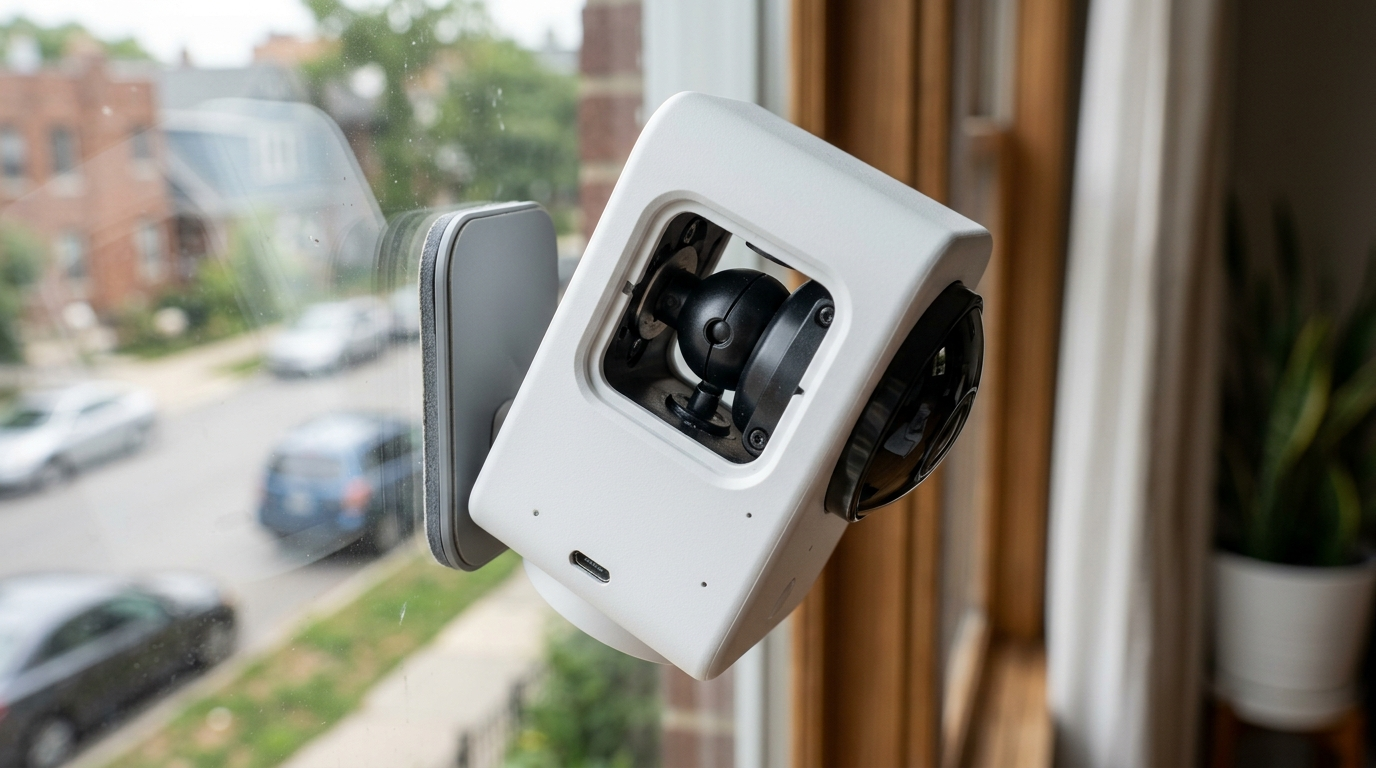
The physical installation of the Baseus PrimeSentinel W1 uses a two-part magnetic assembly. A slim perimeter frame attaches to cleaned interior glass using double-sided adhesive. The camera body then couples magnetically to this base plate. This mounting design permits instant removal whenever the window pane needs cleaning or when the resident needs to adjust the internal microSD card, avoiding the repeated peeling and re-sticking required by hook-and-loop fasteners or single-use adhesives.
A notable mechanical feature highlighted in hands-on testing by CNET is the manual articulation of the internal lens. Many competing window-mounted units fix the sensor in a flat, perpendicular orientation, restricting visibility to whatever sits directly level with the window. The PrimeSentinel W1 houses its optical assembly within an orb-style gimbal that rotates manually within the housing. Users can angle the lens downward toward parking stalls, driveways, or stairwells directly below a second-story apartment window.
| Feature / Specification | Baseus PrimeSentinel W1 | Operational Context |
|---|---|---|
| Video Resolution | 4K Ultra HD | Captures finer details at distance; snapshots show compression softening. |
| Field of View | 130 Degrees | Wide diagonal coverage suitable for broad driveways and yards. |
| Lens Articulation | Manual downward tilt | Permits angle adjustment for multi-story residential windows. |
| Mounting Mechanism | Adhesive magnetic frame | Enables quick detachment for cleaning and microSD maintenance. |
| Night Vision Technology | Starlight low-light sensor | Omits IR reflection; requires minimal ambient exterior light. |
| Local Storage | MicroSD slot (up to 512GB) | Eliminates mandatory monthly cloud storage subscriptions. |
| Audio Configuration | Two-way audio (mic/speaker) | Restricted through glass; useful primarily for interior household communication. |
| Power Source | Wired USB power adapter | Requires a standard wall outlet located within reach of the window. |
Optical Clarity, Resolution, and Nighttime Limitations
The camera integrates an optical sensor capable of 4K live streaming, providing higher pixel density than the 1080p or 2.5K sensors common in competing entry-level window cameras. In daylight conditions, this additional resolution aids in reading distant vehicle license plates and discerning individual facial characteristics across yards or parking lots. Software settings in the companion application also allow users to invert the video orientation 180 degrees, simplifying cable routing when the nearest indoor power outlet sits above the window frame.
Low-light performance represents the primary operational trade-off of glass-mounted surveillance. Because standard infrared illumination cannot penetrate double- or triple-pane glass without severe back-reflection, the PrimeSentinel W1 relies on a starlight color sensor. Evaluators found that the camera resolves adequate detail as long as secondary ambient lighting exists, such as street lamps, garage floodlights, or porch fixtures. If an exterior area descends into total darkness, the sensor struggles to capture meaningful motion or identify subjects.
Additionally, while two-way audio hardware is integrated into the chassis, sound transmission through sealed glass remains physically constrained. Exterior audio rarely reaches the internal microphone clearly, and speaking through the camera speaker will not alert individuals outdoors. The audio channel functions primarily as an internal intercom for communicating with occupants inside the room.
Smart Detection, False Triggers, and Privacy Zones
Baseus incorporates onboard AI detection into the camera firmware at no added cost, classifying movement into human, vehicle, and pet categories. However, glass introduces optical anomalies that challenge machine vision algorithms. In practical evaluations, daytime indoor reflections and changing shadows cast across interior window panes frequently triggered false “person spotted” notifications, even when sensitivity settings were dialed down to minimum thresholds.
To mitigate alert fatigue, users must configure detection boundaries inside the Baseus app:
- Motion Zones: Establish active bounding boxes that restrict motion analysis exclusively to exterior driveways, walkways, or parking stalls, excluding tree branches and interior window edges.
- Privacy Zones: Place opaque black digital masking blocks over neighboring properties or adjacent windows to comply with residential privacy expectations.
- Feature Toggles: Deactivate pet detection when monitoring driveways, as windblown foliage and cast shadows frequently mimic domestic animal silhouettes.
Notably, testing revealed that privacy masking blocks do not always suppress object detection calculations beneath the masked zone. Implementing dedicated motion zones alongside privacy masks remains essential to keep smartphone notification volumes manageable.
Data Governance and Storage Architecture
Connected security devices from emerging overseas hardware manufacturers regularly face scrutiny regarding data handling and network isolation. Baseus operates under standard consumer electronics data policies, noting that customer service personnel may access encrypted personal account data for support inquiries, while financial details are processed via third-party gateways. Independent assessments have uncovered no public record of critical security breaches or systemic vulnerabilities tied to Baseus surveillance hardware.
For risk-conscious users, the inclusion of an onboard microSD slot provides an architectural safeguard. Storing motion recordings and continuous footage locally on physical flash media keeps video payloads off cloud servers entirely. Users maintain direct custody of recorded files without paying ongoing monthly storage fees, aligning with the privacy preferences of privacy-minded buyers.
Fit, limitations and availability
The Baseus PrimeSentinel W1 establishes a capable balance between hardware utility and affordability for consumers restricted by residential rental leases. At an MSRP of $100, it commands a premium over Wyze’s lower-cost offering while undercutting multi-camera smart home hubs. Its primary advantages center on the 4K sensor, detachable magnetic base, downward lens articulation, and subscription-free local storage.
Prospective buyers should evaluate specific installation constraints prior to purchasing. The unit requires continuous wired power, making nearby outlet placement necessary. Furthermore, because its nighttime visibility relies on ambient illumination, the camera is poorly suited for unlit rural settings or completely dark alleyways. For urban and suburban apartment dwellers seeking reliable daylight monitoring over parked vehicles, entry gates, and package drops, the PrimeSentinel W1 serves as an adaptable, non-destructive home security asset.