Key takeaways
- AWS scheduled a multi-hour drill on October 24, 2026, disconnecting its European Sovereign Cloud from the global AWS Network backbone.
- Traffic will fall back to public internet transit across European ISPs, supported by local source code and EU-resident staff in Brandenburg.
- The exercise provides verifiable evidence aligned with Germany’s BSI C3A criteria and the EU Cloud Sovereignty Framework.
- Cloud architects emphasize the drill proves technical survivability and resilience, though legal exposure under the US CLOUD Act remains tied to corporate ownership.
Amazon Web Services will deliberately sever the upcoming AWS European Sovereign Cloud from the global AWS Network backbone for several hours on Saturday, October 24, 2026. The planned isolation drill is engineered to verify that the European partition can sustain continuous operations without relying on connectivity to infrastructure outside the European Union. By redirecting network traffic to the public internet via local European internet service providers, relying on in-region source code repositories, and retaining administrative control with EU-resident personnel, AWS aims to demonstrate compliance with strict European sovereignty benchmarks while addressing broader industry skepticism regarding operational survivability.
Simulated backbone severance in Brandenburg
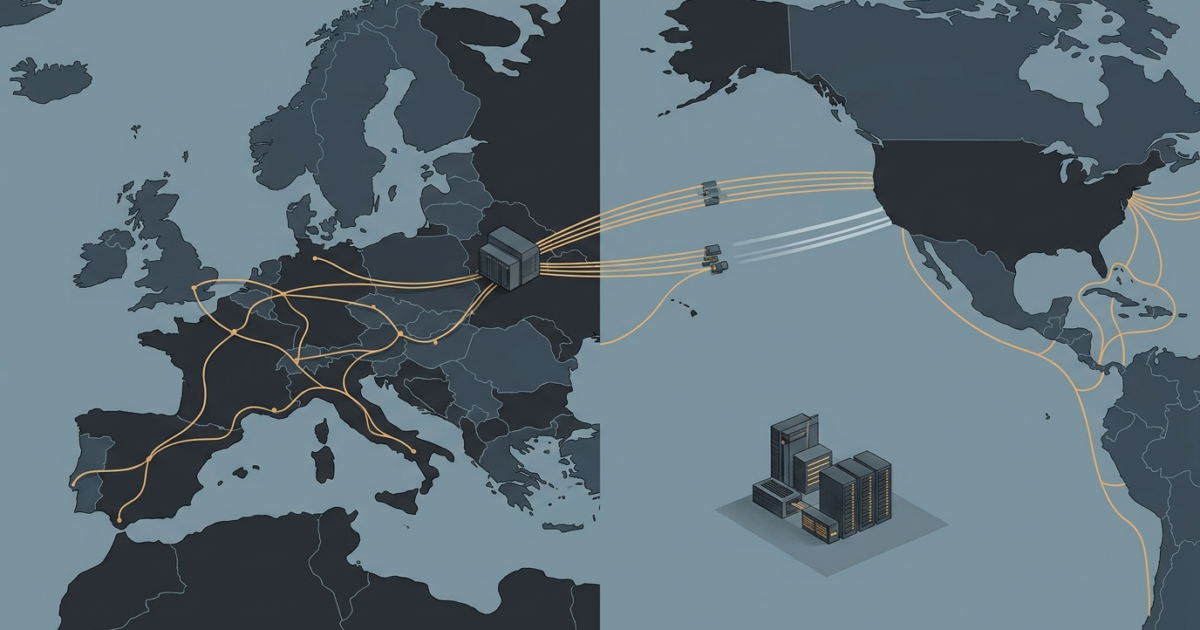
The isolation exercise scheduled for October 24 focuses on the physical and network boundaries of the new sovereign cloud region hosted in Brandenburg, Germany. AWS plans to take two primary communication pathways offline simultaneously: the private AWS Global Network backbone that shuttles operational telemetries between international facilities, and a dedicated secondary channel reserved for bounded operational transfers. Under regular operating conditions, both private channels handle daily telemetric exchanges and inter-region management tasks.
According to Stéphane Israël, managing director of the AWS European Sovereign Cloud, the partition will be operated during the drill by an operations team composed entirely of European Union residents physically located within the EU. The data centers in Brandenburg maintain independent local hardware and an in-EU mirror of the core cloud source code. AWS cautioned that customers with active connections could encounter transient disruptions while Border Gateway Protocol (BGP) routing tables converge across regional peering links, but baseline infrastructure services are projected to run uninterrupted.
AWS has clarified that neither disconnected system is required for the live runtime of customer workloads. Customer-generated data and associated metadata remain strictly confined to the European Union under standard operating procedures. The exercise is structured to generate formal compliance telemetry matching the requirements of the European Commission EU Cloud Sovereignty Framework as well as the Germany Federal Office for Information Security BSI C3A criteria, with test audit logs submitted directly to European regulatory bodies.
| Subsystem | Status During Drill | Fallback and Continuity Mechanism |
|---|---|---|
| AWS Global Network Backbone | Severed | Encrypted traffic rerouted across European ISPs over public transit |
| Operational Data Transfer Channel | Suspended | Outbound operational telemetry to non-EU facilities halted |
| Identity & Access Management (IAM) | Operational | Autonomous European partition IAM backed by an in-region root CA |
| Control Plane Software Stacks | Operational | Local in-EU copy of codebase executed on Brandenburg data center clusters |
| Systems Operations Staff | Operational | Staffed exclusively by EU residents situated inside EU territory |
ISP fallback and isolated control planes
To keep the region online without the private global fiber backbone, operational and user traffic will route through dedicated transit connections supplied by regional European ISPs. Rather than traversing internal transatlantic paths, packets will transit local exchange points over encrypted public internet connections. The test tests whether external control plane interdependencies have been decoupled from primary global regions such as us-east-1, a long-standing vulnerability in global cloud architectures during major outages.
Documentation published in the AWS European Sovereign Cloud design overview outlines that the sovereign environment runs as an entirely distinct partition. This architecture implements its own dedicated Identity and Access Management (IAM) service, localized billing modules, independent top-level domain DNS systems, and an internal European root Certificate Authority (CA). Decoupling these systems prevents global certificate revocations or remote directory failures from propagating into the Brandenburg clusters.
As hyperscalers expand European sovereign offerings—such as rival architectures integrating sovereign capabilities on Google Distributed Cloud—enterprise risk officers are closely scrutinizing whether partitioned clouds can remain truly self-sufficient when external connections drop.
Operational resilience versus legal jurisdiction

The announcement has sparked intense analysis across European infrastructure and security circles, dividing commentators between technical accomplishments and legal jurisdiction. Industry specialists emphasize that cloud sovereignty spans two independent dimensions: service survivability when physical communication is severed, and vulnerability to foreign judicial subpoenas.
Cloud security architect Fadi Dasus pointed out that cutting connectivity to the United States proves operational resilience rather than absolute sovereignty, noting that legal accountability remains tethered to the American parent company. Similarly, Lars Larsson Lundsten, field CTO at European infrastructure provider Elastisys, praised the technical achievement while noting that engineering solutions cannot overcome legal jurisdiction. Conversely, consultants analyzing the regulatory framework observed that statutes such as the US CLOUD Act and EU e-Evidence regulations require formal judicial warrants tied to criminal investigations, adding that customer-controlled cryptographic keys prevent unilateral data extraction regardless of vendor origin.
Technical leaders from municipal governments raised practical operational questions regarding the duration of the test. Odd-Arne Haraldsen, IT operations lead at Sweden’s Svenljunga Kommun, questioned whether a multi-hour simulation confirms sustained autonomy. Critical operational dependencies—such as cryptographic token lifespans, automated certificate renewals, license verification servers, and state synchronization across asynchronous distributed databases—might only exhibit failure modes after days or weeks of isolation.
What happens next
The simulated backbone disconnection will take place on Saturday, October 24, 2026. AWS plans to publish an operational post-mortem and review session following the completion of the exercise, detailing how routing convergence performed across European ISP transit points and whether control plane services reported any synchronization lag.
The resulting performance documentation will be integrated into compliance dossiers for enterprise risk officers evaluating the European Commission EU Cloud Sovereignty Framework and German BSI standards. AWS has not announced an official commercial launch date for general availability of the AWS European Sovereign Cloud, with prospective public sector and regulated enterprise buyers awaiting the October 24 findings before making formal deployment commitments.
Sources
- AWS European Sovereign Cloud: Demonstrating an independent operation | AWS Security Blog
- AWS to disconnect European Sovereign Cloud from global network in independence test
- Design approach – Overview of the AWS European Sovereign Cloud
- European Digital Sovereignty – Amazon Web Services
- AWS Will Run Its European Sovereign Cloud Without the Global Backbone for Several Hours – InfoQ
- AWS European Sovereign Cloud – T-Systems
- AWS wants to prove its cloud can survive without the US: European startups are already there