Key takeaways
- Google launched a public Gemini Notebook, “Prepare for Post-Quantum Cryptography,” consolidating its PQC research, engineering whitepapers, and migration guidance for enterprise security leaders.
- Google hardware estimates indicate that breaking ECDLP-256 and RSA-2048 requires approximately 500,000 and 1 million noisy qubits respectively, underscoring immediate Store Now, Decrypt Later (SNDL) exposure.
- Google committed to an operational roadmap to complete its internal post-quantum transition by 2029, urging enterprise CISOs to adopt accelerated cryptographic modernization timelines.
- Core enterprise CISO priorities comprise constructing complete cryptographic inventories, evaluating data retention risks, modeling network and latency impacts, and implementing crypto-agility.
Google has published a public Gemini Notebook titled "Prepare for Post-Quantum Cryptography" to help chief information security officers (CISOs), platform architects, and policymakers plan enterprise migrations to post-quantum cryptography (PQC). The interactive tool synthesizes Google’s internal cryptography research, architectural whitepapers, and engineering guides into a centralized resource. The release coincides with Google establishing an operational deadline to transition its own systems to post-quantum cryptography by 2029. With quantum computing hardware progressing rapidly, security leaders must address "Store Now, Decrypt Later" threats that leave long-retention encrypted data exposed to retrospective decryption once cryptographically relevant quantum computers emerge.
Google Deploys Gemini Notebook for Post-Quantum Readiness
The public Gemini Notebook, announced by Stephanie Kiel, Head of Cloud Security Policy at Google Cloud, aggregates disparate technical research into an operational knowledge base. Because post-quantum cryptography standards and deployment considerations are distributed across theoretical academic publications, engineering blogs, and standards bodies, organizations frequently struggle to translate cryptographic theory into procurement and migration plans.
The notebook provides interactive interfaces tailored to varying technical depth. Enterprise leaders and security practitioners can query the system using role-specific prompts, such as assessing 90-day CISO migration priorities or analyzing hybrid key encapsulation mechanisms. In addition to text-grounded responses, the notebook generates structured briefing summaries, interactive visual diagrams outlining threat models, study flashcards for security engineering teams, and audio overviews. Google emphasizes that while generative AI accelerates technical discovery, all generated architectural guidance requires verification against primary engineering specifications.
Quantum Hardware Timelines and the Harvest Threat

Underpinning the urgency of cryptographic migration are empirical benchmarks from quantum hardware development. Advances in Google’s Willow superconducting processor, the Quantum Echoes verification algorithm, and surface code error suppression have progressively narrowed the theoretical hardware requirements necessary to compromise legacy public-key encryption.
Google research estimates the hardware thresholds required to break standard asymmetric cryptography using imperfect, noisy quantum components:
| Legacy Cryptographic Primitive | Estimated Noisy Qubit Requirement | Primary Enterprise Use Cases | NIST Post-Quantum Replacement Standard |
|---|---|---|---|
| ECDLP-256 (Elliptic Curve) | ~500,000 noisy qubits | TLS 1.3 handshakes, identity tokens, digital signatures | FIPS 203 (ML-KEM) / FIPS 204 (ML-DSA) |
| RSA-2048 | ~1,000,000 noisy qubits | Root certificates, PKI infrastructure, document signing | FIPS 204 (ML-DSA) / FIPS 205 (SLH-DSA) |
These calculations substantiate the immediate threat of Store Now, Decrypt Later (SNDL) campaigns. Threat actors routinely harvest encrypted enterprise communications, proprietary intellectual property, employee health records, and classified government exchanges. Even if a fault-tolerant quantum computer capable of running Shor’s algorithm remains several years away, data requiring a confidentiality shelf life beyond that window is compromised if captured today. Waiting for physical quantum hardware to demonstrate cryptographic compromise before updating enterprise algorithms leaves existing archives unprotected.
Executive Playbook and Architectural Impact for CISOs
Historical cryptographic transitions provide clear precedent: industry-wide migrations away from SHA-1 or depreciated TLS implementations took over a decade to complete. Post-quantum migration introduces greater architectural complexity, requiring larger key sizes, increased network packet overhead, and pervasive software refactoring.
For enterprise security executives, Google outlines four baseline directives to establish institutional readiness:
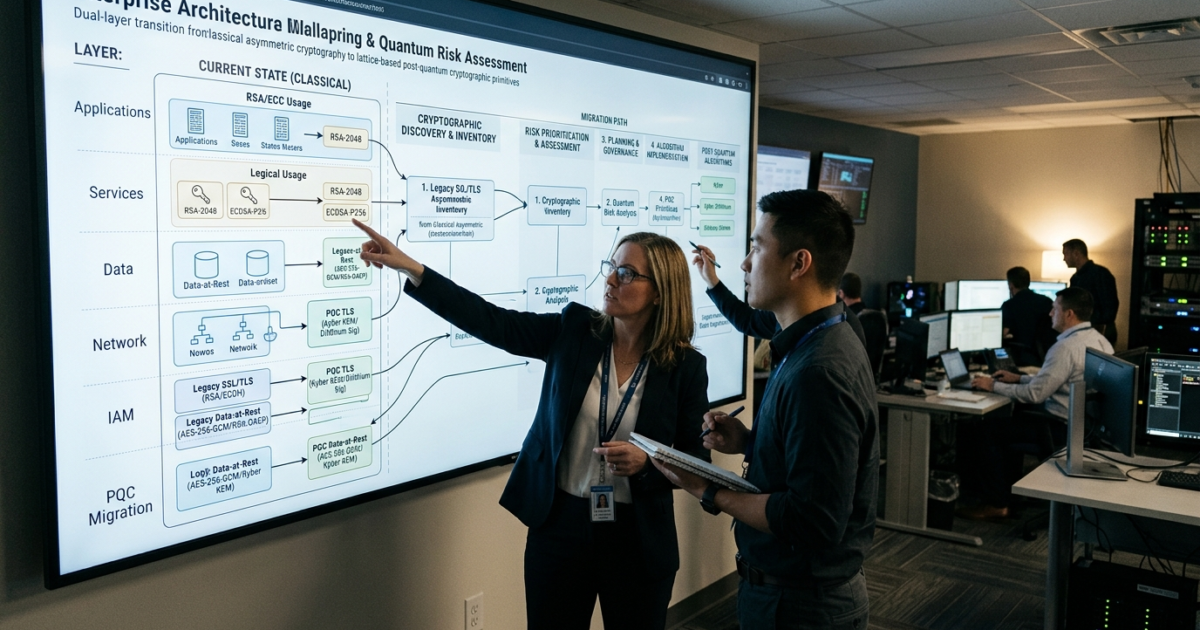
- Build an exhaustive cryptographic inventory: Discover where vulnerable asymmetric algorithms (RSA, ECDH, ECDSA) are embedded across legacy applications, APIs, digital certificates, and cloud infrastructure.
- Prioritize high-exposure data assets: Identify data stores governed by long regulatory retention mandates or strategic intellectual property requirements, prioritizing their transport and storage encryption pipelines.
- Analyze cross-system operational dependencies: Evaluate how increased ciphertext sizes in lattice-based algorithms like ML-KEM impact network MTU limits, latency budgets, and embedded device memory constraints.
- Institutionalize crypto-agility: Decouple cryptographic implementations from underlying application code, ensuring security teams can rotate algorithms without rebuilding operational workflows. Enterprises evaluating broader key management should review how encryption at rest and multi-cloud key management integrate with automated key orchestration.
Google highlighted its production deployments of post-quantum standards, which include hybrid X25519 and ML-KEM key exchange in Chrome, native PQC protections in Android, quantum-safe signing mechanisms in Cloud Key Management Service (Cloud KMS), and internal perimeter traffic protection. In parallel, Google co-founded the Post-Quantum Cryptography Alliance (PQCA) under the Linux Foundation alongside AWS, Cisco, IBM, and NVIDIA to maintain open-source reference implementations such as Open Quantum Safe.
What happens next
Google is aligning its production infrastructure to complete its post-quantum transition by 2029, setting an explicit target for enterprise suppliers and cloud customers. In the public sector, security leaders anticipate heightened pressure on critical infrastructure operators to incorporate quantum risk assessments into formal enterprise risk management filings.
In the near term, enterprise security teams must evaluate third-party software supply chains for PQC readiness. CISOs should require software vendors to provide cryptographic software bills of materials (CBOMs) and establish roadmap commitments for supporting NIST-standardized algorithms (FIPS 203, FIPS 204, and FIPS 205). Organizations that defer cryptographic inventory exercises risk encountering compressed migration cycles when regulatory mandates enforce compliance later in the decade.