Key takeaways
- A newly published patent reveals an Nvidia conversational AI assistant designed to diagnose PC game performance issues from plain-English prompts.
- The system automatically generates and executes targeted GPU profiling scripts, analyzing telemetry to pinpoint stutters, frame pacing hitches, and ray-tracing bottlenecks.
- The tool represents a developer-focused counterpart to consumer-facing AI features like Project G-Assist, shifting optimization efforts earlier into the development pipeline.
- The patent does not confirm a commercial release, and significant questions remain regarding how LLM-generated diagnostic code will be validated for accuracy and stability.
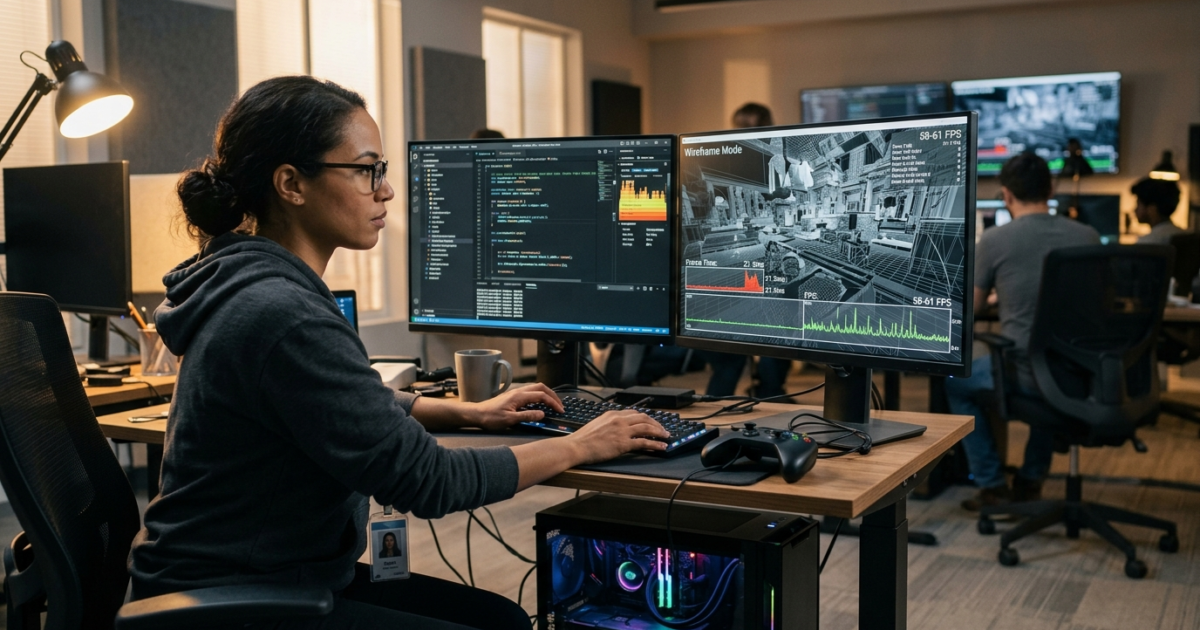
A newly published Nvidia patent filing reveals an experimental artificial intelligence system designed to automate PC game optimization. First spotted by patent analysis firm Patentlyze and reported by Tom’s Hardware, the filing outlines an LLM-based conversational assistant that allows game developers to troubleshoot rendering stutters and performance drops using natural language. Instead of manually instrumenting graphics profilers or writing custom debugging scripts, engineers can query the assistant in plain English about micro-stutters, frame pacing anomalies, or ray-tracing overhead. The system interprets the prompt, synthesizes diagnostic routines, executes them directly against the graphics processing unit, and returns interpreted telemetry to identify rendering bottlenecks before commercial release.
Translating Plain-English Prompts into GPU Profiling Code
Modern graphics debugging is among the most demanding disciplines in software engineering. Pinpointing why a title hitches during dynamic scene transitions requires navigating complex performance suites such as Nvidia Nsight Graphics or RenderDoc, analyzing draw calls, inspecting pipeline states, and interpreting raw GPU counter timelines. For many development teams working under compression toward a shipping milestone, deep hardware-level profiling is constrained by time and specialized engineering headcount.
The patent filing (US 2026/0277953 A1) outlines a system where an artificial intelligence copilot bridges the gap between natural-language observation and low-level GPU diagnostics. According to the filing documentation, a developer can describe an observed defect in conversational terms. Example prompts cited in the patent include queries such as “What is causing the micro-stutter during camera cuts?” and “Why is frame time spiking when ray-traced reflections enter the viewport?”
Upon receiving the prompt, the conversational engine synthesizes a diagnostic workflow tailored to the specific query. The assistant retrieves relevant API documentation, generates targeted profiling scripts (such as Python test harnesses), dispatches the code to execute against the GPU test environment, and parses the collected telemetry. Rather than returning gigabytes of raw trace data, the system evaluates hardware counters—such as shader execution stalls, memory bus saturation, or synchronization barriers—and returns plain-language explanations alongside suggested remediation steps.
| Workflow Stage | Traditional GPU Profiling | Patented AI Assistant Architecture |
|---|---|---|
| Diagnostic Formulation | Engineer manually isolates suspect frame and hypothesizes cause (e.g., pipeline stalls or VRAM thrashing). | Developer submits natural-language prompt describing observed symptom or frame hitch. |
| Scripting & Instrumentation | Specialist configures custom capture triggers and writes manual profiling harnesses. | Assistant automatically generates targeted diagnostic scripts and execution routines. |
| Execution & Metric Capture | Manual capture of multi-gigabyte timeline traces across draw calls and shaders. | Automated script execution directly on the GPU within a testing sandbox. |
| Bottleneck Interpretation | Graphics programmer manually parses timeline graphs, compute passes, and hardware counters. | Model interprets hardware telemetry and provides plain-English root causes and code suggestions. |
Addressing the Chronic Bottleneck of PC Game Stutter
The proposed technology targets a chronic operational vulnerability in PC game releases. Across recent release cycles, high-profile PC ports have faced player backlash over shader compilation stutter, erratic frame pacing, and poor memory management. While modern consoles feature fixed hardware targets, PC titles must run across thousands of hardware permutations, varying CPU-GPU pairings, driver revisions, and memory bandwidth profiles.
The patent indicates an architectural shift in how Nvidia deploys artificial intelligence across gaming ecosystems. At Computex 2024, Nvidia demonstrated Project G-Assist, a consumer-facing AI assistant running on GeForce RTX PCs designed to guide gamers through system tuning, overclocking, and power settings. The newly revealed patent functions as the developer-facing counterpart: rather than relying on runtime post-processing techniques like DLSS frame generation to mask performance hitches on consumer rigs, the tool seeks to catch rendering inefficiencies inside the development studio before code compiles to gold master.
The Validation Gap and Limits of LLM Diagnostics
Despite its promise for lowering the barrier to graphics optimization, the concept raises significant technical hurdles that the patent leaves unaddressed. Foremost among them is diagnostic verification. Large language models frequently hallucinate code parameters, misread subtle causal relationships, or generate flawed testing logic. In GPU performance engineering, a diagnostic script that misisolates a pipeline barrier or samples the wrong performance counter can lead engineers to optimize the wrong shader passes, squandering critical development hours.
Furthermore, running dynamically generated diagnostic code against low-level GPU drivers introduces stability considerations. Without rigorous sandboxing and static analysis of the generated profiling scripts, automated testing could trigger GPU driver crashes or race conditions. While code generation by autonomous tools presents broader operational and security challenges—an architectural friction explored in TechNode HQ’s coverage of AI agent operational security—an automated GPU profiling agent requires deterministic validation before studios can integrate it into mission-critical continuous integration pipelines.
Equally important is the legal and commercial reality of intellectual property filings. Technology hardware vendors routinely file defensive patents that remain internal research prototypes. A published patent application does not confirm that Nvidia has committed to shipping a commercial product or integrating the feature into its public software suites.
What happens next
For this concept to transition from a theoretical patent into an operational tool, Nvidia would need to integrate the assistant into established developer suites such as Nvidia Nsight Systems or distribute it as an engine plugin for Unreal Engine and Unity. Industry observers and graphics engineers will watch upcoming technical conferences, such as Nvidia GTC, for signs of developer betas or SDK announcements.
In the near term, game development teams must continue relying on disciplined manual profiling methodologies. Until AI diagnostic assistants prove capable of delivering validated, hallucination-free performance analyses across complex rendering pipelines, human graphics engineering expertise remains indispensable for delivering stutter-free PC releases.