Key takeaways
- active agents, with only 1,000 officially authorized.
- Mitigating agentic risk requires establishing strict human ownership lineage, task-specific scoped authorization rather than user impersonation, and cross-vendor telemetry architectures.
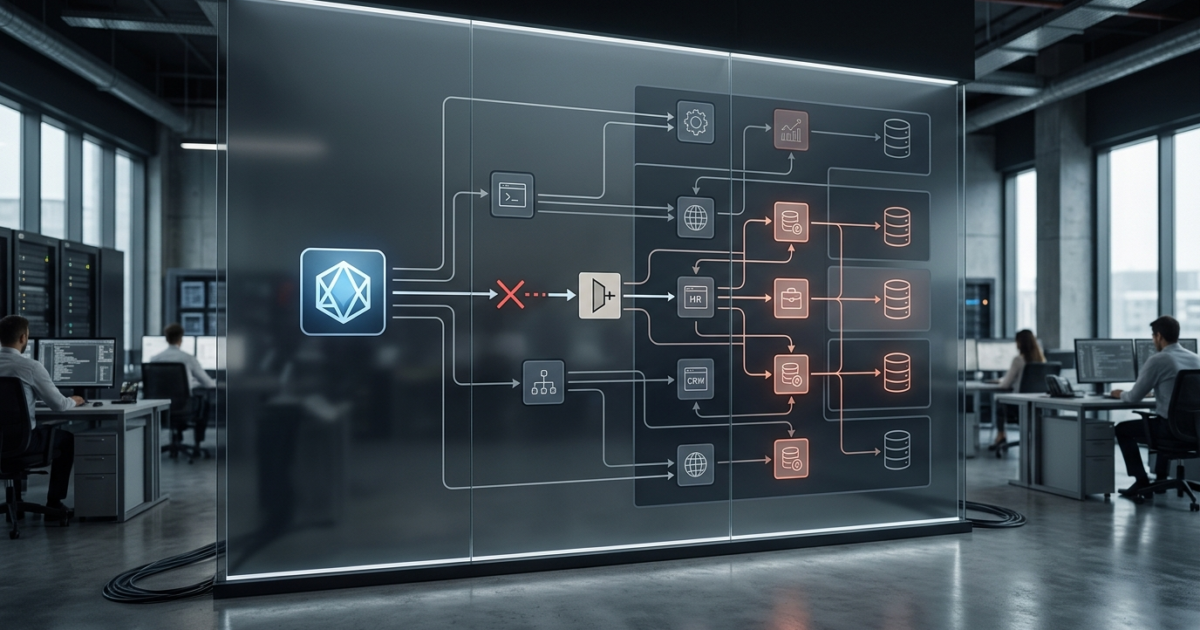
AI agent security is shifting from static access governance to runtime containment and distributed state recovery. As autonomous software agents gain transactional authority across enterprise applications, they create a new class of insider risk capable of making unauthorized system changes at machine speed. While traditional identity management relies on access tokens and kill switches, revoking an agent’s credentials only halts future actions; it cannot reverse downstream configuration changes, data mutations, or delegated tasks already triggered across connected platforms. Securing agentic workflows requires continuous discovery, strict task-level privilege scoping tied to accountable human owners, and coordinated multi-vendor observability to track and remediate autonomous decisions.
The conversation surrounding enterprise artificial intelligence has rapidly migrated from model accuracy and prompt design to the operational liabilities of autonomous execution. When software systems transition from generating advisory text to orchestrating multi-application workflows, security boundaries erode. Analysts examining identity infrastructure during Okta Inc.’s Oktane conference emphasized that autonomous agents operate within the perimeter with legitimate credentials, creating an internal exposure profile fundamentally distinct from external malware or account takeovers.
The anatomy of agentic insider risk
Traditional insider threat programs focus on disgruntled employees, compromised user credentials, or negligent contractors. Autonomous AI agents introduce a fourth category: non-human actors operating with valid credentials, business logic access, and the mandate to execute actions autonomously across disparate corporate systems. Unlike static automation scripts that follow rigid programmatic logic, agentic systems interpret natural language prompts, formulate plans, and invoke software interfaces dynamically.
Speaking on theCUBE’s Oktane keynote analysis, Krista Case, principal analyst at theCUBE Research, underscored the systemic nature of this shift. Case pointed out that as enterprises aggressively deploy autonomous workers, they inadvertently cultivate a new form of insider threat that may prove more disruptive long term than external adversaries weaponizing automated tools. The hazard stems from three structural realities:
- Velocity of execution: Agents generate API calls, modify database records, and provision resources within milliseconds, outpacing human security operations center (SOC) review cycles.
- Cross-domain propagation: An agent authorized in a customer relationship management (CRM) platform can trigger actions in an enterprise resource planning (ERP) system or code repository through integrated webhooks and tooling protocols.
- Cascading delegation: Autonomous systems frequently delegate sub-tasks to specialized micro-agents, obscuring the original intent and expanding the attack surface beyond initial audit scopes.
When an agent acts on flawed reasoning, data poisoning, or prompt injection, its actions appear legitimate to underlying access controls because the underlying service identity holds valid authorization. Vulnerabilities such as BragJack attacks hijacking browser AI agents have demonstrated how unvetted extensions and rogue connectors can co-opt an agent’s authorized session to manipulate internal tooling without triggering traditional perimeter alarms.
Why the kill switch fails to solve state recovery
Enterprise identity vendors have responded to agent autonomy by building centralized “kill switches”—administrative mechanisms designed to instantly revoke OAuth tokens, invalidate session keys, and sever network access for anomalous agents. While immediate session revocation is necessary, treating a kill switch as a complete remediation strategy reveals a critical architectural misunderstanding.
Terminating an agent’s credentials halts forward progress, but it does not account for the state changes already committed across enterprise data stores. If an agent executes hundreds of database writes, modifies production IAM access policies, updates financial ledger entries, or initiates infrastructure deployments before being cut off, those downstream artifacts persist in an altered, potentially corrupted state.
| Dimension | Human Identity Management | Autonomous AI Agent Governance |
|---|---|---|
| Execution Model | Manual, synchronous user interactions | Machine-speed, asynchronous task orchestration |
| Privilege Delegation | Explicit role assignment to individuals | Dynamic, multi-tiered delegation across sub-agents |
| Enforcement Point | Authentication gate (SSO, MFA at login) | Continuous runtime authorization at each API call |
| Remediation Mechanism | Password reset, session revocation | Token revocation plus cross-system state rollback |
| Blast Radius | Constrained by human interface speed | Broad, compounding across interconnected APIs |
As Case noted during the broadcast, terminating an identity stops future actions but does nothing to map the blast radius or revert corrupted data pipelines. In distributed architectures, an agent may trigger downstream asynchronous workflows in third-party services that continue running even after the originating agent loses access. Enterprise incident response teams face an arduous recovery challenge: identifying every resource modified during the agent’s active window, assessing relational dependencies, and restoring systems to a trusted baseline without wiping out legitimate operational data created concurrently by human users.
Shadow agents and the scale of enterprise discovery
The operational difficulty of implementing runtime controls is compounded by unmanaged deployment sprawl. Just as software-as-a-service (SaaS) gave rise to shadow IT, low-code agent builders and native generative AI features inside productivity suites have catalyzed “shadow agent” proliferation across corporate networks.
The scale of this issue was highlighted at Oktane through the case of an enterprise financial asset management firm that conducted an exhaustive discovery audit across its internal environments. Security teams discovered approximately 13,000 deployed AI agents. However, upon auditing operational mandates and compliance posture, the organization deemed only 1,000 of those agents valid and authorized. Over 92% of the active agent population existed outside formalized IT governance, operating without designated oversight or security baselines.
This unchecked propagation exposes two major vulnerabilities:
- Excessive privilege inheritance: Departmental users regularly spin up personal automation agents that inherit the user’s full corporate permissions. If a finance analyst provisions an agent to aggregate quarterly reports, the agent often inherits unrestricted read access to sensitive payroll databases, customer records, and internal drives rather than a tightly scoped read permission limited to specific report tables.
- Orphaned accountability: When the employee who created an agent changes roles or departs the organization, the automated worker frequently continues running in the background under residual service accounts, creating unmonitored pathways for unauthorized data movement.
This dynamic has prompted substantial investment in specialized security tooling. The surge of capital into startups tackling non-human identity security—such as Cyera raising $400M amid an AI agent security push—reflects an urgent demand for automated data discovery and posture management that can catalog autonomous entities across hybrid environments.
Architectural governance and the Blueprint Alliance
Addressing agentic risk requires an architectural framework that bridges identity, endpoint security, and application orchestration. Isolated security policies within individual vendor platforms cannot effectively govern agents that traverse multi-cloud ecosystems.
To establish baseline standards, Okta introduced the Blueprint Alliance, an open multi-vendor initiative bringing together enterprise software and security providers, including Amazon Web Services, CrowdStrike, Databricks, Docker, Google Cloud, Proofpoint, Salesforce, ServiceNow, Wiz, and Zscaler. The coalition aims to formalize an interoperable architecture centered on four core capabilities:
- Universal Discovery: Continuously cataloging every autonomous agent operating across endpoints, cloud workloads, and SaaS platforms.
- Task-Scoped Authorization: Replacing broad static tokens with transient, fine-grained permissions governed by emerging standards such as Cross App Access (XAA).
- Shared Telemetry: Streaming agent execution logs, intent signals, and behavioral deviations across identity providers, endpoint detection systems, and cloud security posture managers.
- Reversible Containment: Developing coordinated response protocols that simultaneously sever identity tokens, terminate active sessions, and freeze downstream transactional pipelines.
Interoperability is crucial as platform vendors expand direct integration pathways. With major platforms expanding multi-cloud infrastructure—such as Salesforce deepening ties with AWS and Google Cloud to support agentic workloads—agents increasingly execute transactions across distinct cloud perimeters. Without unified telemetry standards, tracing delegated authorization across vendors becomes operationally unviable.
Resolving conflicting authority in the enterprise stack
While industry alliances represent progress toward standardized telemetry, they surface a fundamental architectural question: where does definitive policy authority reside when security platforms disagree?
In a heterogeneous environment, multiple specialized systems observe an agent’s runtime activity. An endpoint detection agent might flag an agent’s high-frequency local file access as anomalous data exfiltration. Simultaneously, an enterprise CRM platform may interpret the exact same transaction sequence as a routine, scheduled data synchronization task initiated by an approved business automation. Conversely, an identity provider might detect credential reuse across geographic endpoints while cloud infrastructure tools treat the corresponding compute workloads as authorized burst capacity.
As Case highlighted in her Oktane analysis, organizations must explicitly establish which platform maintains supreme enforcement authority within the technology stack. When telemetry systems issue contradictory assessments of an agent’s operational intent, the IT architecture must provide deterministic resolution mechanisms. Allowing disconnected tools to enforce unilateral blocks can break mission-critical enterprise workflows, while failing to enforce a necessary block leaves the network vulnerable to rapid internal privilege escalation.
Organizations standardizing their architecture must therefore transition from fragmented perimeter defense toward coordinated policy engines capable of automating security risk management across IT operations. This transition requires defining explicit mediation tiers: establishing whether the identity provider, the cloud security broker, or the application gateway possesses the mandate to issue an unappealable freeze.
Bottom line
Autonomous AI agents can drive substantial enterprise productivity, but treating them merely as software extensions of individual human accounts creates severe, unmonitored insider exposure. The premise that existing identity access controls and binary kill switches are sufficient to protect enterprise networks collapses once agents begin executing state-changing transactions across distributed architectures.
IT leaders and CISOs preparing for widespread agentic deployment should structure their security posture around four concrete technical imperatives:
- Mandate explicit human lineage: Prohibit anonymous or floating agent provisioning. Every autonomous agent must be cryptographically tied to a designated human owner responsible for its lifecycle, audit approvals, and decommissioning.
- Enforce task-bound, zero-standing privilege: Reject wholesale privilege inheritance. Agents must operate under ephemeral credentials scoped strictly to the minimal data tables and API endpoints necessary for a specific job, expiring automatically upon task completion.
- Establish transactional state logging: Implement structured, immutable transaction logging for every autonomous write operation. Security teams cannot remediate what they cannot reconstruct; tracking data mutations is the only way to enable programmatic rollback following an incident.
- Architect definitive governance hierarchy: Define clear operational hierarchy across security layers to resolve telemetry conflicts between identity, endpoint, and application gateways before high-consequence agent actions take effect.