Key takeaways
- Major studios are aggressively hiring AI talent despite public industry pushback and recent union strikes.
- Over 10% of recent entertainment job postings involve building or managing generative AI workflows.
- Netflix and Disney are constructing proprietary, unified AI access platforms for production and analytics.
- AI fundamentally alters post-production tasks like rotoscoping, dialogue replacement, and visual effects.
- The shift to AI in filmmaking represents a massive reduction in TCO for major entertainment conglomerates.
The Architectural Reality
The entertainment industry is currently undergoing a profound technological metamorphosis, one that is largely hidden from the public eye. While actors protest and studios navigate complex legal battles regarding intellectual property, the reality on the ground is starkly different: Hollywood AI integration is not a future prospect; it is the current operational standard. Despite the high-profile opposition to AI—most notably highlighted during the paralyzing 2023 WGA and SAG-AFTRA strikes—the internal infrastructure of major entertainment conglomerates is rapidly reorienting around generative artificial intelligence.
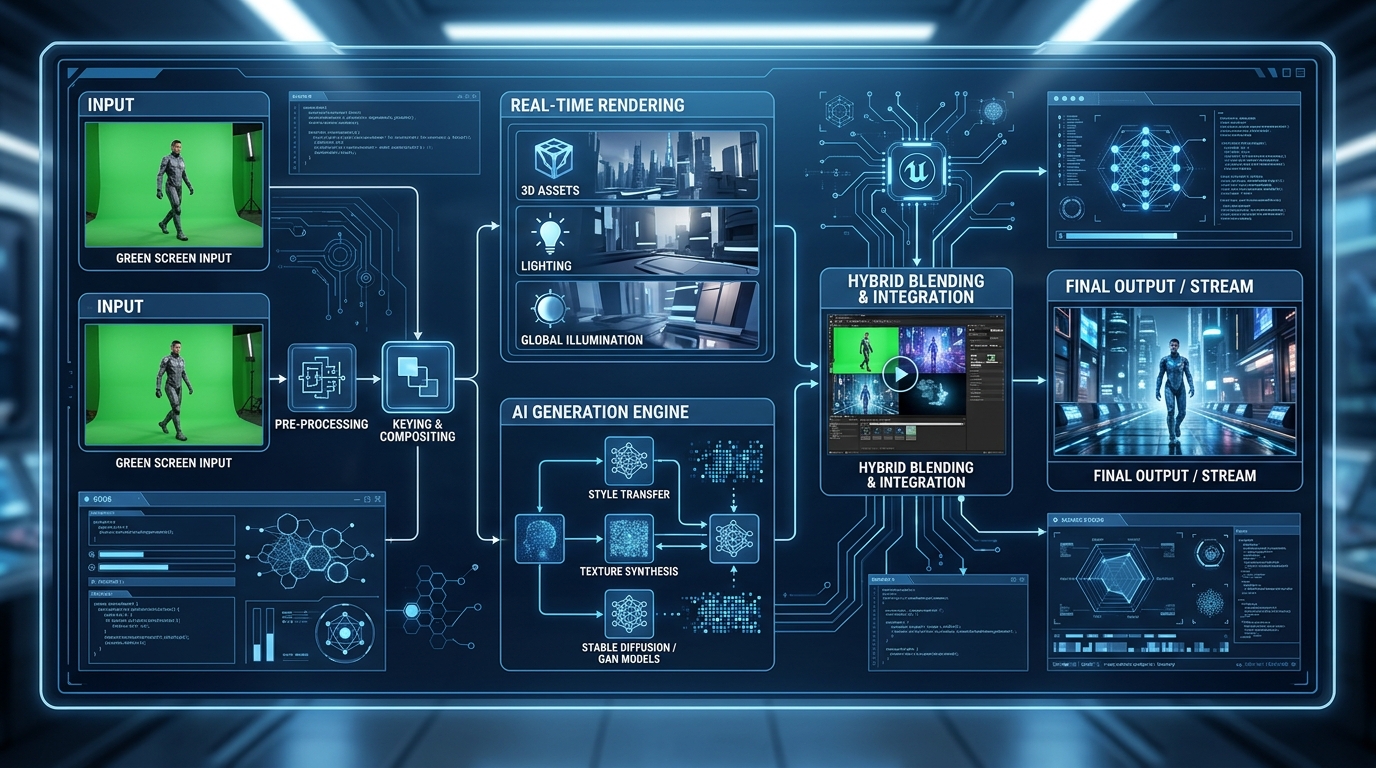
At an architectural level, the tools being deployed are far more sophisticated than simple prompt-based text generators. Studios are building comprehensive machine learning architectures that infiltrate every stage of the production pipeline. In pre-production, AI systems are digesting decades of box office data to suggest optimal casting decisions, refine script structures for demographic appeal, and automate complex budgeting matrices. The goal is to minimize financial risk before a single frame is shot.
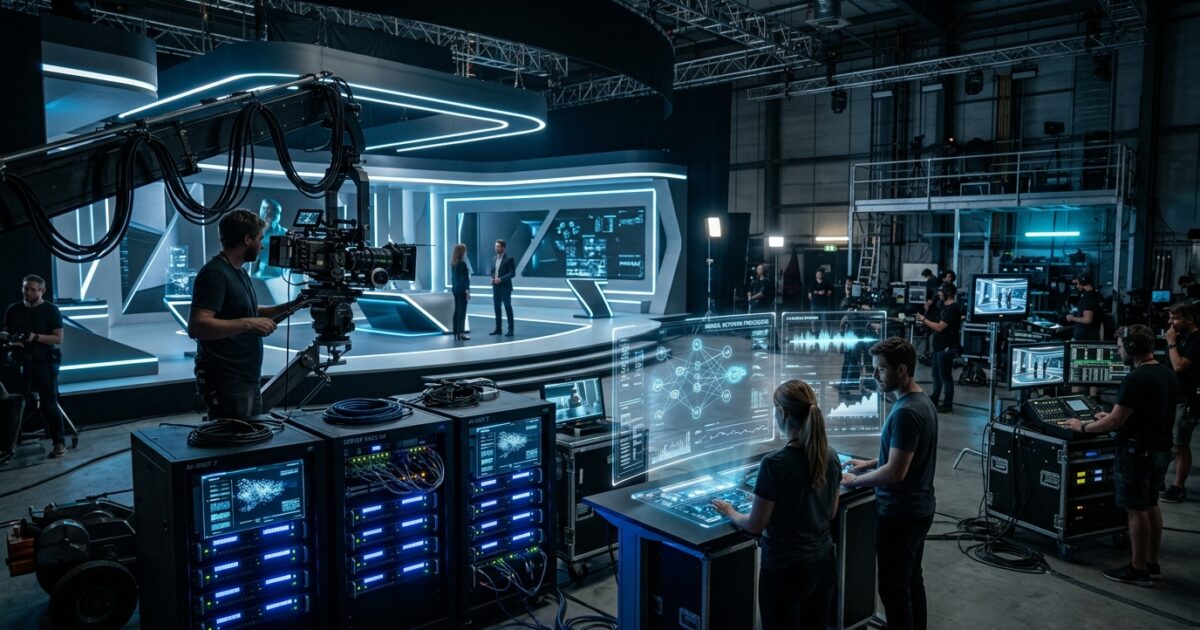
During principal photography, the technology manifests in virtual production environments. The use of massive LED volumes for real-time digital backdrops—a technique popularized by productions like The Mandalorian—now relies heavily on AI-assisted lighting and environment adjustments. These systems dynamically track camera movements and instantaneously render photorealistic backgrounds with accurate parallax and lighting reflections. This represents a monumental leap in computational photography and real-time rendering, blurring the line between physical set construction and digital fabrication.
However, it is in post-production where the integration is most aggressive and transformative. AI tools are increasingly deployed for labor-intensive tasks such as rotoscoping, dialogue replacement (ADR), and extensive visual effects clean-up. For example, Skywalker Sound is reportedly recruiting talent to build proprietary AI models tailored for soundtracks, voice separation, and voice transfer. This allows engineers to extract a specific speaker’s tone and pitch and seamlessly apply it to new, synthesized content. To facilitate this massive technological shift, companies are leveraging third-party software while also constructing robust internal platforms. Tools like ComfyUI are becoming essential node-based interfaces, helping studios juggle different AI models and integrate them into their established render farms.
Market Impact & Deployment
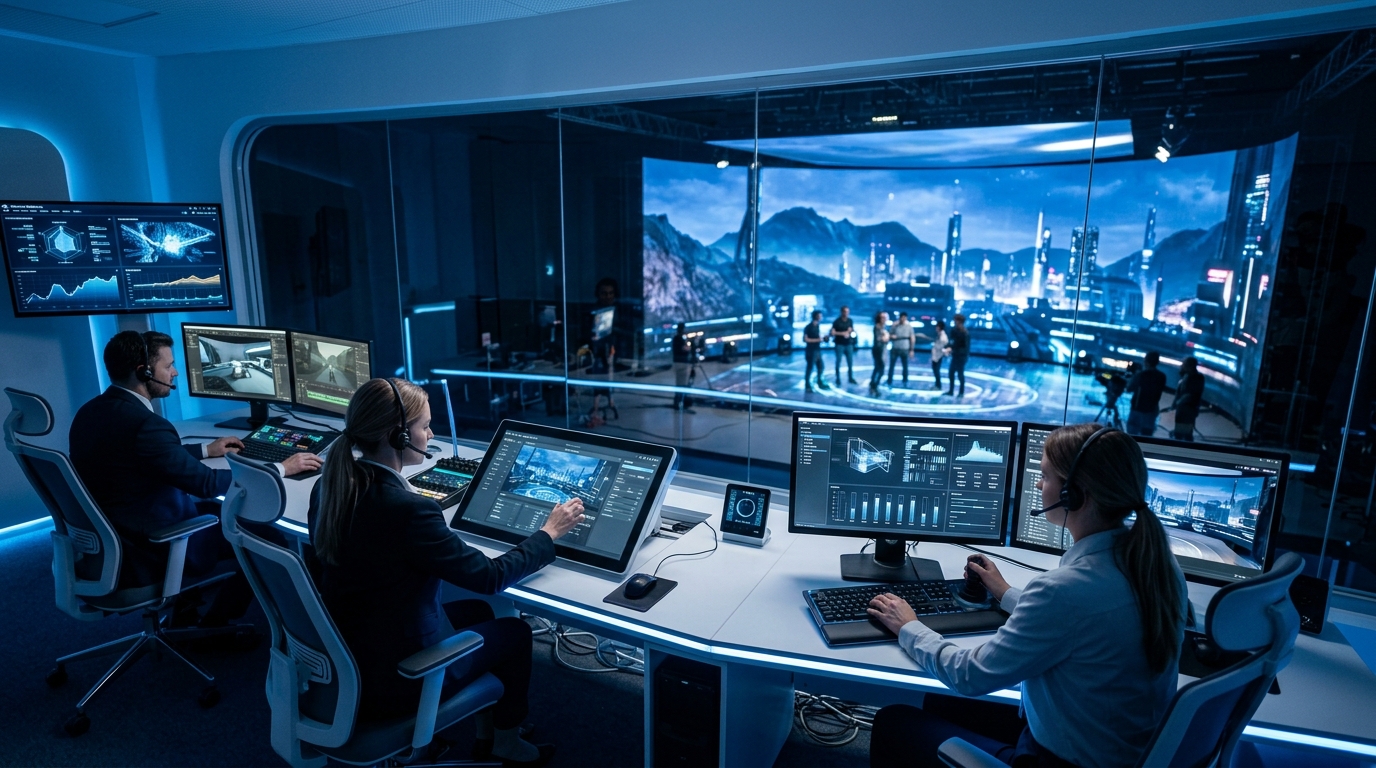
The financial implications of this technological pivot are staggering. For C-level executives at major studios, the Total Cost of Ownership (TCO) for producing a tentpole blockbuster has ballooned to unsustainable levels over the last decade. Generative AI offers a brutal, yet highly effective, corrective mechanism. By automating thousands of hours of manual labor in VFX, sound mixing, and background generation, studios can theoretically slash post-production budgets by unprecedented margins.
The hiring data provides an indisputable map of this strategic deployment. An analysis of hundreds of entertainment job postings reveals that more than one in ten are directly connected to building or managing AI tools. Netflix, for instance, has been remarkably open in executive circles about its ambition to become an “AI Native” company. The streaming giant is actively hiring for roles in AI Foundation & Tooling, Agent Platforms, and Revenue Analytics. Furthermore, Netflix positions heavily emphasize building enterprise infrastructure that provides unified internal access to top-tier Large Language Models (LLMs) such as Claude, GPT, and Gemini. This indicates a desire to create a centralized, secure environment where creative and operational teams can leverage these models without leaking proprietary data.
Disney’s approach is similarly aggressive but leans heavily into foundational research and development. The House of Mouse is aggressively recruiting PhD-level talent to study “computer graphics and AI” specifically for Pixar and Disney Animation. Disney’s initiatives involve research scientists deeply focused on spatial media and the next generation of 3D generative models. By controlling the foundational models rather than just relying on API calls to external vendors, Disney aims to build a moat around its intellectual property while simultaneously revolutionizing its animation workflows.
Yet, this aggressive deployment is deliberately cloaked in euphemism. Because of the extreme industry sensitivity and fear of consumer and union backlash, job roles are frequently posted with a focus on “innovation,” “personalization,” and “operational efficiency.” The industry is treating AI like cosmetic surgery—everyone is acutely aware that it is happening, and the results are on the screen, but very few are willing to openly admit to the procedure. Furthermore, because filmmaking is an inherently global endeavor, studios possess the geographic arbitrage to move AI-heavy workloads to international territories with fewer regulations on data ethics or the use of digital replicas, thereby bypassing domestic union constraints.
Cross-Industry Implications
The tools being forged in the fires of Hollywood production will inevitably bleed into other sectors. The highly optimized voice transfer technologies being developed by audio post-production units have immediate, disruptive applications in customer service automation, localized marketing, and video game development. Similarly, the 3D generative models being heavily funded by animation studios will drastically accelerate the deployment of virtual and augmented reality experiences in retail and architectural visualization. When you master photorealistic rendering for a blockbuster movie, applying that exact same technology to virtual real estate tours or digital fashion showcases is a trivial leap.
The Consumer Translation
For the average consumer sitting in a movie theater or streaming content at home, this highly technical shift will initially be invisible, but eventually undeniable. The immediate public impact is not going to be fully AI-generated blockbuster films featuring entirely synthetic actors. The Academy of Motion Picture Arts and Sciences has already implemented strict rules to restrict entirely AI-generated work from award consideration, ensuring a baseline of human involvement remains the prestigious standard.
Instead, the consumer experience will shift through hyper-abundance and hyper-personalization. As production costs plummet and workflows accelerate, the volume of high-quality, visually stunning content will increase exponentially. The traditional bottleneck of physical production—coordinating schedules, building practical sets, waiting for perfect weather—is being systematically eliminated. Filmmakers like George Lucas recognize this inevitability, likening the rejection of AI to choosing a horse and buggy over an automobile. For storytellers, the barrier to translating imagination onto the screen has never been lower.
However, this transition forces a cultural reckoning. As AI is quietly baked into movies, consumers will increasingly interact with media where the line between human performance and algorithmic generation is impossible to discern. Background extras will be digital constructs. A deceased actor’s voice will be flawlessly synthesized for a prequel. A breathtaking alien landscape will be generated in seconds based on a director’s rough sketch. The public is being slowly acclimatized to synthetic media. If the industry’s strategy succeeds, audiences will accept these AI-enhanced realities not as technological novelties, but simply as the new standard for visual storytelling.
To understand this shift, think of it like the transition from practical special effects to CGI in the 1990s, but applied not just to visual spectacle, but to the very logic and logistics of production itself. It is a fundamental rewiring of the entertainment supply chain, optimizing for speed and scale while fiercely protecting the lucrative intellectual property that drives the industry’s revenue.
Frequently Asked Questions
Q1: How are Hollywood studios currently using AI?
A1: Studios actively use AI for box office analytics, pre-production budgeting, virtual production lighting, and post-production tasks like rotoscoping and dialogue replacement. Major companies like Disney and Netflix are hiring dedicated researchers to build custom generative models.
Q2: Why are studios keeping their AI integration quiet?
A2: There is significant tension and public pushback against AI in Hollywood, particularly following the 2023 WGA and SAG-AFTRA strikes. Studios fear consumer backlash and regulatory scrutiny over data ethics and digital replicas.
Q3: What kind of AI jobs are Hollywood studios hiring for?
A3: Studios are hiring for roles in AI Foundation & Tooling, spatial media research, and building unified access to LLMs like Claude, GPT, and Gemini. Roughly one in ten recent job postings from major studios were connected to AI.
TechNode HQ Verdict: Pros, Cons & Usability
- Pro (Engineering): Radically reduces rendering times and labor hours for rotoscoping and VFX cleanup through automated machine learning pipelines.
- Pro (Consumer): Enables storytellers and independent creators to achieve massive, blockbuster-scale visuals on drastically reduced budgets.
- Con: The technology introduces severe legal and ethical liabilities regarding the unauthorized use of actors’ likenesses and copyrighted training data.
- Con: Vendor evaluations reveal that integrating fragmented, bleeding-edge AI models into stable, legacy studio pipelines remains highly complex and error-prone.
Enterprise Usability: CTOs and technical directors in media should aggressively pursue isolated AI deployments in post-production (like audio separation and rotoscoping) where the ROI is immediate and undeniable. However, full generative workflows for final pixels should be sandboxed until legal precedents regarding copyright are firmly established.
Everyday Usability: For independent creators and consumers, the current suite of AI video and audio tools offers unprecedented creative leverage. The technology is rapidly democratizing high-end production value, making it highly recommended for immediate adoption by forward-thinking creators.