Key takeaways
- The Orchid features a 16-voice polyphonic engine with VA, FM, and vintage reed piano synthesis.
- A proprietary Chord Logic System abstracts music theory, generating complex 9th and 7th chords instantly.
- Secondary market prices fluctuate wildly from the $549-$599 MSRP due to limited late-2024 manufacturing batches.
- The unit supports traditional 5-pin MIDI and modern USB-C, acting as a versatile DAW controller.
- Proprietary Pistil software is required for deep patch design, which currently suffers from UI instability.
For decades, the intersection of hardware synthesizers and compositional workflow has been fraught with steep learning curves and complex interface constraints. Today, the Telepathic Instruments Orchid disrupts this paradigm by offering a profound architectural shift in how harmony is digitally generated. Co-founded by Kevin Parker of Tame Impala, this innovative device is explicitly designed as a chord-generating synthesizer aimed at streamlining the songwriting process. Rather than forcing creators to master the demanding biomechanical fingerings required for advanced music theory, the Orchid abstracts the heavy lifting into a tactile, macro-driven hardware interface. It represents a fascinating bridge between vintage aesthetic charm and cutting-edge digital signal processing, breaking down the barriers between immediate musical ideation and polished studio execution.
The Architectural Reality of the Telepathic Instruments Orchid

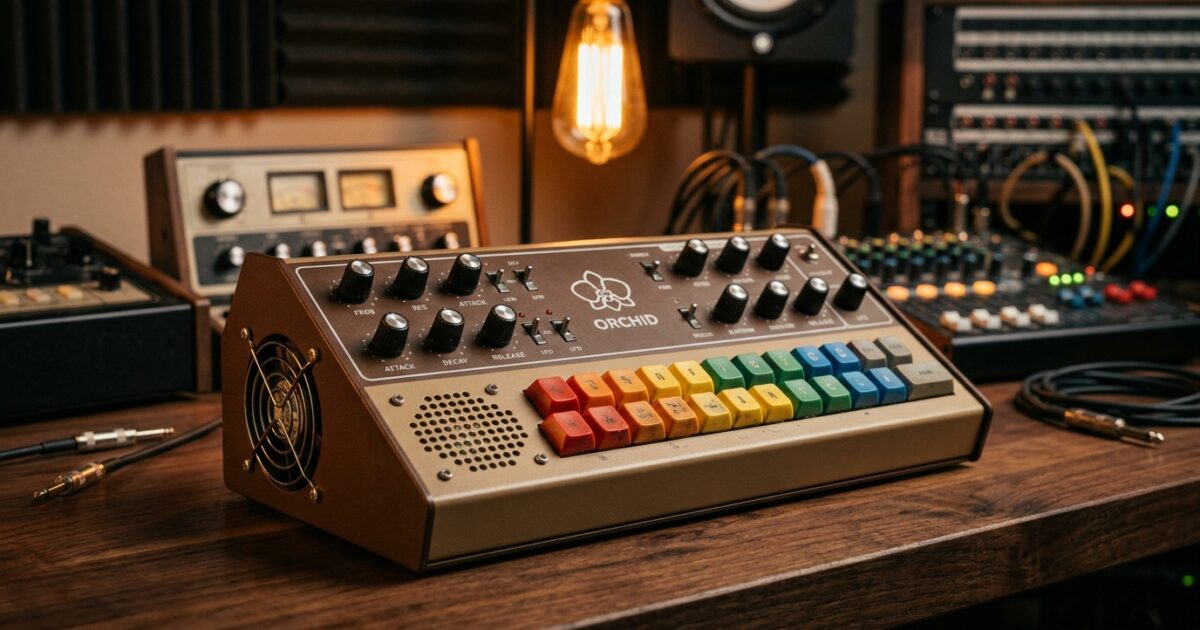
Beneath its aesthetically retro, brown-and-tan chassis—which playfully nods to the fan vents of vintage Bontempi and Magnus chord organs—lies a formidable digital architecture. The Telepathic Instruments Orchid is powered by a robust 16-voice polyphonic engine. This high voice count provides the necessary computational headroom to process massive, overlapping chord extensions without suffering from the dreaded voice-stealing dropouts that plague lesser hardware. The internal Digital Signal Processing (DSP) pipeline is divided into three distinct synthesis engines: a Virtual Analogue (VA) engine for rich, subtractive analog-style textures; an FM (Frequency Modulation) synthesis engine designed to recreate the crystalline, metallic bell tones and electric pianos of the 1980s; and a specialized vintage reed piano emulation that faithfully captures the warmth of classic Wurlitzer and Rhodes instruments.
In addition to this primary polyphonic core, the device houses a completely separate, dedicated monophonic bass engine. This low-end module features 12 distinct foundational tones, ranging from Moog-style sawtooth growls to tuned 808 sub-basses and aggressive Electronic Dance Music (EDM) drones. To shape these raw digital waveforms, the hardware includes a comprehensive suite of onboard stereo effects, including Reverb, Chorus, Delay, Flanger, Phasor, and Overdrive, allowing producers to sculpt mix-ready tones directly at the hardware source.
The physical human-machine interface is where the Orchid truly diverges from standard hardware silicon architecture. The Chord Logic System relies on a tightly integrated matrix of 8 chord-type and modifier keys positioned deliberately to the left of a single-octave, velocity-sensitive keyboard. When this layout is combined with a patent-pending rotary encoder dedicated to a proprietary voicing system, users can seamlessly re-pitch and reposition chords in real-time. This mechanism instantly applies complex harmonic extensions—like 6ths, 7ths, and 9ths—without requiring the user to manually calculate the underlying interval mathematics.
Market Impact and Deployment Economics
From a deployment economics perspective, the Orchid enters the professional audio market with a fascinating value proposition. At a standard retail price of $549 to $599 USD, it represents a substantial capital expenditure compared to the vintage acoustic equipment it lovingly emulates. For historical context, 1960s mechanical Magnus chord organs—which relied on a crude internal electric fan blowing air over physical plastic reeds—can often be procured on secondary markets for as little as $10. However, the Orchid is not merely a nostalgic toy; it is a highly sophisticated piece of modern studio infrastructure. The device was officially announced in late 2024 and deliberately released in limited manufacturing batches. Consequently, supply chain scarcity has caused secondary market prices on reseller platforms like Reverb and eBay to wildly fluctuate.
For a commercial recording studio or a working professional songwriter, the Total Cost of Ownership (TCO) calculation heavily favors the deployment of the Orchid. Consider the standard studio hourly rate and the exorbitant cost of hiring a session keyboardist simply to iterate through complex chord progressions during an early songwriting session. The Orchid acts as an immediate workflow accelerator, allowing vocalists and track producers to rapidly prototype harmonic structures without relying on external personnel. By drastically reducing the latency between musical conception and audible studio execution, the Orchid achieves a rapid return on investment. This efficiency cements its vital place in the modern synthesizer reviews and comparisons landscape as a high-value utility tool rather than an overpriced indie luxury.
The Consumer Translation
For the everyday consumer, bedroom producer, or aspiring singer-songwriter, the highly technical specifications of the Orchid translate into pure, unadulterated creative liberation. The instrument fundamentally democratizes complex musical expression, welcoming those who have historically been intimidated by the piano. A user with absolutely zero formal music theory training can hold the ‘C’ key alongside the ‘Major’ modifier to instantly hear a perfectly voiced C Major chord, or press ‘F#’ and ‘9’ to generate a lush, jazz-infused F#9. To further prevent user error during live recording, the system allows the entire keyboard to be digitally locked to a specific key signature (such as E minor or Bb major). This safeguard ensures that every accidental key press remains perfectly in tune with the broader composition.
This democratization of the consumer tech ecosystem is elevated by the Orchid’s suite of onboard performance modes. Instead of outputting rigid, robotic blocks of MIDI sound, users can engage Strum, Harp, Arpeggiator, and Pattern modes to inject kinetic, rhythmic movement into their chord progressions. Most notably, the highly praised ‘Slop’ mode deliberately introduces randomized, micro-timing imperfections into the MIDI triggering, flawlessly simulating the nuanced, slightly uneven, organic timing of a real human instrumentalist.
Furthermore, the Orchid functions effectively as a self-contained groovebox. It features a lo-fi, twee-sounding drum machine packed with 13 preprogrammed drum patterns heavily inspired by 1970s rhythm machines like the cult-classic Korg Mini Pops. When combined with the integrated audio looper, a solo artist can independently lay down a drum beat, record a thumping bassline, stack a rich chord progression, and perform a soaring lead melody—all from a compact, battery-powered unit equipped with built-in stereo speakers. It transforms the often intimidating blank canvas of a Digital Audio Workstation into an immediate, tactile playground.
Cross-Industry Applications
While explicitly marketed toward indie musicians and synthesizer enthusiasts, the underlying technology of the Orchid ORC-1 holds significant disruptive potential across entirely adjacent industries. In the realm of music education and cognitive therapy, the instrument presents a zero-friction interface for harmonic exploration. Students and patients can visually and audibly map the relationships between complex chord extensions without being hindered by the initial lack of manual dexterity required for traditional piano instruction.
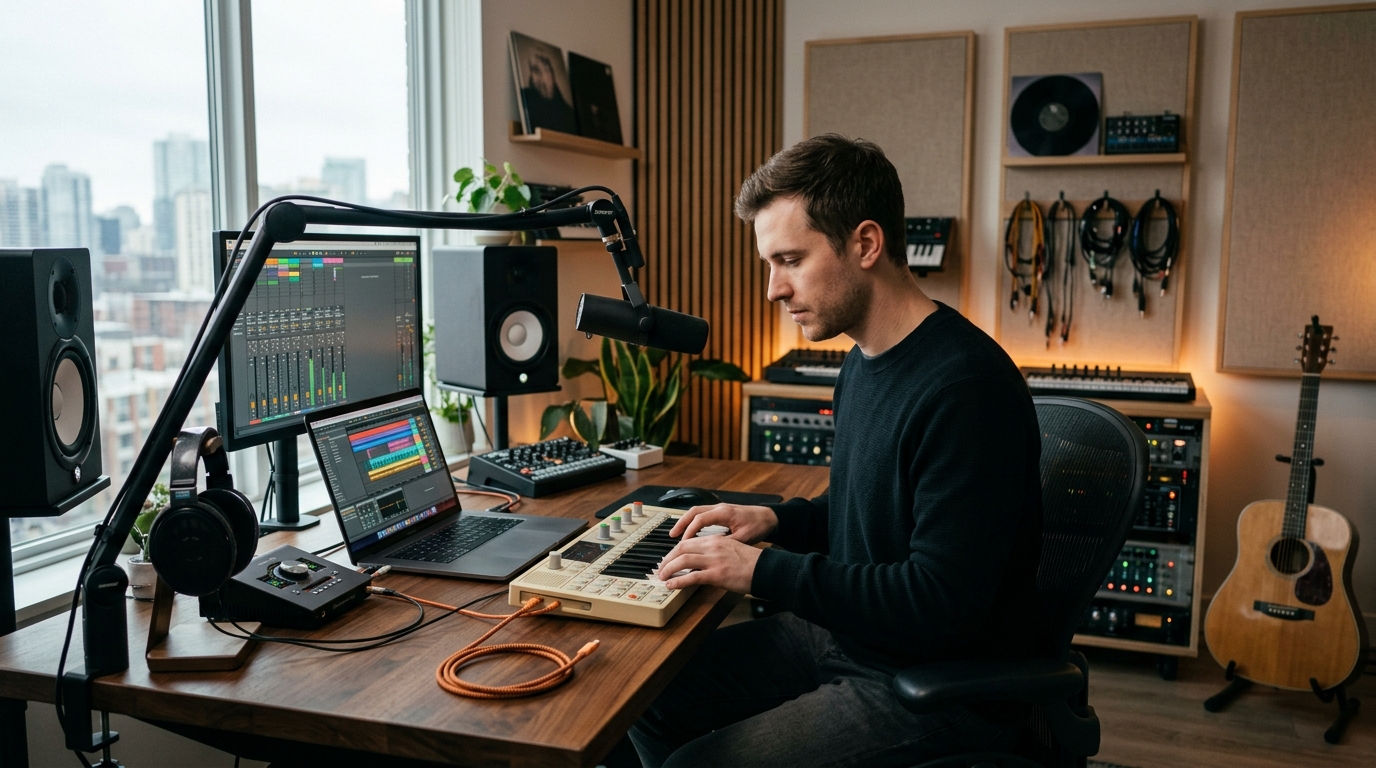
Additionally, in the fast-paced world of digital media production, indie filmmaking, and video game development, the Orchid serves as an unparalleled rapid prototyping tool. Content creators, podcasters, and solo game developers frequently require original, copyright-free ambient soundscapes or emotional musical beds, but lack the exorbitant budget for a dedicated film composer. Because the Orchid is fully capable of transmitting rich chord data via modern USB-C to a DAW, as well as utilizing traditional 5-pin MIDI to function as a master controller for external hardware synths, a solo developer can instantly generate professional-grade, multi-layered scores. The technical barrier to entry for producing high-fidelity audio assets is effectively shattered, allowing creators to maintain complete intellectual property ownership over their cinematic soundtracks.
Executive Abstraction: The API of Music Theory
To conceptualize the hardware architecture of the Orchid for non-engineering stakeholders, consider the device as a physical API (Application Programming Interface) for music theory. In enterprise software ecosystems, developers utilize APIs to abstract away incredibly complex backend server routing, database queries, and security protocols, allowing them to rapidly deploy a user-facing feature with a single line of code. The Orchid’s Chord Logic System functions identically. Instead of requiring the user to manually calculate and execute the biomechanical finger placement for a sprawling 9th chord across a physical keyboard interface, the user simply queries the “API” via a two-button macro. The underlying compute architecture instantly resolves the chord structure, applies the correct DSP effects, and delivers the polished audio payload, accelerating the studio ideation pipeline by orders of magnitude.
Red Team Audit: Bottlenecks and Limitations
Despite its elegant front-end design, a rigorous red team audit of the Telepathic Instruments Orchid reveals distinct architectural bottlenecks. First, the physical input array is severely constrained; the inclusion of only a single-octave keyboard means traditional, virtuosic two-handed playing is structurally impossible. A user who possesses the requisite knowledge to manually voice a Dm13 chord is locked out from executing it organically due to the missing physical keys. Second, the software ecosystem introduces substantial operational friction. To design custom synth patches beyond the 70 factory presets, users are forced to purchase the proprietary Pistil virtual synth software for an additional $99 (or $50 if bundled). Current deployment reports indicate that the Pistil UI suffers from software instability, frequently freezing during patch transfers to the hardware.
Finally, voice management presents a frustrating limitation. While the main synthesizer engine boasts impressive 16-voice polyphony, the accompaniment bass engine is strictly monophonic and shares execution space clumsily in certain algorithmic patches. If a synth pad patch features an extended release and decay time, engaging a solo note can abruptly truncate the chordal release, creating a jarring, unmusical artifact that interrupts the creative workflow.
Frequently Asked Questions
Q1: What is the Telepathic Instruments Orchid?
A1: The Orchid ORC-1 is an innovative hardware synthesizer created by Telepathic Instruments, co-founded by Kevin Parker of Tame Impala. It is designed primarily as a chord-generating synthesizer that abstracts away complex music theory to streamline the songwriting process.
Q2: What sound engines are built into the Orchid?
A2: The synthesizer features a 16-voice polyphonic engine with three distinct sound models: virtual analogue (VA), FM synthesis, and a vintage reed piano emulation. It also includes a dedicated monophonic bass engine with 12 distinct tones ranging from tuned 808s to Moog-style sawtooths.
Q3: Can the Orchid be used as a MIDI controller?
A3: Yes, the unit is fully capable of sending precise chord data to a Digital Audio Workstation (DAW). It supports both modern MIDI over USB-C and traditional 5-pin MIDI connections, allowing it to function as a powerful standalone instrument or a master studio controller.
Q4: What is the retail price and availability of the Orchid?
A4: The standard retail price ranges from $549 to $599 USD. Because the device was announced in late 2024 and subsequently released in highly limited batches, secondary market prices on platforms like Reverb and eBay fluctuate significantly based on demand scarcity.
Q5: How does the Orchid’s Chord Logic System work?
A5: It utilizes a matrix of 8 chord-type and modifier keys alongside a single-octave, velocity-sensitive keyboard. Furthermore, a patent-pending rotary encoder allows users to instantly re-pitch and position complex chords, effortlessly adding advanced harmonic extensions like 6ths, 7ths, and 9ths.
TechNode HQ Verdict: Pros, Cons & Usability
- Pro (Engineering): The 16-voice polyphonic engine ensures zero voice-stealing during lush, heavily effected chord progressions with long release times.
- Pro (Consumer): Instantly abstracts complex music theory, allowing beginners to prototype professional-grade harmonic structures via a tactile, battery-powered interface.
- Con: The strict single-octave physical keyboard limits traditional expressive playing and prevents manual voicing of complex jazz chords.
- Con: The mandatory proprietary Pistil software required for custom sound design costs an extra $99 and suffers from documented UI freezing and transfer bugs.
Enterprise Usability: For commercial recording studios, the Orchid serves as an incredibly efficient rapid prototyping tool. CTOs of media production houses should deploy this to slash the time-to-market for generating background scores, effectively bypassing the need for expensive session instrumentalists during the ideation phase.
Everyday Usability: For the aspiring singer-songwriter or bedroom producer, the Orchid is a highly recommended acquisition. It completely removes the intimidation factor of the piano, transforming the blank canvas of a DAW into an immediate, inspiring playground—provided the buyer is comfortable with the $549+ entry price.