Key takeaways
- Earth’s atmosphere lacks a maximum threshold for generating electrical currents from space weather.
- A Carrington-level event could trigger catastrophic satellite failures and widespread grid damage.
- Modern constellation architectures must re-evaluate shielding, as advanced warning could be under 18 hours.
The Architectural Reality of Solar Storm Risk
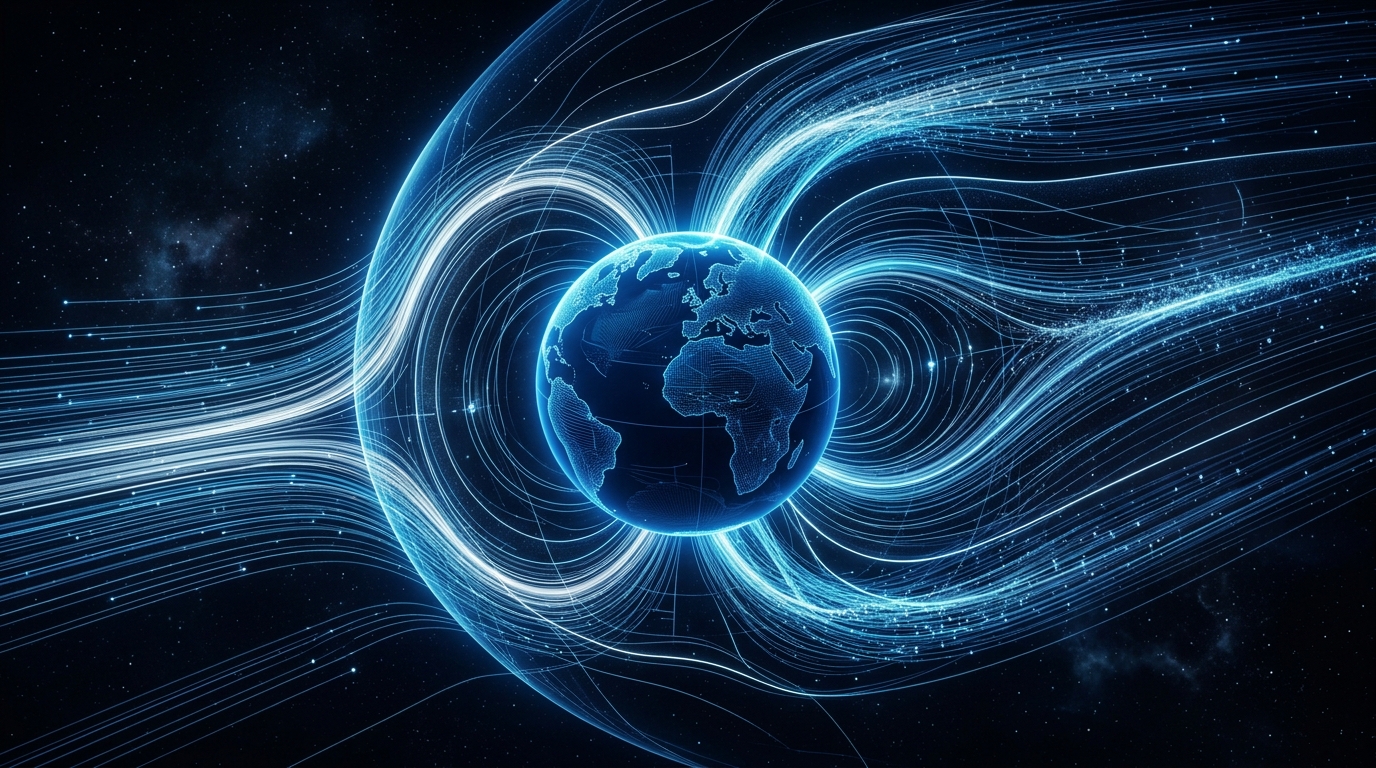
For decades, the technology sector has modeled its orbital and terrestrial resilience on a fundamental assumption about Earth’s magnetosphere: that it possesses an inherent safety valve. We believed there was a strict cap to the atmospheric electrical currents generated by extreme space weather. Today, a new study led by NASA’s Nithin Sivadas and Maria Walach of Lancaster University reveals a profoundly disturbing reality. There is an unbounded solar storm risk that demands a complete architectural re-evaluation of how we protect global communications, logistics, and data centers.
The previous scientific consensus assumed there was a maximum threshold for the electrical current Earth’s atmosphere could generate. Researchers theorized that once the incoming solar wind energy reached this saturation point, the magnetosphere would naturally dissipate the excess energy harmlessly into space. But new research findings indicate that this theoretical ‘upper limit’ simply might not exist. By analyzing spacecraft data measured closer to Earth’s surface—rather than relying entirely on distant telemetry from Lagrange Point 1, located a million miles away—scientists found a stark, direct correlation between solar wind strength and atmospheric electrical currents.
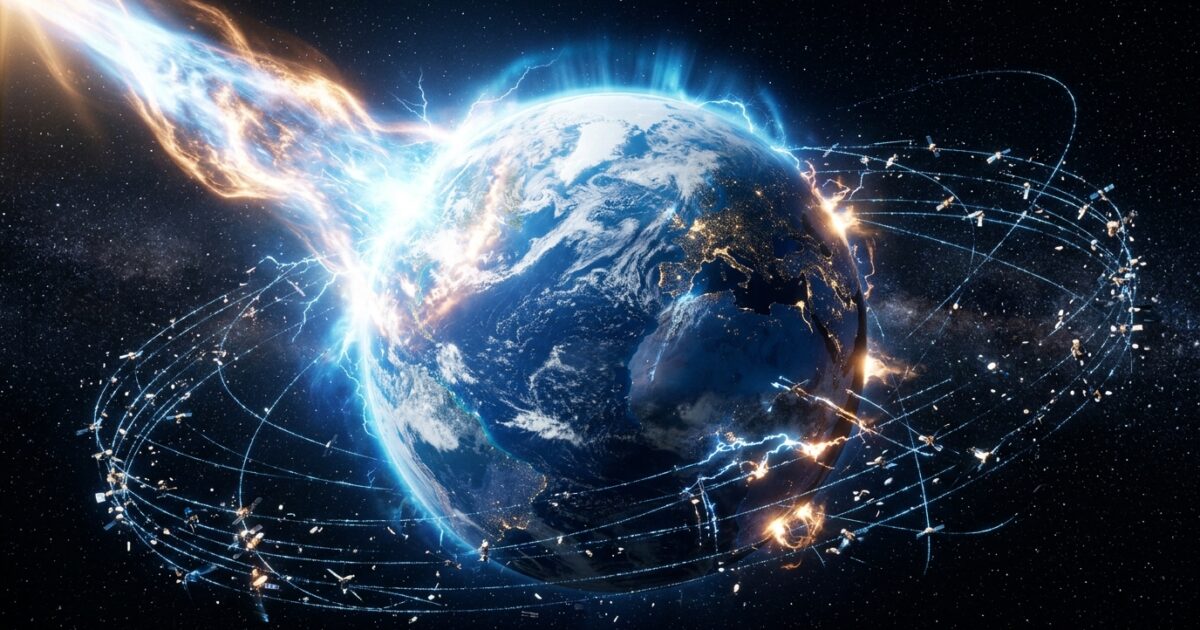
Think of Earth’s upper atmosphere not as a surge protector that neatly trips when overloaded, but as a giant funnel. Previously, scientists modeled this funnel as having a fixed spout size, allowing only a certain amount of current through before overflowing safely. The new telemetry proves the funnel’s spout expands to swallow whatever the solar storm pours into it. Earth’s atmosphere could potentially produce exactly as much electricity as the incoming solar wind generates, exposing satellites and orbital infrastructure to devastating surges of energy.
To grasp the scale of the threat, one must look back to the Carrington Event of 1859, which remains the most intense geomagnetic storm in recorded history and the definitive benchmark for extreme space weather. Because this event predates modern satellite monitoring, researchers have estimated its magnitude through historical records, such as telegraph disruptions—where operators reported telegraph machines catching fire—and by analyzing scientific proxies like tree-ring radiocarbon data. Estimates for the geomagnetic impact of the Carrington Event vary significantly, with the Disturbance Storm Time (Dst) index ranging from roughly -685 nT to an apocalyptic -2000 nT, and the flare intensity estimated by some researchers at approximately X45.
Market Impact & Deployment

The realization that our protective magnetosphere does not inherently cap extreme electrical surges shifts the conversation from theoretical astrophysics directly into Enterprise IT and risk management. Modern society’s extreme reliance on satellite constellations and global power grids means the consequences of a Carrington-level event occurring today would be vastly different—and exponentially more expensive.
Simulations indicate that a massive solar storm today could cause catastrophic effects on orbital infrastructure, potentially triggering a chain reaction of satellite failures. Even during the much milder Halloween storms of 2003, Earth temporarily lost contact with 59% of its operational satellites. Since then, the deployment of massive Low Earth Orbit (LEO) constellations has scaled logarithmically. While the speed of a coronal mass ejection (CME) helps predict its arrival time, researchers note it is not a consistently reliable indicator of the storm’s ultimate severity. Instead, the magnetic orientation of a CME relative to Earth’s magnetic field plays a critical role in determining exactly how much devastating energy is transferred during a solar storm.
For Chief Technology Officers and data center architects, this translates to a massive shift in Total Cost of Ownership (TCO). Shielding space assets—a core tenet of modern Hardware & Silicon design—must now account for practically unlimited current induction. The Carrington Event consisted of a series of eruptions rather than just a single, isolated solar flare. A precursor eruption likely ‘cleared the road’ of interplanetary solar wind, which allowed the primary coronal mass ejection to travel to Earth with minimal resistance. This main ejection arrived at Earth in an unprecedented 17 to 18 hours. For commercial satellite operators, 17 hours is barely enough time to verify telemetry, let alone coordinate the mechanical re-orientation of thousands of nodes into protective safe modes.
The Consumer Translation
While engineers model the failure states of high-altitude electronics, the worldwide public will experience this unbounded solar storm risk at the ground level. We depend on satellite GPS not just for driving directions, but for the fundamental timestamping protocols that synchronize global financial trading, ATM networks, and cellular towers. Any prolonged disruption to these orbital arrays threatens the backbone of modern civilian life.
If a direct hit occurs, the resulting atmospheric currents will induce massive electrical loads into the Earth’s surface, seeking the path of least resistance: our global power grid. High-voltage transformers, the critical nodes that step down electricity for residential use, are highly vulnerable to these geomagnetically induced currents. The failure of these transformers could plunge entire continents into darkness for weeks or months, as the manufacturing supply chain for replacing these massive, custom-built industrial components is incredibly slow. The downstream effect on Networking & Cloud services would halt everything from remote hybrid work platforms to basic point-of-sale systems at grocery stores.
While researchers provide some solace by noting that Earth’s magnetic field still does a robust job of protecting biological life on the surface, and that the sun is nearing the end of its current 11-year solar maximum, the statistical risk remains. A one-in-a-hundred-year event is a mathematical certainty on a long enough timeline, and our current technological stack has never been tested by the sheer, unbounded force of a direct, extreme coronal mass ejection.
Frequently Asked Questions
Q1: What is the new discovery regarding solar storm risk?
A1: Research shows there is no upper limit to the electrical current Earth’s atmosphere can generate during a solar storm, contradicting previous models that assumed a natural saturation point.
Q2: How does a Carrington-level event threaten modern infrastructure?
A2: Unlike 1859, today’s society relies heavily on orbital infrastructure; a similar event could trigger a chain reaction of satellite failures and massive power grid blackouts.
Q3: How much advance warning do we get for coronal mass ejections?
A3: Historical data suggests that a massive coronal mass ejection can reach Earth in as little as 17 to 18 hours, leaving almost no time for satellite constellations to enter protective safe modes.
TechNode HQ Verdict: Pros, Cons & Usability
- Pro (Engineering): Identifying the lack of an upper saturation limit allows aerospace engineers to build more accurate, robust hardware resilience models for future satellite deployments.
- Pro (Consumer): Heightened awareness of grid vulnerability forces public utilities to invest in localized micro-grids and decentralized power generation.
- Con: Upgrading current orbital shielding to account for unbounded electrical currents drastically increases the weight, launch cost, and overall TCO for LEO constellations.
- Con: Rapid-moving precursor CMEs that clear the interplanetary medium can reduce advance warning to just 17 hours, severely limiting mitigation windows.
Enterprise Usability: CTOs and infrastructure architects must aggressively audit their disaster recovery protocols. Organizations heavily dependent on satellite communications and GPS synchronization should invest immediately in redundant terrestrial fallbacks, hardened on-premise timing systems, and diversified cloud availability zones that do not share a single high-voltage power grid.
Everyday Usability: While the public cannot control solar weather, the realization of grid fragility makes a strong case for basic household preparedness. Investing in offline local backups for critical data, maintaining analog emergency kits, and possessing standalone solar generators are rational precautions in an increasingly digital world.