Key takeaways
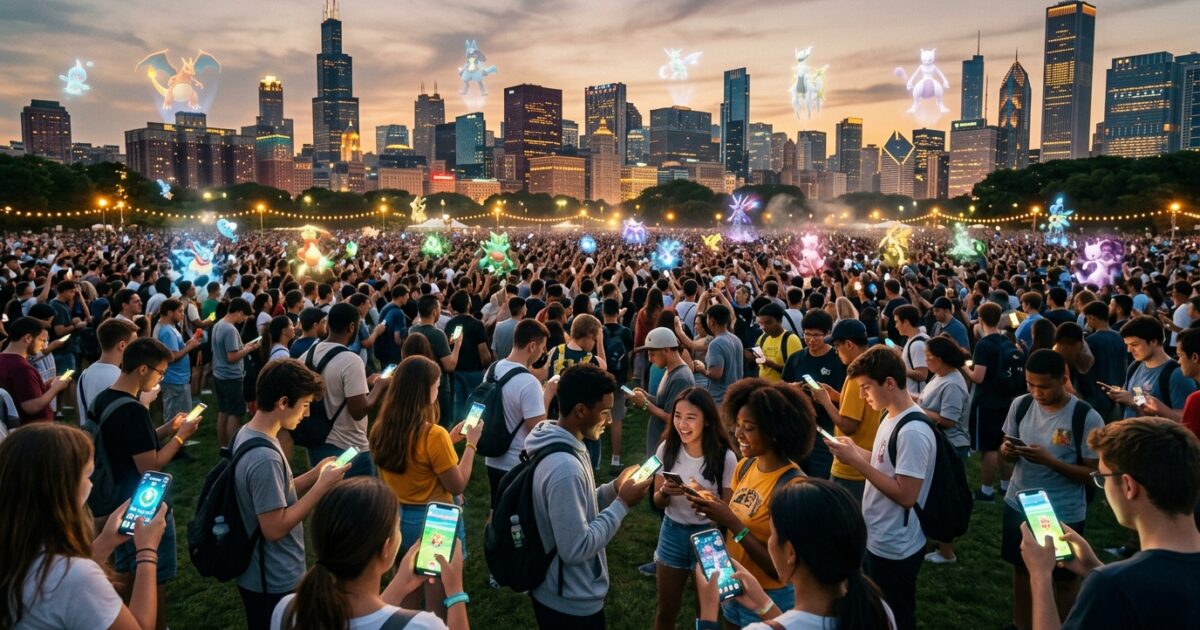
- Pokemon Go Fest 2026 drew 717,000 concurrent players in Chicago alone.
- Niantic uses player movement data to build large geospatial models for robotics.
- The 2026 global event debuted Mega Mewtwo X and Y in Super Mega Raids.
- Player-generated mapping reduces corporate data collection costs significantly.
- Scopely’s 2025 acquisition of Niantic properties signals AR market consolidation.
The Architectural Reality
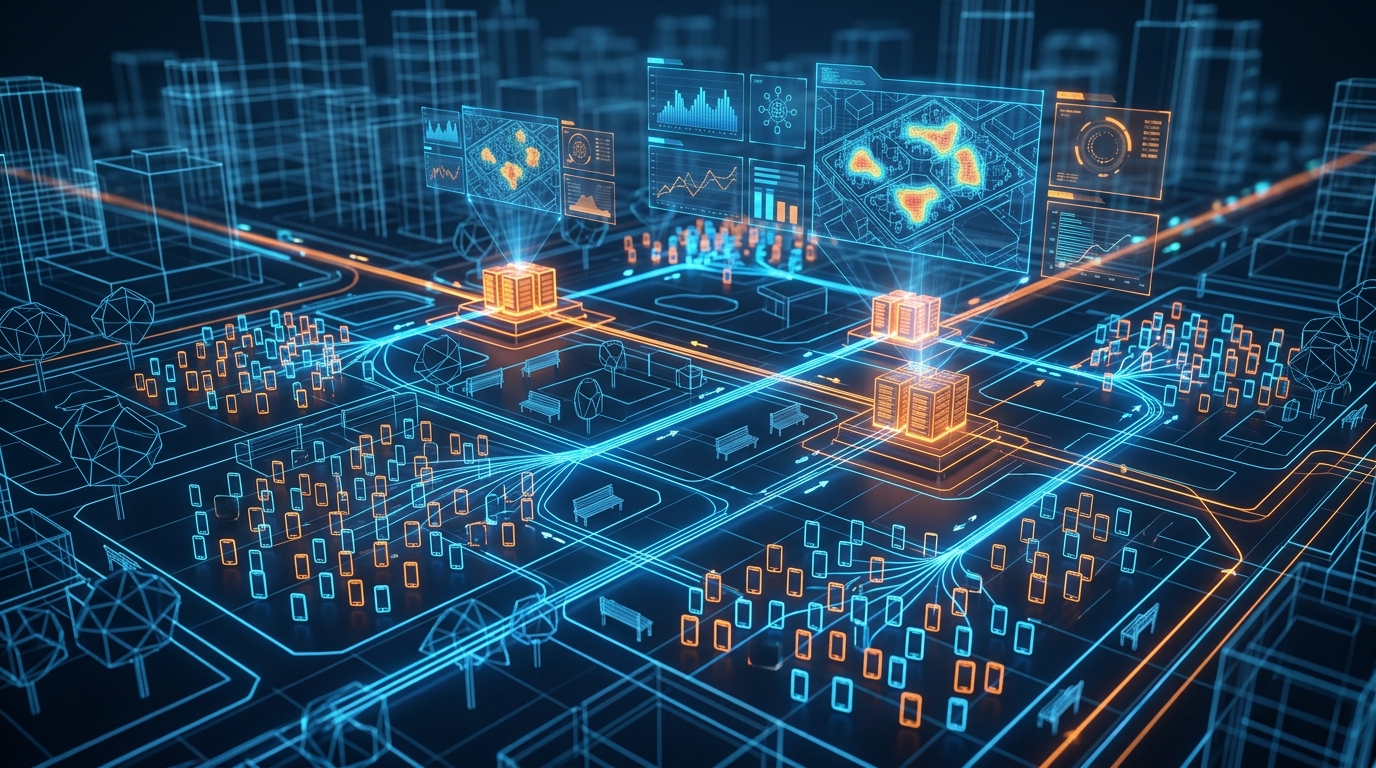
When an estimated 717,000 people converged on Chicago for the 10th-anniversary celebration of Pokemon Go Fest in June 2026, they were not just participating in a massive mobile gaming event—they were actively serving as distributed edge nodes in one of the world’s most ambitious real-time data collection networks. The sheer scale of the event, which resulted in the capture of nearly 62 million digital creatures citywide, presents a staggering infrastructural challenge. Processing simultaneous user inputs, location tracking, and augmented reality (AR) asset rendering for a crowd of this magnitude demands a network architecture resilient enough to handle unprecedented concurrent API calls and database writes without catastrophic failure.
Behind the colorful interface of spinning PokéStops and Mega Raid battles lies a sophisticated deployment of edge computing. To prevent network saturation and latency spikes—which would immediately shatter the AR illusion—the underlying infrastructure relies on localized processing and dynamic load balancing. By staggering the 90,000 ticketed entries at Grant Park, the system distributed network requests over time, effectively smoothing out traffic spikes that traditionally cripple cellular networks at major sporting events or concerts.
However, the most critical architectural reality of this platform is not merely its ability to sustain a high volume of traffic, but its capacity for continuous, low-friction environmental mapping. Every time a player engaged with the app to capture a Shiny variant or participate in a Unity Raid for Mega Mewtwo, their smartphone’s camera and GPS sensors were feeding valuable environmental data back to the central servers. This user-generated telemetric data is the engine powering a much larger technological ambition. As recently reported, the platform utilizes this continuous stream of global player data to develop large geospatial models for robotics and advanced spatial computing.
To understand the structural analogy, consider the mechanics of a global logistics network. Just as a shipping company tracks millions of individual packages to optimize routes and identify supply chain bottlenecks in real time, this AR infrastructure tracks millions of individual player movements to construct an increasingly high-fidelity, three-dimensional map of the physical world. Each player acts as a microscopic surveyor, collectively updating a living blueprint of global infrastructure faster and cheaper than any fleet of dedicated mapping vehicles ever could.
Market Impact & Deployment

The economic implications of this decentralized mapping strategy are profound, particularly when evaluating Total Cost of Ownership (TCO) and data acquisition costs. For enterprise IT leaders and CTOs observing from the outside, the Pokemon Go infrastructure represents a masterclass in incentivized data harvesting. By gamifying the act of environmental scanning, the platform entirely offloads the labor and hardware costs associated with geospatial mapping onto the consumer. The players purchase the hardware (their smartphones), pay for the bandwidth (their cellular plans), and volunteer their time (often walking upwards of 26 miles over a weekend, as some dedicated participants did in Chicago), all in exchange for digital rewards.
This operational efficiency translates directly into massive revenue scaling and asset valuation. The 2025 report regarding the sale of Pokemon Go properties to Scopely highlights the immense market value placed on this established, engaged user base and the underlying spatial data engine. For enterprise companies heavily invested in autonomous navigation, drone delivery logistics, or urban planning, the large geospatial models refined by this gaming data represent a highly lucrative enterprise product. The ability to cross-reference pedestrian traffic patterns, environmental obstacles, and granular terrain details across global metropolitan centers provides a distinct competitive advantage over organizations relying solely on static satellite imagery.
Furthermore, the strategic deployment of the 2026 events demonstrated a masterstroke in user retention and ecosystem expansion. Following the in-person events in Tokyo, Chicago, and Copenhagen, the global finale on July 11 and 12 broke new ground by being entirely free for all trainers. By removing the financial barrier to entry for the global finale, the publisher maximized concurrent user participation, dramatically expanding their active data collection net over a 48-hour period. This strategy not only reinvigorated lapsed players—many of whom returned to the game with fierce devotion—but also generated a massive influx of fresh spatial data from newly activated suburban and rural user bases.
However, an objective red team audit of this deployment reveals significant vulnerabilities beneath the marketing triumph. While the PR narrative highlights community building and the thrill of capturing rare “Shundo” variants, the reality is that the network struggled under the localized density of users. The admission that gameplay was suspended in certain high-traffic areas, including around the highly publicized Pokemon Fossil Museum exhibit at the Field Museum, indicates severe bottlenecks in local cellular infrastructure and server-side connection handling. When a platform’s core product is real-world exploration, localized network failures represent a critical failure of the service agreement with the user.
The Consumer Translation
For the millions of consumers worldwide, the underlying geospatial data harvesting is largely invisible, overshadowed by the immediate social and emotional rewards of the experience. The 2026 Pokemon Go Fest served as a powerful testament to the game’s evolution from an isolating screen-time activity into a robust engine for social engineering. Players are no longer simply capturing digital assets; they are engaging in highly coordinated, physical community events. The implementation of “Raid Trains” and massive “Unity Raids”—such as those targeting the global debuts of Mega Mewtwo X and Y—requiring the synchronized physical movements of hundreds of players to defeat a digital boss, forces interpersonal interaction and cooperation.
This gamified physical activity has undeniable real-world impacts. Participants willingly subjected themselves to intense physical exertion—walking dozens of miles in extreme heat and rain—driven by the psychological hooks of the game’s collection mechanics. The introduction of features like remote trading and user-generated routes over the past decade has lowered the friction for social engagement, turning a solitary digital habit into a powerful excuse for family reunions and travel. The fact that six couples reportedly got engaged during the Chicago event underscores the profound level of social connection facilitated by the platform’s community-driven design.
Moreover, the integration of the digital IP with physical civic institutions points to a new frontier in consumer entertainment and education. The Pokemon Fossil Museum exhibit at Chicago’s Field Museum—running through April 2027—represents a brilliant cross-industry disruption. By combining actual natural history with an alternate, fictional evolutionary timeline featuring detailed skeletons of fictional creatures, the exhibit creates an unprecedented hybrid experience. It draws a demographic that might not typically visit a natural history museum, using familiar digital IP to introduce concepts of paleontology and evolution. This blurring of lines between virtual entertainment, physical retail (via robust, exclusive gift shops), and civic education illustrates how deeply AR platforms can embed themselves into the cultural fabric of a city.
Yet, the consumer experience is not entirely frictionless. As the game shifts towards decentralized, citywide challenges rather than centralized park events, some veteran players have expressed frustration. The loss of a tightly contained, fully walkable festival environment alters the social dynamic, dispersing the crowd and making the event feel less cohesive. This tension highlights the delicate balance the developers must maintain: expanding the spatial data collection footprint across a wider urban area while still delivering the concentrated, festival-like atmosphere that users are paying to experience.
Frequently Asked Questions
Q1: When did Pokemon Go Fest 2026 take place?
A1: The global finale took place on July 11 and 12, 2026, while in-person events were held in Tokyo (May 29-June 1), Chicago (June 5-7), and Copenhagen (June 12-14).
Q2: What new features debuted during the 2026 event?
A2: The global event marked the debut of Mega Mewtwo X and Mega Mewtwo Y in Super Mega Raid Battles, along with opportunities to catch the Mythical Pokemon Zeraora.
Q3: How much did it cost to participate in the global event?
A3: For the first time in the game’s 10-year history, the Pokemon Go Fest 2026 Global event was entirely free for all trainers who logged in during the weekend.
Q4: What is the business value of Pokemon Go’s player data?
A4: Niantic utilizes the massive amounts of player movement and visual data collected during gameplay to develop large geospatial models, which are critical for advancements in robotics and spatial computing.
Q5: How long does the Pokemon Fossil Museum exhibit run?
A5: The detailed alternate history exhibit at Chicago’s Field Museum, featuring life-size Pokemon skeletons and themed artifacts, runs through April 2027.
TechNode HQ Verdict: Pros, Cons & Usability
- Pro (Engineering): Successfully leverages millions of active edge nodes (smartphones) to crowd-source high-fidelity spatial data for robotics models with near-zero hardware acquisition costs.
- Pro (Consumer): Drives massive physical engagement and social interaction, turning solitary digital habits into highly coordinated, community-driven health and lifestyle events.
- Con: Severe susceptibility to localized cellular network bottlenecks, resulting in suspended gameplay in high-density areas and failing the core service promise.
- Con: The shift toward decentralized, citywide play alienates legacy users who prefer the centralized, walkable festival experience of previous years.
Enterprise Usability: For CTOs and enterprise architects, the infrastructure driving this platform is a prime case study in gamified data acquisition. Companies developing autonomous logistics, spatial computing hardware, or localized delivery networks should study this model to understand how consumer applications can subsidize the massive data requirements of large geospatial modeling.
Everyday Usability: For the general public, the platform remains an engaging, albeit battery-intensive, tool for outdoor activity and social connection. The decision to make the 10th-anniversary global event free significantly lowered the barrier to entry, making this an ideal time for lapsed players to return and experience the vast improvements in cooperative gameplay features.