
Key takeaways
- Deterministic guardrails are absolutely essential for executing critical, high-stakes tasks in Agentic AI Platforms.
- Purpose-built agent hierarchies drastically outperform monolithic AI models in both reliability and operational efficiency.
- Organizations should leverage the LLM-as-a-judge test pyramid for rigorous, multi-level evaluation of agent behaviors.
- The era of casual “vibe checking” AI systems is over; production-grade AI requires stringent software engineering.
- Specialized role delegation within AI ecosystems directly mirrors traditional human corporate organizational structures.
The enterprise technology landscape is undergoing a monumental paradigm shift. For the past three years, the tech industry has operated under the intoxicating, yet dangerous, assumption that simply throwing more compute and raw tokens at an artificial intelligence model will magically yield flawless production-grade systems. We have seen countless organizations attempt to shoehorn large language models (LLMs) into every conceivable workflow, often with disastrous or comically inaccurate results. The reality of building Agentic AI Platforms at an enterprise scale requires a far more nuanced, rigorous approach. We can no longer rely on casual “vibe checking” to validate software that fundamentally controls massive financial transactions, security perimeters, and physical infrastructure. Instead, the focus must shift to a hybrid architecture—one that meticulously balances deterministic precision with probabilistic exploration.
Aaron Erickson, Senior Manager and Founder of the DGX Cloud Applied AI Lab at NVIDIA, recently outlined this exact philosophy in his presentation at QCon San Francisco, aptly titled “Designing AI Platforms for Reliability: Tools for Certainty, Agents for Discovery.” His central thesis dismantled the myth of the omnipotent, monolithic AI. Erickson argued that Enterprise IT leaders shouldn’t have to choose between strict, rule-based execution and open-ended generative creativity. Instead, both are strictly required. You must anchor the core operations with “Tools for Certainty”—deterministic software guardrails like constrained schemas and rigid runbooks—while deploying “Agents for Discovery” to navigate complex, fuzzy logic scenarios that require deep reasoning.
This is not merely a theoretical framework; it is a battle-tested blueprint for designing production-grade agent hierarchies. By examining NVIDIA’s internal projects like LLo11yPop, we can extract the engineering realities, the return on investment (ROI), and the overarching market impacts of treating agentic architecture as a traditional software engineering discipline rather than a stochastic parlor trick.
The Architectural Reality
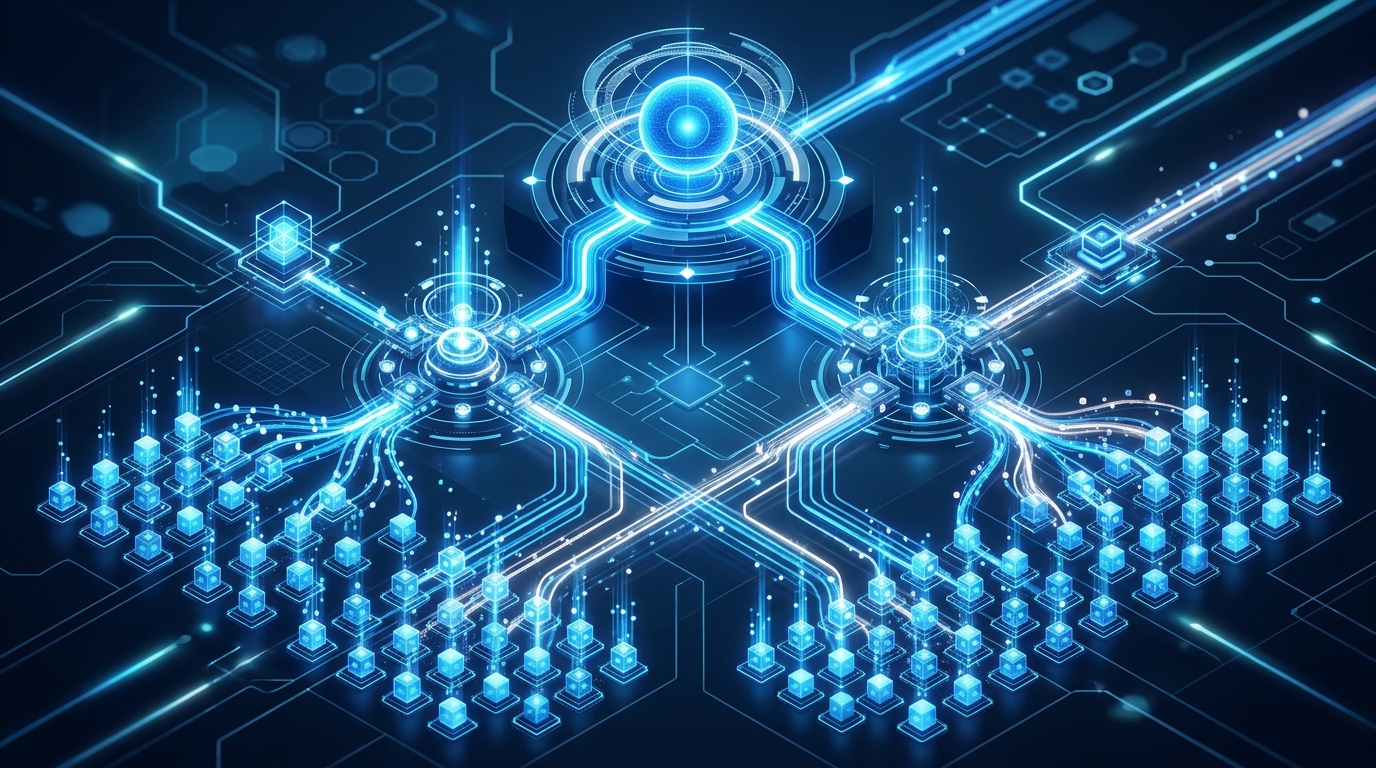
When constructing highly reliable Agentic AI Platforms, treating the system as a monolithic oracle is a recipe for failure. Just as human organizations employ diverse specialists—interns, analysts, managers, and executives—a robust AI architecture must employ specialized, purpose-built agent hierarchies. NVIDIA’s approach fundamentally embraces role specialization within its agent ecosystems. Rather than asking a single LLM to retrieve data, analyze anomalies, and execute infrastructure changes, the architecture is deliberately segmented.
At the foundation, we find Worker Agents. These are narrow, hyper-focused agents tasked with “painting all the rocks on the beach.” They might scan 100,000 GPU clusters looking for wattage fluctuations or network connectivity issues. They do not possess deep reasoning capabilities, nor do they need them. By constraining their scope and forcing them to interact with a flat database schema rather than executing complex SQL joins, engineers drastically reduce hallucination rates and save valuable inference tokens. These agents are governed by deterministic software guardrails. If a query requires exact mathematical counting, the agent delegates the task to a deterministic Python script rather than attempting to guess the answer probabilistically.
Sitting above the workers are Analyst and Ruminative Agents. These agents take the raw anomalies surfaced by the workers and apply long-running reasoning. For example, if a cluster of GPUs is running unusually hot, a ruminative agent can look at historical incident reports, cross-reference them with current telemetry, and identify a novel failure mode. They are designed for discovery. To ensure these higher-level agents don’t drift into pure hallucination, they are frequently grounded using vetted, internal data stores—what NVIDIA terms “rare context.” This is the highly specific, proprietary terminology and operational history unique to the organization, which no off-the-shelf zero-shot model could possibly possess.
Finally, we reach the orchestration layer, populated by Middle Manager, Consultant, and Tool Selector Agents. These agents take the insights from the analysts, select the appropriate deterministic tools, and formulate a goal-oriented execution plan. Crucially, any action that mutates the state of the infrastructure—such as rebooting a node or reallocating a million-dollar GPU cluster—is executed via a deterministic “Tool for Certainty.” The AI does not randomly write infrastructure-as-code; it triggers a pre-vetted, heavily tested runbook. To ensure this entire hierarchy functions correctly, organizations must deploy an “LLM-as-a-judge” test pyramid, applying rigorous unit and integration tests at every tier of the agent ecosystem to continuously monitor and validate agent behavior through operational telemetry.
Market Impact & Deployment
The transition from experimental AI prototypes to deterministic agent hierarchies carries immense implications for market deployment and Total Cost of Ownership (TCO). In the early days of generative AI, companies burned millions of dollars on compute, allowing massive models to “think” about basic data retrieval tasks. By implementing AI & Machine Learning architectures that aggressively route simple tasks to deterministic tools, enterprises can radically slash their inference costs. Every token not spent on counting rows in a database is a token that can be invested in deep, ruminative anomaly detection.
Furthermore, this architecture solves the crisis of trust that has plagued enterprise AI adoption. Executives are rightfully terrified of deploying autonomous agents with root access to their production systems—the famous examples of chatbots hallucinating massive refunds or inventing non-existent policies serve as stark warnings. By embracing deterministic software guardrails, CTOs can confidently deploy AI into highly regulated environments. The agent is allowed to discover and propose solutions, but the execution relies entirely on predictable, traditional software pathways. This drastically lowers the barrier to entry for highly sensitive sectors like finance, healthcare, and global supply chain logistics.
We are already seeing the market react to this hybrid approach. NVIDIA’s push toward modular, composable models—eschewing the monolithic “one model to rule them all” philosophy—mirrors the industry’s historical shift from monolithic applications to microservices. Tool catalogs, runbooks, and constrained schemas are becoming the standard product offerings for enterprise AI startups. The market understands that the future belongs to systems that can securely manage “dumb diamonds”—those highly repetitive, low-level tasks that require minimal intellect but massive scale—while safely escalating true anomalies to advanced reasoning engines.
The Consumer Translation
While the intricacies of agent hierarchies and LLM-as-a-judge frameworks are deeply entrenched in the enterprise, the underlying philosophy is already spilling over into consumer technology. How does this highly technical shift impact the worldwide public? The most visceral example is the autonomous vehicle, such as the Waymo self-driving car.
A self-driving car is the ultimate embodiment of an agentic system navigating a chaotic world. It relies on deterministic tools—anti-lock brakes, strict physics calculations, and immediate collision avoidance sensors—that operate with zero latency and absolute certainty. However, it also employs probabilistic agents for discovery, analyzing erratic pedestrian behavior, interpreting complex construction zones, and predicting the trajectory of a swerving cyclist. It is this exact fusion of certainty and discovery that allows an AI to safely pilot a two-ton vehicle through a crowded urban parade. As these hybrid Networking & Cloud architectures mature, everyday consumers will interact with AI that feels significantly less like a generic chatbot and more like a highly competent, specialized assistant.
Consider the future of consumer health tech or personal finance applications. A user’s health agent won’t just vaguely summarize their diet; a worker agent will deterministically pull precise biometric data from a smartwatch, a ruminative agent will search for long-term physiological trends, and a deterministic tool will schedule a doctor’s appointment based on rigid calendar rules. The end user will experience a seamless, error-free interaction precisely because the underlying system refused to let a probabilistic language model guess its way through a deterministic task.
Frequently Asked Questions
Q1: What are “Tools for Certainty” in AI platforms?
A1: Tools for certainty refer to deterministic software anchors, such as runbooks and constrained schemas. They provide absolute reliability and precision for high-stakes tasks like financial transactions or infrastructure management.
Q2: What is the purpose of “Agents for Discovery”?
A2: Agents for discovery are specialized AI components that utilize probabilistic exploration to navigate complex, ambiguous problems. They excel in scenarios like anomaly detection and surfacing novel optimization strategies.
Q3: How does NVIDIA test its agentic AI systems?
A3: NVIDIA employs an ‘LLM-as-a-judge’ test pyramid. This rigorous framework evaluates specialized agents at a low level through strict telemetry before assessing higher-level integrative reasoning.
Q4: Why shouldn’t organizations use monolithic AI for everything?
A4: Monolithic AI models are expensive and prone to hallucinations when forced to handle both deterministic tasks and complex reasoning. Breaking tasks into specialized agent hierarchies saves inference tokens and improves accuracy.
Q5: What is the “vibe checking” approach to AI testing?
A5: Vibe checking is the informal, casual testing of AI outputs based on human intuition rather than strict metrics. Industry leaders emphasize replacing this with formal, reliable, and multi-agent evaluation frameworks.
TechNode HQ Verdict: Pros, Cons & Usability
- Pro (Engineering): Drastically reduces token expenditure and hallucination rates by offloading discrete counting and state-mutation tasks to traditional deterministic scripts.
- Pro (Consumer): Enables highly reliable autonomous systems (like self-driving cars and medical diagnostics) that consumers can actually trust with their physical and financial safety.
- Con: Designing, tuning, and maintaining an LLM-as-a-judge test pyramid across a multi-agent hierarchy requires significantly more initial engineering overhead than deploying a single chatbot.
- Con: Organizations must meticulously document and curate their “rare context” (internal wikis, incident reports) to prevent garbage-in, garbage-out scenarios during agent grounding.
Enterprise Usability: CTOs should immediately halt any projects attempting to use an LLM for direct database mutations or critical infrastructure routing. Begin refactoring AI initiatives into strict agent hierarchies, utilizing your existing DevOps runbooks as the deterministic tools your agents must rely upon to execute actions.
Everyday Usability: For the general public, this architecture shift means AI products are about to become vastly more reliable. You should confidently invest time in personal AI assistants that offer clear tool integrations (like direct API access to your calendar or bank) over pure conversational interfaces, as those systems are built on these exact reliability principles.