Key takeaways
- The SL3-P features a 44.9MP BSI CMOS sensor and Maestro IV processor for extreme throughput.
- It shoots up to 40 fps in 12-bit mode but lacks live view during maximum continuous bursts.
- An 819-point hybrid phase-detection AF system accurately tracks people, pets, and vehicles.
- 8.1K Open Gate video and native Apple ProRes support transform it into a cinema tool.
- The L-Mount alliance drastically lowers the Total Cost of Ownership via third-party lenses.
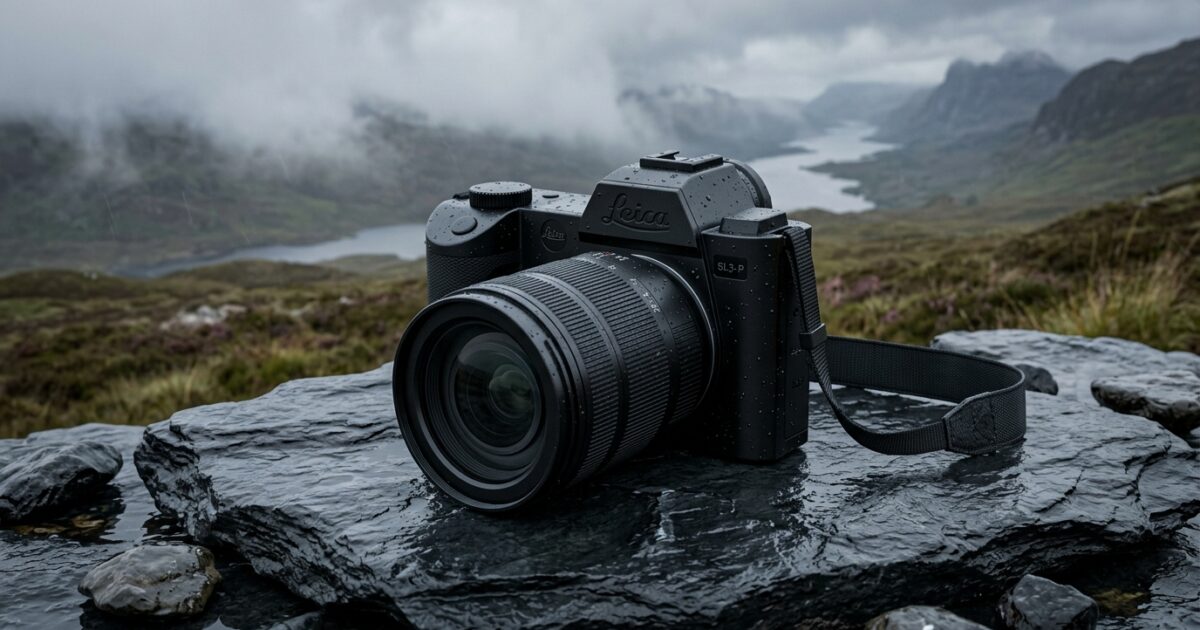
In this comprehensive Leica SL3-P review, we dissect the latest powerhouse to join the storied manufacturer’s L-mount lineup. Officially announced on June 25, 2026, the Leica SL3-P arrives not as a traditional flagship, but as a strategically positioned “Goldilocks” model designed to bridge the gap between the ultra-high-resolution 60-megapixel SL3 and the video-centric 24-megapixel SL3-S. Stripped of the iconic red dot for an understated, stealthy aesthetic, this camera hides a formidable array of professional-grade hardware beneath its monolithic all-metal exterior. We recently took the SL3-P to the rugged, weather-beaten landscapes of the Scottish island of Mull to push its new 44.9-megapixel BSI CMOS sensor and its high-throughput Maestro IV processor to their absolute limits, evaluating whether it truly stands as the ultimate hybrid workhorse for enterprise creatives and demanding enthusiasts alike.
Leica SL3-P Review: The Engineering Under the Hood
At the technological core of the SL3-P is a custom-designed 44.9-megapixel effective (44-45MP) Back-Illuminated (BSI) CMOS sensor. The back-illuminated architecture intrinsically improves light gathering efficiency by moving the wiring circuitry behind the photodiode layer, directly impacting the camera’s remarkable dynamic range, which maxes out at an impressive 15 stops. This sensor is mated to the sheer computational throughput of the new Leica Maestro IV processor. This advanced silicon architecture elevates the camera’s performance metrics into the highest echelons of modern imaging. For continuous shooting, the SL3-P’s electronic shutter achieves a staggering 40 frames per second in 12-bit mode, and a highly respectable 15 to 25 fps when capturing 14-bit raw files. This unparalleled speed ensures that fleeting micro-moments—whether in high-stakes street photography, wildlife documentation, or fast-paced commercial shoots—are captured with immaculate, uncompromised detail.
The autofocus system represents a monumental leap forward for Leica’s mirrorless ecosystem. Moving away from the computational limitations of older contrast-only systems, the SL3-P employs an advanced hybrid autofocus array featuring 819 phase-detection points. This dense hardware grid allows for real-time depth calculations and instantaneous subject tracking. Bolstered by intelligent subject recognition algorithms, the system seamlessly locks onto people, pets, and vehicles with minimal hunting. During our urban testing in Edinburgh, the camera accurately isolated a human subject taking a photograph inside a glass phone booth, entirely ignoring the chaotic foreground distractions and immediately securing critical focus. This level of autonomy fundamentally changes how a photographer interacts with the scene, shifting the cognitive load from mechanical focusing to pure composition.
For videographers and cinematographers, the SL3-P’s specifications are equally unyielding. The camera supports 8.1K Open Gate video recording, which utilizes the entire 3:2 sensor area, providing immense flexibility for cropping into various aspect ratios (like 16:9 for YouTube or 9:16 for vertical social media platforms) during post-production without sacrificing resolution. Furthermore, it handles 5.9K up to 60p, and 4K up to 120p for pristine slow-motion capture, all backed by native Apple ProRes codec support. The inclusion of ProRes transforms the SL3-P from a mere stills camera into a formidable cinema tool, bypassing heavily compressed H.265 formats and integrating flawlessly into high-end, color-critical production workflows.
The L-Mount Alliance and Open Ecosystem Advantage
One of the most profound strategic shifts in the modern camera industry is the advent of collaborative lens mounts, and the Leica SL3-P is perhaps the most compelling beneficiary of the L-Mount Alliance. Formed as a partnership between Leica, Panasonic, Sigma, and later joined by others, this alliance standardizes the physical and electronic communication protocols between the camera body and the lens. For a premium manufacturer like Leica, this represents a radical departure from the closed, proprietary ecosystems that historically defined luxury camera brands. By adopting an open ecosystem approach, Leica effectively democratizes access to its world-class sensor technology.
In practice, this means a photographer can pair the SL3-P body with a hyper-expensive, optically perfect Leica APO-Summicron-SL prime lens for high-end portraiture, and then seamlessly switch to a cost-effective, weather-sealed Sigma Art zoom lens for hazardous documentary work in unpredictable environments. This modularity is a game-changer for production agencies managing complex balance sheets. Instead of depreciating hundreds of thousands of dollars on a single manufacturer’s proprietary glass, firms can mix and match optical assets across different tiers of quality and price. Furthermore, firmware updates across the alliance ensure that features like the SL3-P’s 819-point phase-detection autofocus remain blistering fast and critically accurate, regardless of whether a Panasonic or a Sigma lens is attached to the mount. This open-source philosophy applied to physical hardware is redefining the economic viability of high-end camera systems in an increasingly competitive media landscape.
Translating Specs to ROI for Creative Professionals
Priced at £5,150 (approximately $8,090), the Leica SL3-P is undeniably a substantial capital expenditure. However, when analyzed through the lens of enterprise procurement for commercial studios and production houses, the Total Cost of Ownership (TCO) calculation is highly favorable. The primary financial advantage lies in its membership in the aforementioned L-Mount Alliance. This ecosystem interoperability provides immense financial flexibility for consumer technology agencies and independent contractors managing tightly constrained budgets while scaling their hardware infrastructure.
From an operational standpoint, think of the SL3-P as a high-performance sports car engine dropped into a daily-driver chassis. It delivers the raw data throughput, the 15 stops of dynamic range, and the expansive ISO flexibility (ranging from a base of ISO 50 all the way up to an astonishing ISO 200,000) necessary for demanding post-production environments. Yet, it maintains the ergonomic familiarity and ruggedness of a standard workhorse. The camera’s all-metal construction is rigorously tested to meet IP54 ratings for dust and water resistance. During our trials in the driving rain of the Scottish Highlands, the camera performed flawlessly without additional weather sealing. For a production company, this durability directly translates to fewer equipment failures in extreme conditions, minimizing costly downtime on location shoots and reducing the overall velocity of hardware depreciation.
Sensor Dynamics and Computational Photography Pipelines
To truly appreciate the engineering marvel of the SL3-P, one must delve deeper into the interplay between the 44.9-megapixel BSI CMOS sensor and the Maestro IV computational pipeline. Traditional front-illuminated sensors suffer from microscopic light loss as incoming photons must navigate through a web of metallic wiring before striking the light-sensitive photodiode. By inverting this structure—placing the wiring behind the photodiodes—the SL3-P’s Back-Illuminated (BSI) architecture drastically increases the fill factor of each pixel. This translates directly to the camera’s astonishing dynamic range, allowing photographers to extract usable detail from the deepest, ink-black shadows without blowing out the highlights in a high-contrast sky. When CNET tested the camera on the Scottish coast, this dynamic range was crucial for capturing the subtle tonal gradations between dark, ominous clouds and the turbulent, reflective waters below.
But raw sensor data is useless without a processor capable of interpreting it in real-time. The Maestro IV processor acts as the central nervous system of the SL3-P, governing everything from color science interpolation to thermal management during sustained 8K video recording. When shooting at the maximum burst rate of 40 frames per second, the processor must instantly analyze, demosaic, and write massive 14-bit raw files to the memory buffers without catastrophic bottlenecking. The inclusion of Apple ProRes encoding further highlights this processing power. ProRes is an intra-frame codec, meaning every single frame is compressed individually rather than relying on inter-frame predictive algorithms like standard H.264. This results in massive file sizes that require immense bandwidth to write to the dual CFexpress and SD card slots, but the payoff is unprecedented editing performance. In post-production, ProRes files decode with minimal CPU overhead on modern editing workstations, saving thousands of hours in rendering and proxy-generation time across a year of commercial video production.
The Red Team Audit: What Leica Isn’t Saying
No piece of imaging technology is without its functional compromises, and a rigorous, objective review must address the SL3-P’s hidden bottlenecks to provide a complete picture for potential buyers. While the 40 frames per second burst rate sounds incredible on a marketing spec sheet, critical field testing and early reviewer feedback have noted a distinct lack of live view during high-speed continuous shooting. This blackout or viewfinder lag makes tracking fast-moving, erratic subjects at maximum burst speeds exceptionally difficult. For dedicated sports, aviation, and wildlife photographers who rely on uninterrupted visual feedback to keep a subject perfectly framed, this limitation fundamentally throttles the utility of the 40 fps mode, forcing users to drop down to slower burst rates to maintain strict compositional control.
Additionally, the brand’s aesthetic decisions have sparked intense debate. The removal of the iconic Leica red dot logo caters directly to photojournalists and street photographers desiring a stealthier, less conspicuous profile in sensitive operational environments. However, this minimalist approach inadvertently strips away some of the traditional mystique and prestige historically associated with the brand. As CNET’s lead photographer Andrew Lanxon astutely observed, the SL3-P operates, feels, and performs much like a high-end Canon, Nikon, or Sony mirrorless body. It is a spectacular, hyper-competent tool, but it lacks the distinct, intangible “thrill” and mechanical soul that purists seek when willingly paying the exorbitant Leica premium. It is a camera designed for pragmatic, calculating execution rather than romanticized inspiration.
Cross-Industry Disruption and Ergonomic Superiority
Beyond the strict confines of traditional commercial photography, the Leica SL3-P is poised to disrupt multiple adjacent industries that require uncompromising visual data capture. Independent documentary filmmakers and run-and-gun news crews benefit immensely from the robust 5-axis In-Body Image Stabilization (IBIS) system. During our landscape testing, this advanced stabilization allowed for half-second exposures entirely handheld, rendering cumbersome tripods practically obsolete for certain sweeping sequences and long-exposure water blurring. The expansive ISO range further ensures absolute usability in near-total darkness, a crucial tactical advantage for investigative journalism, industrial structural inspections, and high-end surveillance content creation where supplemental artificial lighting is either physically impossible or strictly prohibited.
Human-machine interaction has also been refined to a razor’s edge. Photographers and operators interact with the device primarily through a massive, ultra-high-resolution 5.76-million dot electronic viewfinder (EVF), which provides a lifelike, zero-latency window into the sensor’s raw data stream. Complementing the EVF is a brilliant 3.2-inch, 2.3-million dot articulating touchscreen, which facilitates complex low-angle shots and lightning-fast menu navigation. This seamless integration of tactile, physical dials and highly responsive digital interfaces makes camera testing and field operation remarkably intuitive, radically minimizing the learning curve for new operators. Ultimately, the Leica SL3-P stands as a towering achievement in practical, results-oriented engineering, perfectly balancing the uncompromising resolution demanded by fine-art archivists with the rugged, high-speed versatility required by today’s multidisciplinary visual storytellers.