Key takeaways
- Consolidate fragmented kitchen appliances into a single culinary mainframe to maximize your workflow ROI.
- The paddle attachment efficiently shreds warm, cooked meats in just 15 to 60 seconds on low speed.
- High-RPM wire whisking rapidly emulsifies heavy cream into fresh butter and buttermilk without manual fatigue.
- Hardware calibration via the ‘dime test’ ensures optimal beater-to-bowl clearance for homogeneous mixing.
- Repurpose the mixer as a central processing unit for large batch dips, mayonnaise, and custom spice blends.
The Architectural Reality of the KitchenAid Stand Mixer
For decades, the KitchenAid stand mixer has been relegated to a singular, highly specific workload within the domestic and professional sphere: baking. Yet, beneath its seemingly retro-chic, enameled exterior lies a highly robust, variable-speed electric motor capable of delivering intense torque and sustained RPMs under massive physical resistance. When we critically analyze this hardware infrastructure, it becomes abundantly clear that utilizing it solely for occasional cookie dough is fundamentally inefficient. It is akin to using a high-end enterprise server cluster simply to run a basic text editor. The true architectural reality is that a stand mixer operates as the culinary equivalent of a centralized mainframe.
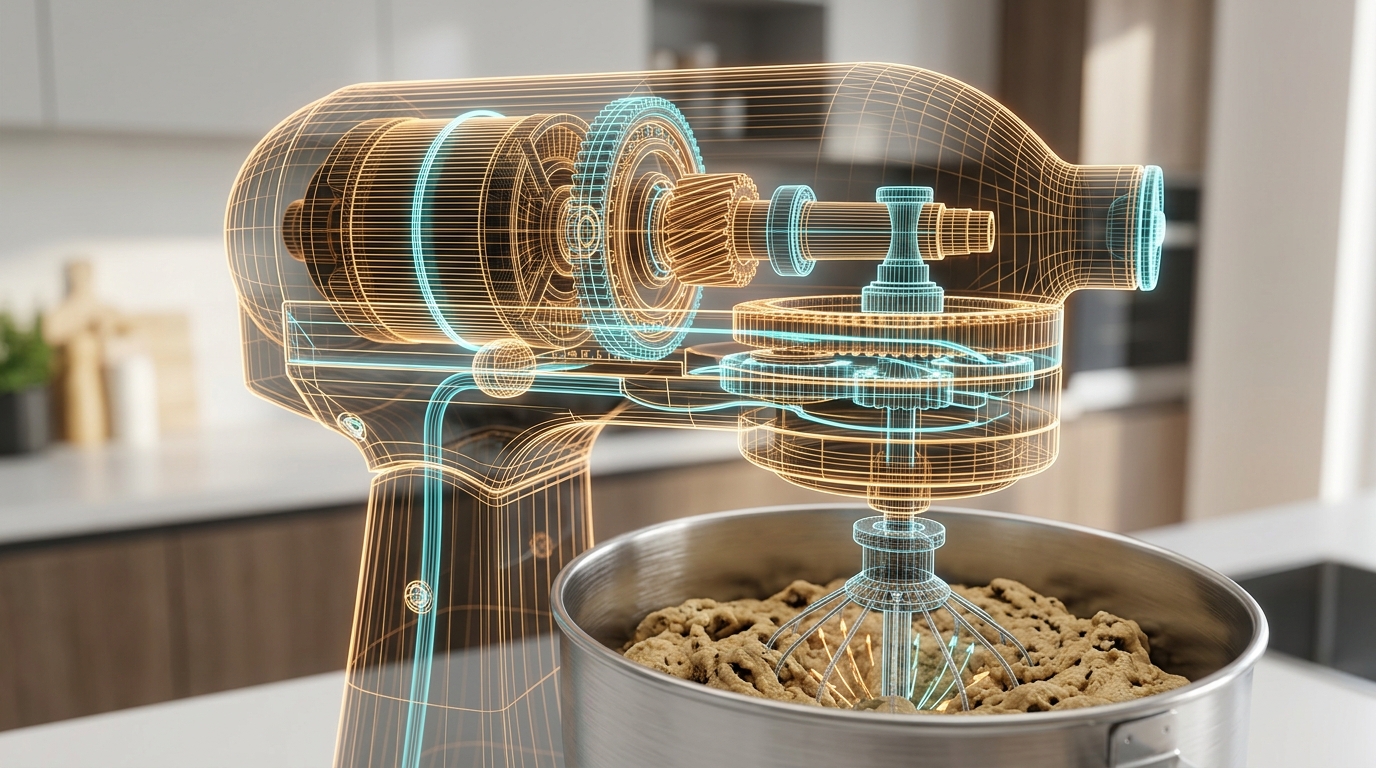
At the core of this system is its proprietary planetary mixing action. In this mechanical configuration, the attachment shaft spins in one direction while navigating the entire circumference of the bowl in the opposite direction. This dual-axis rotation guarantees comprehensive bowl coverage, completely negating the need for manual stirring or scraping and ensuring that heterogeneous compounds are perfectly homogenized. However, to ensure maximum mechanical efficiency and prevent unmixed dead zones, operators must perform routine calibration. The widely recognized ‘dime test’ allows users to calibrate the appliance with microscopic accuracy. By adjusting the hinge set screw, the attachment should just barely graze a dime placed at the bottom of the stainless steel bowl. This precision tuning ensures minimal waste and maximum ingredient integration across all operational loads.
Beyond the primary gear train, the physical chassis itself provides the necessary mass to dampen kinetic vibration. When the motor engages high-viscosity materials, the heavy die-cast metal body ensures that the central processing unit remains rooted to the workstation. This stability is critical when running high-torque operations, preventing catastrophic hardware migration across the countertop. By reframing the mixer as a stable, centralized dock, we can begin to port numerous other peripheral tasks into its workflow.
High-Yield Workloads: Meat Processing and Emulsifications
When deployed in savory, non-baking environments, the system’s modularity truly shines. By simply hot-swapping the standard attachments, users can execute vastly different culinary operations with zero downtime. For instance, the coated flat beater transforms the mixer into an industrial-grade shredder. Warm, cooked meats like chicken breast, braised pork shoulder, or even vegan alternatives like Quorn’s Meatless Diced ChiQin Pieces can be placed directly into the bowl. When engaged on a low-speed setting, the paddle entirely shreds the proteins in merely 15 to 60 seconds. This rapid processing significantly outpaces manual fork-shredding, dramatically reducing prep time and repetitive stress injuries in professional kitchens and home environments alike.
Furthermore, emulsification and heavy liquid processing workloads are handled with extreme fluid-dynamic precision. Using the wire whisk attachment on a high-speed vector, operators can rapidly whip heavy cream until it mechanically separates due to kinetic energy transfer, yielding both fresh, spreadable butter and liquid buttermilk in one automated, continuous pass. This entirely eliminates the severe physical fatigue associated with hand-churning. By strategically chilling the stainless steel mixing bowl and the whisk attachment prior to execution, users can manipulate the thermodynamics of the process to maximize the volume, structural integrity, and consistency of whipped products.
The mixer also acts as a sophisticated, high-RPM centrifuge for unstable liquid arrays. Even complex emulsions like homemade mayonnaise—requiring a precise blend of egg yolks, Dijon mustard, vinegar, sunflower oil, salt, and pepper—can be stabilized flawlessly. The wire whisk aerates and binds the hydrophobic and hydrophilic molecules at a velocity impossible to achieve by hand, completely bypassing the need for a standalone food processor.
Market Impact and Deployment: ROI in the Kitchen
The Total Cost of Ownership (TCO) for modern consumer electronics in the culinary sector can skyrocket when purchasing fragmented, single-use micro-appliances. A dedicated meat shredder, a specialized potato masher, a standalone butter churner, a heavy-duty food processor, and various hand mixers all demand initial financial investment, ongoing maintenance, dedicated power sockets, and, most crucially, premium counter space. Deploying a single stand mixer fundamentally consolidates these distinct endpoints into one unified architecture.
Consider the processing of highly dense, starchy materials. Mashing boiled potatoes with the standard paddle attachment on a low-speed cycle effortlessly yields a fluffy, lump-free texture. This rotational mashing method actively prevents the ruptured starch cells and gluey consistency inherently caused by the high-speed shearing blades of traditional blenders or food processors. The paddle is equally proficient at blending thick, viscous cream-cheese-based dips, evenly coating massive batches of granola with dense honey and oils without breaking the clusters, or cohesively combining crumbled cake and frosting to create the perfect structural consistency for cake pops.
Beyond edible components, the mixer provides the necessary unyielding torque to knead incredibly thick salt dough used for crafting handprints or holiday ornaments, proving its extreme utility and durability across disparate, non-standard deployment scenarios. Furthermore, when mixing volatile dry goods or fine particulate matter like powdered sugar or custom spice rubs, operators can simply drape a clean kitchen towel over the top of the bowl. This acts as a highly effective, zero-cost DIY splash guard to perfectly contain flour dust or chaotic liquid splatters without requiring proprietary plastic shields.
The Consumer Translation: Scaling Everyday Efficiency
For the everyday consumer, this technical paradigm shift translates directly into recovered operational hours and massively scaled output. Preparing a large gathering or executing a weekly meal prep regimen no longer requires exhaustive, multi-step manual labor. A massive batch of avocados can be instantly tossed into the bowl and mashed with the dough hook or paddle to achieve the perfect, customized chunky or smooth guacamole. Similarly, an exceptionally high volume of eggs can be whisked into a flawlessly uniform, aerated mixture before scrambling for a crowd, or hard-boiled eggs can be rapidly mashed into a quick egg salad before folding in the homemade mayonnaise.
The mixer also serves as a sophisticated compounding hub for custom infused salts or dry spice rubs, ensuring a perfectly even distribution of microscopic flavor compounds that manual tossing simply cannot achieve. Ground meats, spices, and breadcrumbs for meatballs, burgers, or meatloaf integrate perfectly under the paddle without overworking the delicate proteins or introducing thermal transfer from warm human hands. Finally, the hardware footprint is fully optimized by storing the modular attachments directly inside the mixing bowl when powered down. By cushioning them with a small towel to prevent friction and scratching, users dramatically streamline the enterprise deployment of this essential culinary equipment.
Frequently Asked Questions
Q1: Can a KitchenAid stand mixer shred cooked meat?
A1: Yes. Using the flat paddle attachment on low speed, the mixer shreds warm, cooked chicken or pork in 15 to 60 seconds, drastically outperforming manual fork shredding.
Q2: How do you calibrate the beater clearance on a stand mixer?
A2: You can perform the ‘dime test’ to ensure correct clearance. Adjust the machine’s calibration screw until the beater just barely touches a dime placed at the bottom of the bowl.
Q3: Is it possible to make butter using a stand mixer?
A3: Absolutely. Whipping heavy cream with the wire whisk attachment on high speed will mechanically separate it into solid butter and liquid buttermilk in one pass.
Q4: Can the mixer handle dense, non-food items?
A4: The high-torque motor effortlessly handles extremely dense mixtures, such as thick salt dough used for crafting handprints and ornaments, without burning out.
Q5: How can I prevent ingredients from splashing out during mixing?
A5: You can simply drape a clean kitchen towel over the top of the machine and the bowl. This acts as a highly effective DIY splash guard to contain flour dust or liquid splatters.
TechNode HQ Verdict: Pros, Cons & Usability
- Pro (Engineering): The high-torque planetary gear system allows for massive workload consolidation, fully eliminating the need for standalone food processors, hand mixers, and manual churning devices.
- Pro (Consumer): Dramatically reduces physical fatigue and manual prep time for high-volume, labor-intensive tasks like shredding dense meat, mashing starchy potatoes, and whipping raw cream.
- Con: The upfront capital expenditure is significant for casual users, and the heavy physical footprint makes it difficult to deploy in kitchens with strictly limited counter space.
- Con: Homemade emulsions like mayonnaise lack synthetic preservatives and must be strictly refrigerated and consumed within a tight four-day window to prevent bacterial degradation.
Enterprise Usability: Culinary directors and high-volume prep kitchens should standardize their operations around this centralized hardware to streamline batch processing, enforce absolute consistency in spice blending and meatball integration, and drastically reduce overall equipment maintenance overhead.
Everyday Usability: Home chefs experiencing chronic cooking fatigue should absolutely invest in this central hub. By actively leveraging the modular paddle and whisk attachments for savory dishes, the ROI is realized almost immediately through massive time savings and enhanced, uniform food quality.