Key takeaways
- Invisibility: Sits behind or on top of fridges with a slim 2.95-inch profile.
- 10ms UPS switchover: Ensures refrigerator compressors never stall during utility power cuts.
- Long lifespan: LiFePO4 cells support 4,000+ charge cycles for over a decade of service.
- Expandable: Scalable from 2,016Wh to 8,064Wh to provide up to four days of cooling backup.
The transition toward specialized domestic energy resilience reaches a significant milestone with this comprehensive Bluetti FridgePower Review, examining how Bluetti’s latest dedicated backup solution redefines critical appliance protection. Unlike generalized backup solutions that attempt to power an entire home, the FridgePower introduces a highly focused, localized approach. This system isolates the most critical appliance in the home—the refrigerator—and provides it with a dedicated, intelligent, and physically unobtrusive energy buffer. By targeting the refrigeration load specifically, the system avoids the immense capital costs and complex electrical work associated with whole-home generators, presenting a modular alternative designed for seamless installation and zero-maintenance operation.
Domestic refrigeration represents one of the most significant challenges during utility grid failures. Refrigerator compressors require high initial surge currents to start, and prolonged outages rapidly compromise food safety, leading to hundreds of dollars in wasted perishables. Traditional portable power stations can mitigate these risks but demand manual intervention: users must retrieve the heavy units from storage, drag extension cords across the kitchen, and manually toggle connections in the dark. The BLUETTI FridgePower solves this operational friction by functioning as a dedicated uninterruptible power supply that remains connected 24/7, monitoring the grid and instantly routing backup electricity when the utility line drops.
The Architectural Reality: A Deep Bluetti FridgePower Review
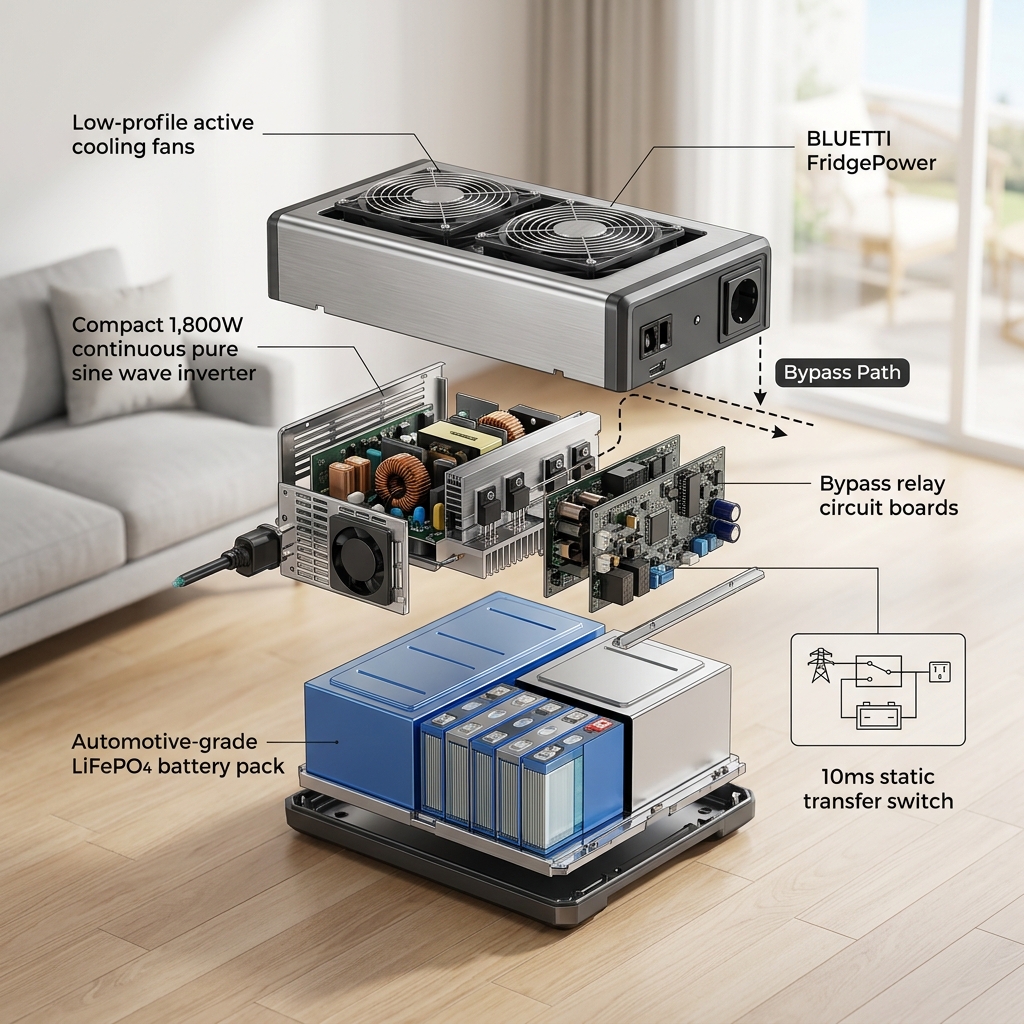
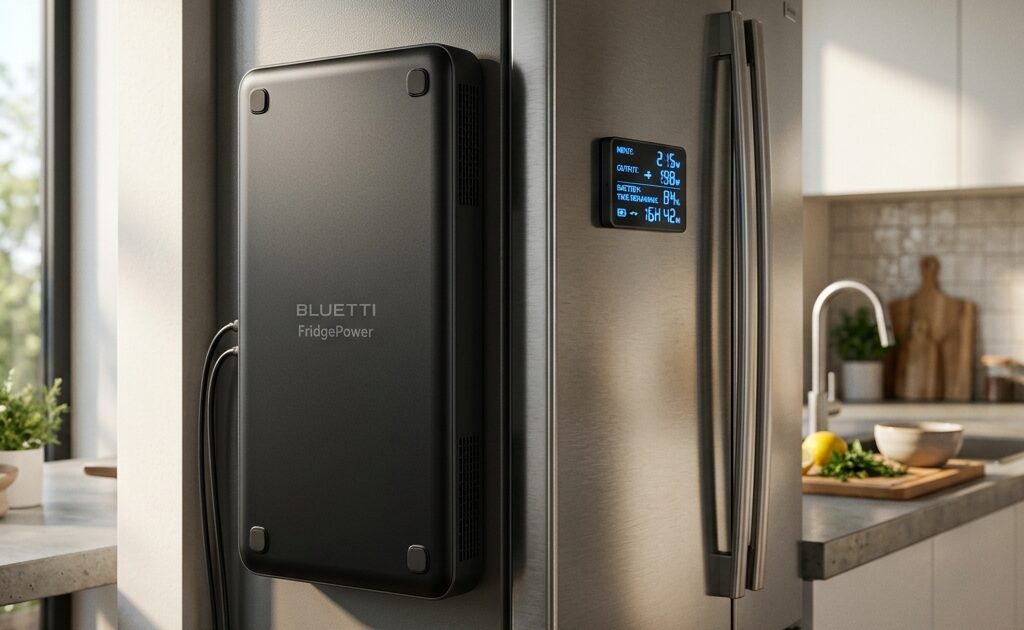
At the core of the BLUETTI FridgePower is a highly specialized electrical and physical architecture optimized specifically for kitchen installation. The physical chassis measures approximately 22.83 in × 13.78 in × 2.95 in (580 mm × 350 mm × 75 mm), enabling it to slide into narrow gaps behind or on top of standard refrigerator units. This form factor represents a major departure from the boxy, handles-heavy design of typical battery generators. To achieve this 2.95-inch thickness, BLUETTI stripped the unit of a built-in LCD screen, relying instead on an external, detachable magnetic display screen that snaps onto the front of the refrigerator door, alongside Bluetooth and Wi-Fi connectivity to the mobile application. This physical optimization keeps the unit’s weight at 19 kg (43 lbs), making it manageable for a single installer to lift and place on top of a refrigerator cabinet.
Bypass Topology and UPS Switching
Internally, the FridgePower utilizes a bypass circuit design that protects its internal cells from premature aging. When the utility grid is operating within normal parameters, power flows directly from the wall outlet through internal relays to the refrigerator. The system supports a bypass capacity of up to 2,300W, allowing it to easily handle the highest-wattage domestic refrigeration units on the market. During this bypass phase, the internal battery remains isolated at 100% capacity, drawing a minimal 3 to 4 watts of idle power for its internal monitoring systems. This architecture prevents the continuous charging and discharging cycles that degrade batteries in standard inline UPS systems, ensuring the cells are preserved for actual emergency use.
When utility power fails, a high-speed static transfer switch detects the voltage drop and switches the AC output to the internal inverter in less than 10 milliseconds. This rapid transition is critical: most refrigerator compressors will stall or restart if power is interrupted for more than 16 milliseconds (one full AC cycle). By keeping the switchover time under 10ms, the FridgePower ensures the compressor continues running without interruption, maintaining cooling cycles and preventing thermal spikes inside the freezer and refrigeration compartments. The integrated pure sine wave inverter delivers 1,800W of continuous power and can support surges of up to 3,600W, accommodating the high inrush currents demanded by older, inductive compressor motors.
Cell Chemistry and Thermal Management
To ensure long-term reliability in enclosed spaces, the FridgePower utilizes automotive-grade Lithium Iron Phosphate chemistry. LiFePO4 cells are widely recognized for their thermal stability and chemical safety, resisting thermal runaway even under high temperatures. BLUETTI rates these cells for approximately 4,000 cycles to 80% of their original capacity, which translates to over 10 years of daily standby service. This chemistry operates quietly, generating an estimated 30 decibels of noise under typical standby and low-discharge conditions. However, during rapid charging cycles or prolonged high-current discharge, the active cooling fans engage, producing a noticeable hum that facility managers and homeowners should consider when planning installation locations.
Market Impact & Deployment

The launch of the BLUETTI FridgePower introduces a new category of specialized appliance backups, challenging both traditional whole-home battery installations and general-purpose power stations. Historically, homeowners looking to protect their food storage during blackouts had to choose between cheap but noisy gas generators or expensive whole-home systems like the Tesla Powerwall, which often cost upwards of $10,000 when accounting for professional electrical installation and permit fees. The FridgePower bypasses these economic barriers with a targeted, plug-and-play solution that requires no permit, no hardwiring, and no professional installation services.
Capital Expenditure and Total Cost of Ownership
The economic value proposition of the FridgePower becomes clear when evaluating its pricing structure and long-term asset protection. During its Kickstarter crowdfunding campaign, which ran from April 16, 2026, to May 31, 2026, early backers could purchase the standalone unit starting at $759, a significant discount from its $1,299 manufacturer’s suggested retail price (MSRP). The product transitioned to retail in early June 2026 with a Prime Day launch price of $849. When compared to the potential loss of high-value perishables, specialized medications, or commercial food inventories, the initial capital expenditure is quickly justified. Spread over its rated 4,000-cycle lifespan, the amortized cost of the unit is roughly $118 per year, providing inexpensive insurance against power grid instability.
Furthermore, the system’s modularity allows users to scale their investment as their backup needs grow. The standalone 2,016Wh unit provides up to 21.6 hours of runtime for a standard refrigerator, covering the vast majority of short-term utility blackouts. For extended emergencies, the system can scale up to 8,064Wh (8kWh) by daisy-chaining up to three BlueCell 200 expansion batteries. Standalone BlueCell 200 batteries launched at $699, with Kickstarter bundles ranging from $1,398 up to $2,799 for the maximum capacity configuration. This modular scaling allows users to customize their runtime without purchasing redundant inverter hardware, optimizing their cost-per-watt-hour of backup storage.
Grid Arbitrage and Time-of-Use Value
Beyond emergency backup, the FridgePower can actively reduce utility costs through localized grid arbitrage. Using the companion mobile application, users can configure the system to operate in Time-of-Use (TOU) mode. In this configuration, the unit charges its internal battery during off-peak hours when electricity rates are lowest, and then uses that stored energy to power the refrigerator during high-rate peak hours. For residential and commercial users on dynamic pricing structures, this daily cycling can reduce the refrigeration energy bill by up to 30%. Because the system uses high-cycle LiFePO4 cells, this daily cycling does not prematurely destroy the battery, allowing the unit to pay for itself over its 10-year lifespan while maintaining full emergency backup readiness.
The Consumer Translation
For the average consumer, the BLUETTI FridgePower represents a shift from active crisis management to passive, automated protection. During sudden blackouts, the immediate concern in most households is the preservation of food. A standard refrigerator can keep food safe for only about four hours if the doors remain closed. The FridgePower removes the anxiety of this countdown, instantly engaging to maintain cooling cycles without requiring the homeowner to lift a finger. This “set-and-forget” utility makes it accessible to demographics who cannot operate heavy, combustion-based portable generators, such as elderly individuals, apartment dwellers, and those with physical limitations.
Redefining Home Energy Resilience
The integration of the BLUETTI app adds a layer of proactive protection by linking the battery storage to local environmental factors. The app monitors regional weather forecasts and pushes extreme weather alerts directly to the user’s smartphone. If a severe storm or high-outage risk is detected, the app automatically overrides any cost-saving TOU schedules and charges the FridgePower to 100% capacity from the grid. This smart charging approach ensures the system is fully prepared before the storm hits, maximizing backup runtime. The app also allows users to manage four distinct intelligent UPS modes: Standard, PV Priority, TOU, and Customized, giving tech-literate consumers precise control over how their backup energy is sourced and utilized.
This localized, app-enabled approach to home backup signals a broader trend in the consumer electronics space: the shift toward task-specific, decentralized energy systems. Rather than relying on a single, massive battery backup for the entire home, consumers are increasingly deploying smaller, specialized units for critical loads. By separating the refrigerator from the rest of the household energy system, users can guarantee their food supply remains secure for days, even if the rest of the house loses power. This modularity reduces the overall vulnerability of the home during extended grid failures, allowing for a more resilient and flexible emergency plan.
Additionally, the unit’s plug-and-play setup simplifies the user experience. There is no need to hire an electrician to install a transfer switch at the main breaker panel. Instead, the user simply plugs the FridgePower into a standard kitchen wall outlet, and then plugs the refrigerator into the AC outlet on the unit. This simplicity, combined with the slim design that tucks neatly out of sight, makes the FridgePower a compelling option for those who want emergency power without the complexity and aesthetic disruption of traditional backup systems. The inclusion of a 5-year manufacturer’s warranty further bolsters consumer confidence, offering long-term support for a critical piece of home infrastructure.
Frequently Asked Questions
Q1: How long can the BLUETTI FridgePower keep a standard refrigerator running?
A1: A single 2,016Wh unit provides up to 21.6 hours of backup. Daisy-chaining three BlueCell 200 expansion batteries increases total capacity to 8,064Wh, extending cooling runtime up to four days.
Q2: What makes the FridgePower different from a typical portable power station?
A2: Unlike general power stations requiring manual setup, the FridgePower remains connected 24/7. It uses bypass relays to reduce battery wear and switches to battery backup in under 10 milliseconds during outages.
Q3: How does the bypass architecture protect the unit’s internal battery?
A3: In normal conditions, the bypass relays route grid power directly to the load up to 2,300W. This prevents battery cycling, keeping the 2,016Wh LiFePO4 pack at 100% capacity and extending its operational lifespan.
Q4: What is the lifespan and warranty of the BLUETTI FridgePower?
A4: The unit features automotive-grade LiFePO4 chemistry rated for 4,000 cycles to 80% capacity, translating to roughly 11 years of daily use, and is backed by a 5-year manufacturer’s warranty.
TechNode HQ Verdict: Pros, Cons & Usability
- Pro (Engineering): In-line bypass architecture handles up to 2,300W of throughput while completely isolating the internal LiFePO4 battery cells from wear and tear.
- Pro (Consumer): Ultra-slim 2.95-inch profile allows the unit to slide invisibly behind or on top of the refrigerator, preserving kitchen floor space.
- Con: Lack of a built-in display screen on the main unit makes status checking dependent on a smartphone app or the external magnetic display accessory.
- Con: High-rate charging or heavy surge discharge cycles engage active cooling fans, which can exceed the quiet 30dB baseline noise level in domestic environments.
Enterprise Usability: For facility managers of commercial kitchens, medical labs, and residential complexes, the FridgePower offers a reliable, low-overhead solution to secure critical cold chains. The plug-and-play installation bypasses electrical permitting and wiring fees, allowing for rapid deployment across multiple locations. The TOU mode can be leveraged to offset peak electricity costs, creating a clear pathway to a positive return on investment.
Everyday Usability: For the average homeowner, the BLUETTI FridgePower is a highly practical investment in home resilience. Its automatic 10ms UPS switchover guarantees that food inventory is protected during sudden grid failures without manual intervention. While the $1,299 MSRP may seem steep compared to entry-level power stations, the early-bird promotional pricing makes this specialized appliance backup a smart, set-and-forget insurance policy for any modern home.