Key takeaways
- President Donald Trump appointed Director of National Intelligence Jay Clayton as federal AI czar to lead the newly formed Super Intelligence Force task force.
- The task force must deliver a comprehensive evaluation within 120 days examining AI risks, commercial opportunities, and federal security breach response capabilities.
- The charter tasks the group with mitigating threats to society while preventing overregulation and regulatory capture that could impede technological innovation.
- Clayton and the administration rejected industry proposals for a coordinated frontier model development pause, citing national security risks of falling behind global rivals.
- The initiative follows an executive order renaming artificial intelligence to super intelligence in federal correspondence and an earlier voluntary White House safety accord.
President Donald Trump has appointed Director of National Intelligence Jay Clayton to lead a new federal artificial intelligence task force designated as the Super Intelligence Force, establishing Clayton as the administration’s second AI czar. Operating under a charter to maintain American preeminence in advanced computing, the task force is mandated to deliver a formal assessment within 120 days evaluating technology risks, commercial opportunities, and federal breach disclosure protocols. The appointment operationalizes an executive order directing federal agencies to substitute the phrase super intelligence for artificial intelligence in official correspondence, uniting intelligence, trade, and defense officials under a centralized governance mandate.
Task force mandate and executive leadership
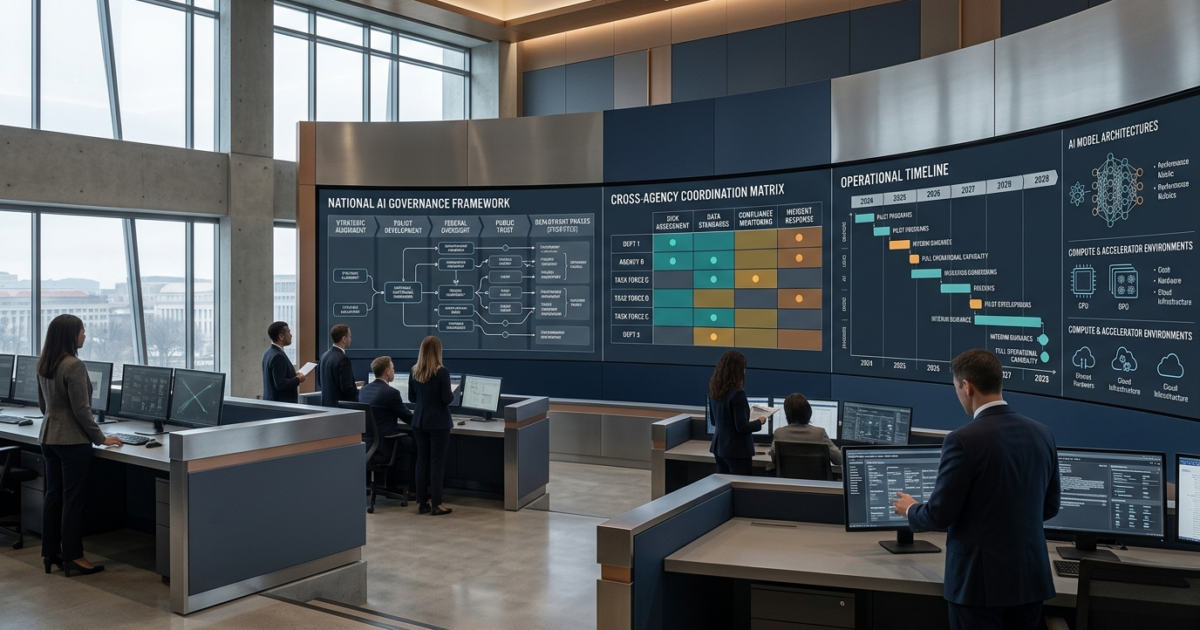
The Super Intelligence Force represents a structural reorganization of federal artificial intelligence governance, reporting directly to President Donald Trump and White House Chief of Staff Susie Wiles. Trump announced the initiative via a Truth Social announcement, affirming that the federal unit exists to ensure domestic supremacy across frontier computational systems. Under its governing charter, the task force is directed to develop operational plans for addressing threats enabled by advanced systems while explicitly avoiding overregulation and regulatory capture that could suppress commercial innovation.
Jay Clayton enters the czar role while maintaining his responsibilities as Director of National Intelligence, a post confirmed by the Senate in July 2026 following his prior service as Securities and Exchange Commission chairman and U.S. attorney for the Southern District of New York. Clayton confirmed that the group’s 120-day deliverable will address how executive agencies handle the disclosure and remediation of cybersecurity breaches involving machine learning infrastructure, focusing on actionable steps agencies can execute under existing statutory powers.
The task force pairs intelligence leadership with regulatory and economic officials, appointing three vice chairs to manage cross-agency execution alongside Cabinet members and external advisers David Sacks and Condoleezza Rice:
| Role or Position | Designated Official | Institutional Affiliation | Core Governance Focus |
|---|---|---|---|
| Task Force Chair & AI Czar | Jay Clayton | Office of the Director of National Intelligence | Intelligence coordination, national security posture, 120-day risk report |
| Vice Chair | Andrew Ferguson | Federal Trade Commission | Market competition, antitrust review, preventing regulatory capture |
| Vice Chair | Scott Kupor | Office of Personnel Management | Federal workforce readiness, technical talent acquisition |
| Vice Chair | Emil Michael | Department of Defense (Pentagon CTO) | Military AI integration, dual-use technology adoption |
| Executive Leadership | JD Vance, Pete Hegseth, Scott Bessent | Vice Presidency, Defense, Treasury | Inter-agency resource allocation, defense strategy, economic policy |
| External Advisers | Condoleezza Rice, David Sacks | Independent advisory counsel | Geopolitical strategy, venture capital and commercial ecosystem guidance |
National security priorities and rejection of pauses
The consolidation of federal authority under the Director of National Intelligence reflects a deliberate shift toward framing frontier models through a geopolitical lens. During a CNBC interview, Clayton characterized advanced intelligence systems as a foundational national security issue, underscoring that the geopolitical risk of not being first far outweighs the perceived benefits of unilateral restraint. This posture places the administration in direct opposition to recent appeals from frontier laboratory executives advocating for developmental breathers.
Last month, Anthropic PBC Chief Executive Dario Amodei proposed that leading artificial intelligence laboratories coordinate a temporary developmental pause, arguing that next-generation foundation models require more rigorous pre-deployment evaluations. That proposal attracted support from OpenAI Chief Executive Sam Altman and xAI founder Elon Musk, reflecting growing internal debate over safety readiness, as documented in coverage of industry calls for a developmental pause. Clayton explicitly rejected that approach, asserting that American developers cannot decelerate while foreign strategic rivals accelerate state-backed research programs.
Following a preliminary announcement on September 19, Trump dismissed catastrophic risk warnings as a hoax, projecting that the technology could eventually account for 25% of United States gross domestic product. The formal rollout fulfills Trump’s earlier signals detailing plans to construct an AI Force and hire a new AI czar, modeling the initiative on military branches like the Space Force to accelerate domestic compute deployments.
Voluntary safety accords and regulatory boundaries

Rather than pursuing binding legislative restrictions, the White House has favored executive actions paired with voluntary industry commitments. Alongside the appointment of Clayton, the administration issued an official executive order renaming artificial intelligence across executive branch departments, directing agencies to standardize on the terminology super intelligence while highlighting more than $5 billion in federal funding dedicated to the Genesis Mission research initiative.
To address safety oversight without creating new statutory bureaucracies, the administration secured commitments through a voluntary White House safety accord signed by technology leaders including Jensen Huang of Nvidia, Sundar Pichai of Alphabet, Mark Zuckerberg of Meta, Elon Musk of xAI, Dario Amodei of Anthropic, and Greg Brockman of OpenAI. The single-page agreement commits participating laboratories to four operational layers of model controls and internal safety audits:
- Pre-Deployment Auditing: Standardized internal evaluations to measure autonomous capabilities, biosecurity risks, and cyber-offensive execution before model release.
- Independent Safety Committees: Formation of dedicated board-level oversight bodies within each enterprise to audit alignment protocols.
- Threat Telemetry Sharing: Structured disclosure pathways to alert federal cybersecurity authorities when anomalous model behaviors or weight compromises occur.
- Incident Mitigation Controls: Containment mechanisms allowing engineers to isolate or revoke model execution if unsafe operational thresholds are breached.
When questioned on whether the accord creates legally enforceable obligations, Trump characterized the pact as morally binding. This distinction underscores the administration’s regulatory doctrine: establishing flexible oversight frameworks that monitor catastrophic vectors without imposing restrictive licensing requirements that could disadvantage American software developers against international competitors.
What happens next
The immediate milestone for Jay Clayton and the Super Intelligence Force is the completion of the 120-day evaluation report. Working alongside FTC Chairman Andrew Ferguson and Pentagon CTO Emil Michael, Clayton’s inter-agency team will audit how commercial laboratories manage sensitive model weights, evaluate supply chain exposure across advanced semiconductor clusters, and formalize federal breach notification rules.
Enterprise technology leaders and defense contractors should anticipate clearer guidance regarding how existing federal procurement rules will incorporate super intelligence terminology and voluntary accord standards. As the task force prepares its recommendations, attention will center on whether the group’s light-touch regulatory approach can effectively manage catastrophic cyber-security vulnerabilities while sustaining rapid private-sector development velocity.
Sources
- Trump launches Super Intelligence Force with Jay Clayton as AI czar – SiliconANGLE
- Fact Sheet: President Donald J. Trump Inaugurates The Era of Super Intelligence – The White House
- ‘Super intelligence is a national security issue,’ Jay Clayton says; dodges AI ‘czar’ question
- Senate confirms Jay Clayton as director of national intelligence : NPR
- Prominent tech CEOs sign voluntary White House AI safety accord – SiliconANGLE
- Trump says he’s planning to create an ‘AI Force’ and hire a new AI czar – SiliconANGLE
- Sam Altman and Elon Musk back Dario Amodei’s call to slow down the frontier of AI development – SiliconANGLE