
Key takeaways
- Microsoft addressed a record 974 vulnerabilities in September 2026, including 113 critical flaws and two actively exploited zero-days.
- Year-to-date Windows vulnerabilities exceeded 2,760, surpassing previous records as AI-driven discovery tools accelerate patch volume.
- Operational testing bottlenecks intensify as admins report September server updates causing Remote Desktop Services hangs and login failures.
- Security leaders emphasize reachability and exploitability context rather than raw CVE counts to prioritize enterprise remediation effectively.
Microsoft Patch Tuesday and Windows Architectural Exposure
The September 2026 edition of Microsoft Patch Tuesday has delivered an unprecedented security update bundle, addressing a record 974 vulnerabilities across Windows operating systems, server infrastructure, and enterprise software suites. Driven by the rapid enterprise adoption of AI-assisted vulnerability discovery, this massive release includes two zero-day flaws under active exploitation—CVE-2026-81963 and CVE-2026-85880—alongside 113 flaws designated as critical severity threats. As infrastructure administrators confront the operational burden of staging and validating hundreds of updates against complex production environments, the release underscores a growing divergence between automated flaw discovery speed and human testing capacity.
The scale of the September 2026 release shatters every prior milestone in software maintenance history. Just two months earlier, in July 2026, Microsoft published updates for 570 vulnerabilities, followed by roughly 620 fixes in August. September’s release of 974 patches—which expands to 997 when incorporating third-party Chromium browser fixes ported into Microsoft Edge—brings the cumulative total for 2026 beyond 2,760 resolved vulnerabilities. With three months remaining in the year, Microsoft has remediated more software flaws in 2026 than in 2023, 2024, and 2025 combined, more than doubling its previous annual record of 1,245 set in 2020.
This surge in reported vulnerabilities reflects software engineering organizations utilizing artificial intelligence to audit source trees and binary interfaces. Security research teams across Microsoft, Google, Adobe, Cisco, Mozilla, and Oracle are deploying neural models and automated fuzzing harnesses to analyze legacy codebases. By applying pattern recognition to abstract syntax trees and decompiled binaries, automated agents uncover edge-case memory corruption flaws and concurrency race conditions that evaded conventional static analysis tools for decades. In May 2026, Mozilla demonstrated this methodology when its Mythos engine identified 271 unique vulnerabilities with virtually no false positives. As AI vulnerability discovery transforms into production pipelines, software vendors uncover defects at rates that dwarf human triage capabilities.
Architectural Analysis of Active Zero-Day Mechanics
At the center of September’s urgent advisory are two zero-day vulnerabilities actively exploited in the wild: CVE-2026-81963 and CVE-2026-85880. Both defects reside within foundational Windows system services, granting local unprivileged attackers the capability to elevate privileges to NT AUTHORITY\SYSTEM status and seize administrative control over compromised endpoints.
CVE-2026-81963 targets a synchronization flaw within the Windows Update Service itself. By manipulating file system handles and symbolic links during background patch staging, an unprivileged process can trigger an arbitrary file replacement race condition. When the update daemon executes privileged installation transactions, it operates on malicious payloads redirected into system directories, executing code with system privileges. Conversely, CVE-2026-85880 resides in the Windows Advanced Local Procedure Call (ALPC) subsystem, which provides inter-process communication between user-mode applications and the kernel. The vulnerability stems from improper validation of structured memory buffers during message transfers. Attackers send malformed ALPC messages that corrupt kernel memory pools, bypassing token-based security boundaries to achieve unrestricted privilege escalation.
Enterprise Patch Management and Market Impact
While software vendors celebrate the detection of nearly 1,000 security holes as an engineering triumph, the operational reality for corporate IT infrastructure presents severe friction. For enterprise platform leaders, the primary bottleneck in digital defense is no longer the availability of vendor patches; it is the human and financial cost of staging, testing, and rolling out massive update bundles across production environments. Modern enterprise architectures operate hundreds of interdependent legacy applications and custom database integrations that risk breaking when underlying operating system libraries change.
As Tyler Reguly, associate director of security research and development at Fortra, observed following the release, corporate leadership frequently underestimates the friction inherent to operating system updates. Deploying updates across an enterprise requires compatibility testing because third-party enterprise tools regularly fail when core operating system components undergo structural changes. Reguly emphasized that Chief Information Security Officers and platform directors must recognize the severe operational strain placed on systems engineering personnel, who are frequently forced into weekend and after-hours deployment windows to prevent business disruption. In fast-moving corporate environments, relying on operational heroics cannot replace funded testing automation.
Furthermore, vulnerability management strategists caution that raw patch volume creates a deceptive perception of enterprise risk. Satnam Narang, senior staff research engineer at Tenable, pointed out that while automated tools generate thousands of CVE identifiers, the percentage of flaws that present immediate danger to a given enterprise remains relatively small. Modern vulnerability discovery platforms generate vast haystacks of theoretical weaknesses, but the volume of actionable needles has not expanded proportionally. To maintain organizational velocity without collapsing under maintenance backlogs, technology leaders must deploy enterprise patch management frameworks that prioritize reachability, network exposure, and real-world exploitability over arbitrary severity ratings.
Production Instability and Remote Desktop Service Failures
The hazards of unvetted patch deployment became apparent within hours of September’s update release. System administrators managing Windows Server environments reported service failures directly attributed to cumulative update KB5122882. Across Windows Server 2019, Windows Server 2022, and Windows Server 2025 virtual machines, the update introduced a severe regression in the Remote Desktop Services (RDS) session management stack.
Under production workloads, RDS host servers became unresponsive approximately 24 to 36 hours following patch installation. Telemetry revealed that when active Remote Desktop users disconnected or logged out, the terminal services session broker entered an unrecoverable deadlock state. The kernel failed to deallocate user session tokens, preventing new user logins via RDP while freezing the management console. Enterprise virtualization clusters experienced outages, requiring IT teams to execute hard virtual machine resets to restore administrative access. Incidents of this magnitude demonstrate why enterprises cannot treat monthly vendor patches as risk-free drops, highlighting the dangerous friction between rapid security remediation and production availability.
Threat Intelligence Analysis and Zero-Day Mechanics
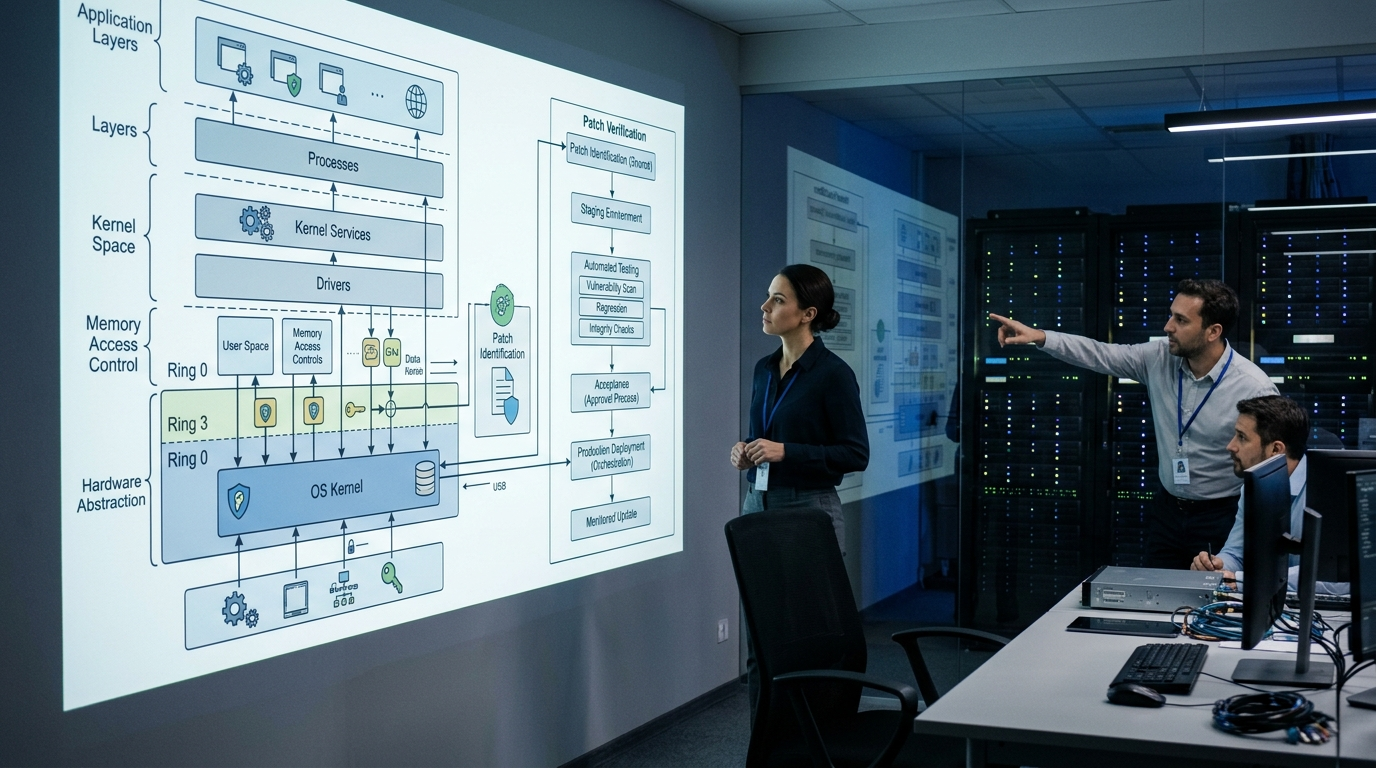
Beyond the actively exploited zero-days, September’s security bulletin cataloged high-severity network flaws capable of autonomous propagation. Dustin Childs of the Zero Day Initiative highlighted that 112 vulnerabilities in the release earned a critical designation, with over 20 distinct flaws classified as wormable—requiring zero user interaction or authentication to achieve remote code execution across enterprise local networks and hybrid cloud infrastructure.
Among the most critical network services targeted is the Windows Domain Name System (DNS), tracked under CVE-2026-69730. Affecting every Windows Server release from Windows Server 2012 through modern Windows Server 2025, as well as enterprise Windows 10 and Windows 11 endpoints running local resolution services, this flaw enables remote unauthenticated attackers to execute arbitrary code by transmitting a single crafted UDP or TCP packet to port 53. Because DNS services must remain exposed to facilitate name resolution across corporate domains, this vulnerability presents severe lateral movement potential. Simultaneously, CVE-2026-69829 exposed a remote code execution vulnerability in the Windows Shell carrying a CVSS base score of 9.8. Exploitable with low attack complexity and requiring zero administrative privileges or user engagement, the flaw permits remote adversaries to seize complete workstation control through crafted network calls.
Enterprise Software Stack and AI Agent Vulnerabilities
The scope of vulnerability discovery extended deep into Microsoft’s productivity, messaging, and database ecosystems. In Microsoft Exchange Server, CVE-2026-55007 permits remote code execution when the server processes incoming email messages containing malicious Visio attachments. Because the parser operates asynchronously during message ingestion, an attacker can compromise a perimeter mail gateway simply by transmitting a weaponized document to any corporate address without recipient interaction.
Similarly, Microsoft SharePoint Server was impacted by 17 distinct remote code execution vulnerabilities grouped under CVE-2026-69465, while Microsoft Authenticator suffered a critical local privilege escalation defect (CVE-2026-80097) that subverts core identity token issuance. Perhaps most indicative of modern architectural shifts is CVE-2026-65669, one of 60 SQL Server privilege escalation vulnerabilities resolved in September. This defect is triggered when an enterprise user or autonomous script submits natural-language instructions through SQL Copilot. By crafting adversarial prompt injections that manipulate the underlying model’s query generation parameters, an unprivileged user can bypass database role-based access controls and execute commands with administrative database authority.
This release arrives alongside a joint warning issued by Microsoft, Google, AWS, OpenAI, Anthropic, and over 100 enterprise cybersecurity organizations. In a published collective cyberdefense advisory, industry leaders cautioned that the window between vulnerability discovery and autonomous adversarial weaponization is rapidly compressing. As threat actors construct autonomous offensive frameworks capable of scanning internet-facing assets for newly patched CVE signatures, organizations that fail to automate validation pipelines face catastrophic exposure windows.
Ecosystem Fallout and the Consumer Translation
While enterprise infrastructure teams grapple with deployment logistics, the structural shift toward automated vulnerability discovery fundamentally alters the consumer technology experience. For the worldwide public operating personal laptops, gaming rigs, and home workstations, operating systems have ceased to be static software environments; they are now dynamic, continuously mutating operating environments that demand constant maintenance.
To grasp the magnitude of this transformation, consider an analogy in civil water infrastructure. Consider a municipal water utility that manages thousands of miles of subterranean aqueducts and piping. Historically, maintenance crews inspected pipes visually and repaired visible leaks when water pressure fluctuated. Now, imagine the utility deploys autonomous acoustic sensors capable of detecting 1,000 microscopic fractures throughout the distribution network every month. While identifying potential failure points is theoretically beneficial, dispatching excavation crews to dig up hundreds of street intersections simultaneously creates gridlock, damages adjacent electrical conduits, and disrupts water service to thousands of homes. Microsoft’s AI fuzzing engines are identifying every microscopic crack in Windows, but enterprise IT departments and consumer endpoints must endure the constant disruption of tearing up the digital streets to install the patches.
For everyday users, this maintenance dynamic manifests as persistent update notifications, mandatory system reboots, and unexpected software regressions. When background update services download multi-gigabyte patch packages, residential internet bandwidth saturates and portable laptop battery life degrades. Furthermore, as patch volumes balloon, consumer hardware drivers and anti-cheat gaming engines frequently experience compatibility conflicts. However, because September’s release contains dozens of wormable flaws and active zero-days, home users cannot afford to disable Windows Update. Everyday consumers must maintain active update configurations while scheduling installation reboots during off-peak hours to ensure critical shell, DNS, and browser protections are applied.
Bottom line
The September 2026 security release establishes a permanent new reality for enterprise technology operations: AI-accelerated vulnerability discovery has outpaced conventional human patch administration. When a single vendor delivers nearly 1,000 security fixes in thirty days, traditional manual staging and ad-hoc testing workflows collapse under the operational weight. Enterprise technology leaders must abandon reactive patching paradigms in favor of automated, ring-based deployment architectures paired with runtime reachability analysis. Organizations that build resilient, automated validation pipelines will successfully navigate this torrent of updates, while those relying on manual verification will find their systems perpetually vulnerable or perpetually disrupted.
TechNode HQ Verdict: Pros, Cons & Usability
- Pro (Engineering): Automated AI discovery surfaces deep architectural flaws across legacy kernel and RPC subsystems before adversaries can quietly weaponize them.
- Pro (Consumer): Automatic Windows Update deployment delivers critical background mitigations against wormable shell and DNS exploits without requiring technical intervention from everyday users.
- Con: Unprecedented patch volumes severely overwhelm IT staging cycles, while cumulative updates like KB5122882 introduce critical operational regressions including Remote Desktop host freezes.
- Con: Generating thousands of CVEs creates diagnostic noise, obscuring genuinely dangerous attack paths behind theoretical vulnerabilities that lack real-world reachability.
Enterprise Usability: Chief Technology Officers and enterprise administrators should configure ring-based canary deployment groups, validating cumulative packages against representative virtual server workloads for 48 hours while prioritizing perimeter DNS and Exchange remediations.
Everyday Usability: Mainstream Windows users should keep automated updates enabled to protect against active zero-day privilege escalations, while configuring active hours within Windows Update to prevent unexpected mid-day reboot interruptions.