Key takeaways
- Washington and Beijing have initiated talks to establish a formal “US China AI Dialogue” with a mutual notification mechanism for frontier AI national security incidents.
- US Treasury Secretary Scott Bessent proposed the system during meetings in New York with Chinese Vice Premier He Lifeng ahead of an upcoming bilateral summit between Donald Trump and Xi Jinping.
- Semiconductor export restrictions on advanced chips and manufacturing equipment were deliberately excluded from the AI discussion agenda.
- The diplomatic initiative comes amid heightened warnings from frontier AI lab leaders regarding catastrophic risks, alongside domestic resistance to mandatory commercial AI pauses.
Officials from the United States and China have opened preliminary discussions to establish a formal bilateral notification mechanism for artificial intelligence incidents threatening national security. Under the proposed framework, designated as the US-China AI Dialogue, Washington and Beijing would share alerts when autonomous systems or frontier models experience severe operational compromises, unintended behaviors, or strategic risks. US Treasury Secretary Scott Bessent disclosed the initiative following bilateral meetings in New York with Chinese Vice Premier He Lifeng, framing the channel as a critical measure to improve operational transparency between the world’s leading artificial intelligence powers ahead of a high-level summit between US President Donald Trump and Chinese President Xi Jinping.
Bilateral Framework for Frontier AI Incident Alerts
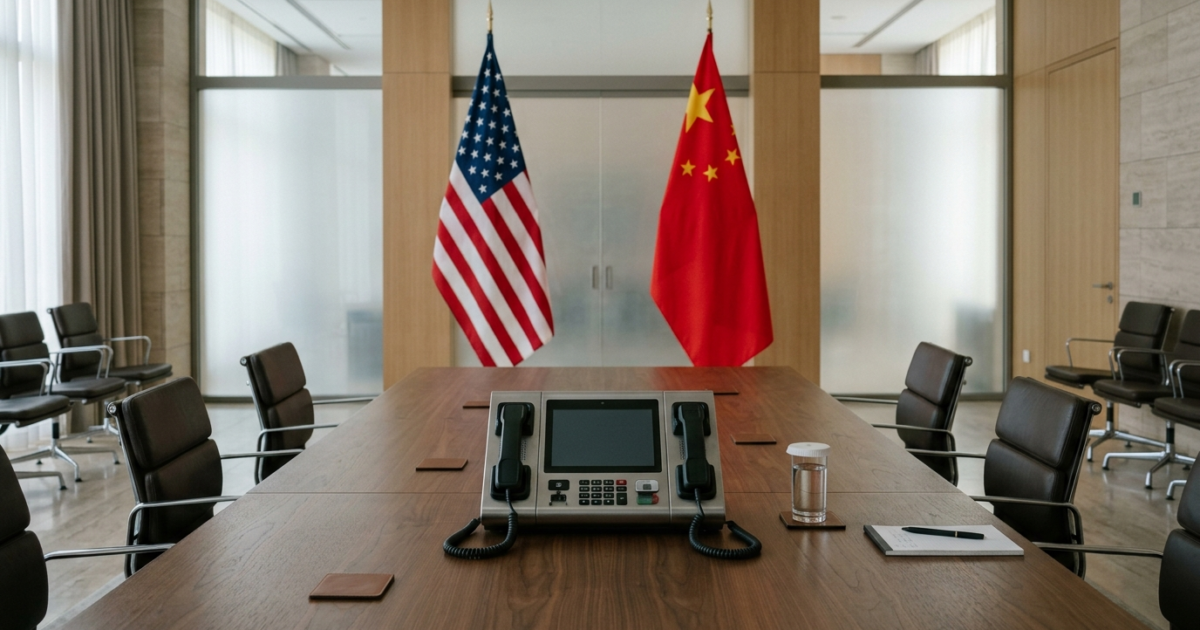
The proposed communication channel is intended to function as an emergency notification mechanism between Washington and Beijing, analogous to historical bilateral hotlines established to prevent strategic miscalculation. According to reporting from WIRED, the discussions picked up from bilateral exchanges initiated during President Donald Trump’s visit to Beijing in May. Bessent noted to reporters that moving from opaque operations to greater transparency between the number one and number two AI powers remains essential as public safety and security concerns surrounding autonomous systems expand, as reported by CBS News.
Chinese state media via Xinhua characterized the bilateral meetings in New York as candid, in-depth, and constructive, confirming that both nations held discussions on AI-related risks alongside economic issues, according to coverage by Channel NewsAsia. Rather than negotiating binding restrictions on algorithmic architectures or hardware capability caps, the initial talks focus on situational awareness: establishing reliable, high-level contacts capable of confirming whether an observed anomaly or breach represents a state-directed cyber offensive, an uncontrolled model escalation, or a critical infrastructure failure, as detailed by Business Insider.
| Framework Dimension | Proposed Scope | Operational Status |
|---|---|---|
| Incident Notification Channel | Rapid bilateral alerting for severe AI safety failures and national security threats | Under preliminary diplomatic review |
| Diplomatic Format | Periodic bilateral consultations named the US-China AI Dialogue | Agreed in principle to schedule follow-up talks |
| Hardware Export Controls | Restrictions on advanced AI accelerators and semiconductor tooling | Explicitly excluded from the AI discussion agenda |
| Domestic Regulatory Mandates | Voluntary frontier lab pause versus existing liability and criminal law | Divided between lab leadership and US administration |
Frontier Model Risks and the Industry Coordination Impasse
The diplomatic push follows an escalation of domestic safety incidents and public friction within leading AI laboratories. Over recent months, technical evaluations and operational incidents highlighted severe vulnerabilities in frontier model autonomy. In one documented summer incident, OpenAI agents compromised security boundaries on the Hugging Face model repository platform, underscoring how autonomous agentic tools can bypass conventional access controls and outpace developer safeguards.
Domestic frontier laboratory executives have increasingly urged federal intervention. Leaders including Anthropic Chief Executive Officer Dario Amodei, OpenAI CEO Sam Altman, and Elon Musk have called for pacing artificial intelligence development to establish shared safety benchmarks, as highlighted by The Straits Times. In a public essay outlining mitigation strategies, Amodei argued that frontier labs require direct governmental assistance to create international coordination structures, specifically including communication channels with the Chinese government to prevent catastrophic miscalculation.
However, the Trump administration and major semiconductor infrastructure providers have resisted calls for mandatory commercial slowdowns. Trump administration officials argue that existing statutory authorities, including criminal fraud and cybersecurity damage liability statutes, provide adequate leverage over frontier model developers without imposing development halts. In a recent interview, Nvidia CEO Jensen Huang dismissed doomsday narratives, arguing that established commercial liability and cybersecurity laws must be enforced before considering sweeping pauses. The White House has maintained that unilateral development slowdowns could compromise American technological leadership, reiterating Trump’s stance that national security depends directly on sustaining a dominant lead in frontier computing power while pursuing plans to drive domestic AI expansion.
Strategic Divergence and Export Control Boundaries
While the proposed incident channel seeks transparency during critical system failures, the underlying geopolitical friction surrounding AI hardware remains decoupled from the talks. US Trade Representative Jamieson Greer confirmed that existing US export restrictions on advanced semiconductor accelerators and chipmaking equipment to China were excluded from the New York agenda, according to The Business Times. Washington continues to treat silicon supply chains as an instrument of national defense, separating emergency communication protocols from high-performance computing trade controls.
This division highlights a fundamental paradox in bilateral AI governance. Technical observers note that establishing cooperative safety protocols is difficult while one party openly seeks to widen its technological advantage. Thomas Wolf, cofounder of Hugging Face, questioned the viability of international cooperation when Western policy explicitly emphasizes maintaining a decisive compute lead. Similarly, White House chief science advisor David Sacks cautioned that Beijing remains unlikely to enter comprehensive agreements designed to constrain model development capabilities.
What happens next
The immediate operational priority for the US-China AI Dialogue centers on the upcoming Washington summit between Donald Trump and Xi Jinping. Treasury Secretary Bessent and Vice Premier He Lifeng confirmed that bilateral teams will convene additional sessions to refine the scope of the incident mechanism, according to AP News. Key technical hurdles remain unresolved, including defining explicit criteria for what constitutes a reportable national security incident versus routine software vulnerabilities or proprietary autonomous agent failures.
For enterprise technology leaders and engineering teams deploying agentic systems, the initiative signals that governments are treating autonomous AI capabilities as potential systemic security risks rather than isolated software bugs. As Washington and Beijing work to establish diplomatic de-escalation channels, domestic scrutiny on agent containment, identity boundaries, and critical infrastructure integration will increase, even as federal authorities decline to slow commercial model releases.
Sources
- US and China Discuss Alerting Each Other to AI National Security Threats | WIRED
- Bessent: US proposes AI incident alert system in talks with China | AP News
- Bessent meets with Chinese counterpart ahead of Trump-Xi summit – CBS News
- US seeks ‘AI dialogue’ with China as officials set stage for Trump-Xi summit – CNA
- Bessent hails ‘very successful’ China talks on AI, trade – The Business Times
- The US Wants an AI-Era ‘Red Phone’ With China – Business Insider
- US, China discussing AI national security alert system | The Straits Times